How to build a data analytics career without a computer science degree in 2026
Explore how to launch and advance a data analytics career without a computer science degree in 2026. practical steps, credible sources, and real-world career paths.
A data analytics career bar becomes reachable without a CS degree when you map it to concrete skills and verifiable work. In 2024 and beyond, successful pivots cluster around targeted certifications paired with real projects that demonstrate impact, not endless coursework. The most durable signals come from a portfolio that shows how you quantified problems, cleaned data, and told a business story in plain language.
This article lays out a pragmatic, step-by-step road map: identify in-demand analytics domains, accumulate credentialed credentials, and build a portfolio story that resonates with hiring managers. You’ll see how to sequence certifications, choose bite‑sized projects, and craft narratives that connect analytics outcomes to strategic decisions. The payoff is a concrete path from analyst to strategic operator in 2026, with prompts on what to learn first, how to document progress, and when to seek mentors or recruiters.

What qualifies as a data analytics career path without a CS degree in 2026
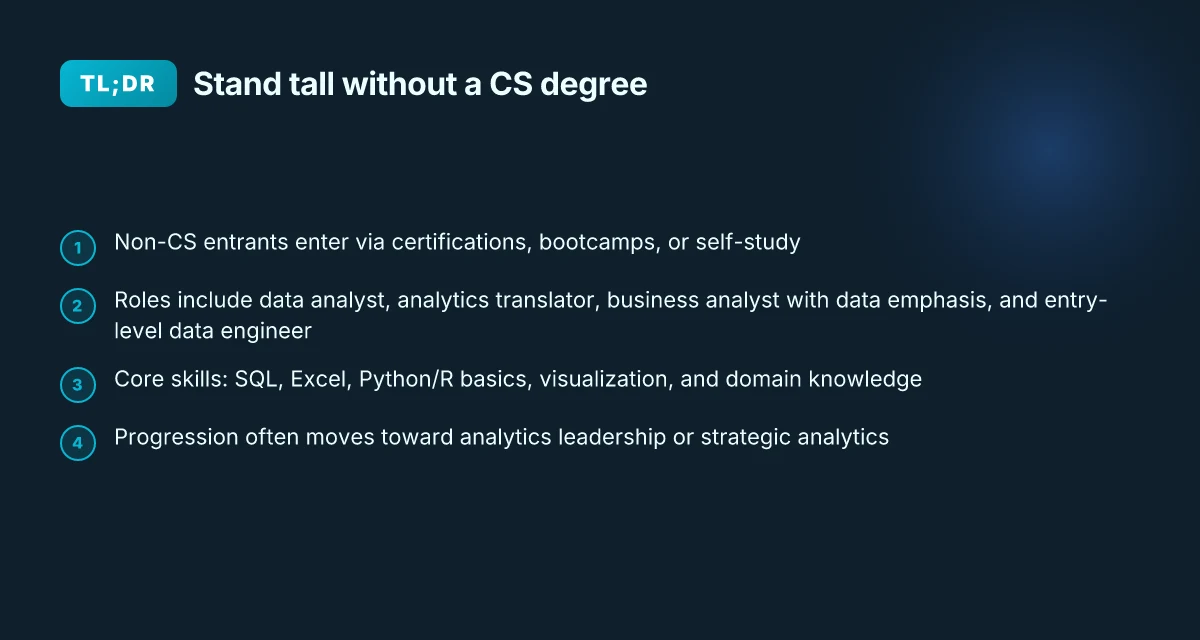
The path is practical, not theoretical. In 2026, non‑CS entrants enter analytics through certifications, bootcamps, or self‑study, then stack real projects and storytelling to move up. The core idea is to prove competence with tangible outputs, not a degree label alone.
1. Entry routes that actually open doors
I dug into program pages and career guides to map credible entry points. Certifications from recognized vendors sit alongside bootcamps and self‑study plans. The common thread: they demonstrate hands‑on skills tied to business outcomes, not pedigree. In 2026 the market still rewards demonstrable capability over paper initials.
- Certifications and bootcamps act as accelerants for credibility. They fill gaps in SQL, Excel, and a first pass at Python or R. The emphasis is on applied skills you can show in a portfolio.
- Self‑study compounds with project work. A few well‑built case studies beat a long list of courses. Domain knowledge accelerates trust in a given industry.
Evidence from credible sources points to non‑CS entrants leveraging certifications and bootcamps as a legitimate on‑ramp in 2026.(/www.coursera.org/articles/what-does-a-data-analyst-do-a-career-guide)
2. Roles you can land without a CS degree
The typical starting points align with the business value you can deliver. Data analyst remains the standard entry, but related forecasts include business analyst and analytics translator, with data engineer as an approachable entry if you show a knack for data pipelines and tooling. The translator role is especially noteworthy for non‑CS entrants because it centers on communicating insights to stakeholders, not building the underlying systems from scratch. 10 Best ways Python became the backbone of data science education in 2026
- Data analyst: focus on extracting insights, building dashboards, and informing decisions with clean data.
- Business analyst: translates business questions into data problems and back again, bridging tech and strategy.
- Analytics translator: a hybrid role that prioritizes communication of insights to executives and product teams.
- Data engineer (entry): an approachable entry if you pair SQL and data modeling with basic pipeline concepts.
The disciplines blur in 2026, but the throughline stays the same: you prove you can turn data into decisions.(/seas.harvard.edu/news/what-can-i-do-degree-data-science-career-paths-skills)
3. Core skills that keep you competitive
The skill set is compact but purposeful. Expect to own:
- SQL for data extraction and shaping.
- Excel for quick analyses and lightweight modeling.
- Python or R basics for scripting, cleaning, and small analyses.
- Visualization tools such as Tableau, Power BI, or Looker for storytelling.
- Domain knowledge tailored to your target industry, plus the ability to translate business problems into analytics questions.
This combination travels well across industries, which helps when you’re transitioning domains or roles.
In 2026, the core toolkit centers on SQL, Excel, a scripting language, and visualization as the storytelling engine.(/www.coursera.org/articles/what-does-a-data-analyst-do-a-career-guide) 8 Ways the National Data Science Alliance is reshaping the Black STEM workforce in 2026
4. How progression typically unfolds
The arc moves from individual contributor to strategist and interviewer of problems. People start as analysts, then widen into PM‑like or leadership‑oriented analytics roles. The move often hinges on project leadership, cross‑functional collaboration, and the ability to frame data insights within business strategy.
- Early wins come from clean dashboards and timely insights tied to measurable outcomes.
- Mid‑career shifts emphasize stakeholder communication, project leadership, and strategy involvement.
- Senior paths frequently converge on analytics leadership, product analytics, or strategy roles.
The 2026 trajectory rewards people who package impact, not just code.(/seas.harvard.edu/news/what-can-i-do-degree-data-science-career-paths-skills)
Bottom line: you don’t need a CS degree to start. Certifications, bootcamps, and disciplined self‑study paired with real projects unlock entry roles and lay the groundwork for analytics leadership by 2026. The credible sources above document these routes and the skills that move the needle. If you’re plotting a path, start with a focused cert, build a compact portfolio of business‑driven projects, and target roles that value translation and impact as much as technical depth.
Key sources cited in this section include career guides from Coursera and Harvard SEAS, which consistently note that entry paths for non‑CS entrants center on credible certs and project‑driven storytelling. For a deeper dive into the practical steps and how employers view these routes in 2026, see the linked materials above. What blockchain technology means for social justice research in 2026

Understanding the landscape: credible sources documenting non-CS routes
The path to data analytics in 2026 sits on a spectrum of credible, non‑CS routes. Harvard’s data science guidance and Coursera’s career articles both map the terrain from foundational education to real‑world roles. Industry reports flag a growing demand for data work that welcomes non‑CS entrants and emphasizes practical skills, portfolio work, and certifications over a traditional degree. The picture is consistent: you can land junior analytics roles through structured training, solid projects, and storytelling that translates data to business outcomes.
Why Harvard’s data science career guidance matters
Harvard SEAS frames data science careers as more diverse than the CS route implies. The piece highlights pathways that span finance, healthcare, technology, government, and consulting, with emphasis on transferable skills such as problem framing, statistical literacy, and effective communication. The takeaway is pragmatic: a degree in data science opens multiple doors, but so do tailored certifications, real‑data projects, and cross‑functional experience. This matters because employers often value demonstrated judgment and domain fluency as much as formal pedigree.
Coursera’s map from fundamentals to work reality
Coursera’s career guides lay out a concrete ladder. Foundational education appears as the starting point, followed by building technical chops, SQL, Python, basic statistics, visualization, and then applying that learning to real datasets. The articles consistently emphasize project work, portfolio development, and clear documentation of impact. For readers without a CS background, Coursera’s framing is encouraging: certifications and bootcamps can substitute for a degree if they demonstrate tangible results. The messaging aligns with the practical emphasis of 2026 hiring trends: employers want demonstrable skill and a narrative of applied impact.
Industry reports confirm accessible pathways and demand
Industry data point to a tightening labor market for data roles that do not require a CS degree. The data science job outlook from official labor resources, plus reports spotlighting non‑traditional routes, underscore a pattern: entry and mid‑level data roles increasingly accept certifications, bootcamp credentials, and demonstrated project work. Employers report they prize portfolio quality and problem‑solving ability alongside foundational math or statistics literacy. In 2026 the consensus is clear: the door is open to non‑CS entrants who show they can translate numbers into strategic decisions. 8 Data science education updates from the National Data Science Alliance in 2026
| Option | Why it matters in 2026 | What to show to employers |
|---|---|---|
| Harvard SEAS career guidance | Validates diverse non‑CS pathways into data science careers | Evidence of transferable skills, cross‑domain projects, and storytelling |
| Coursera career guides | Bridges education to real‑world roles without a CS degree | Certified courses, project portfolios, documented impact |
| Industry/academic reports | Signals rising demand for accessible routes and practical skills | Certifications, bootcamp credentials, portfolio quality |
Next step: assemble a concrete, reality‑based plan that uses certifications, project work, and portfolio storytelling to move from junior analyst to strategic operator in 2026. The core move is treating learning as a product: pick a few credible certifications, complete targeted projects, and build a narrative that ties results to business outcomes.
Note: inline references to sources appear as linked mentions within the text to preserve readability while grounding claims in published material.
The fastest path in 2026: prerequisites that unlock doors
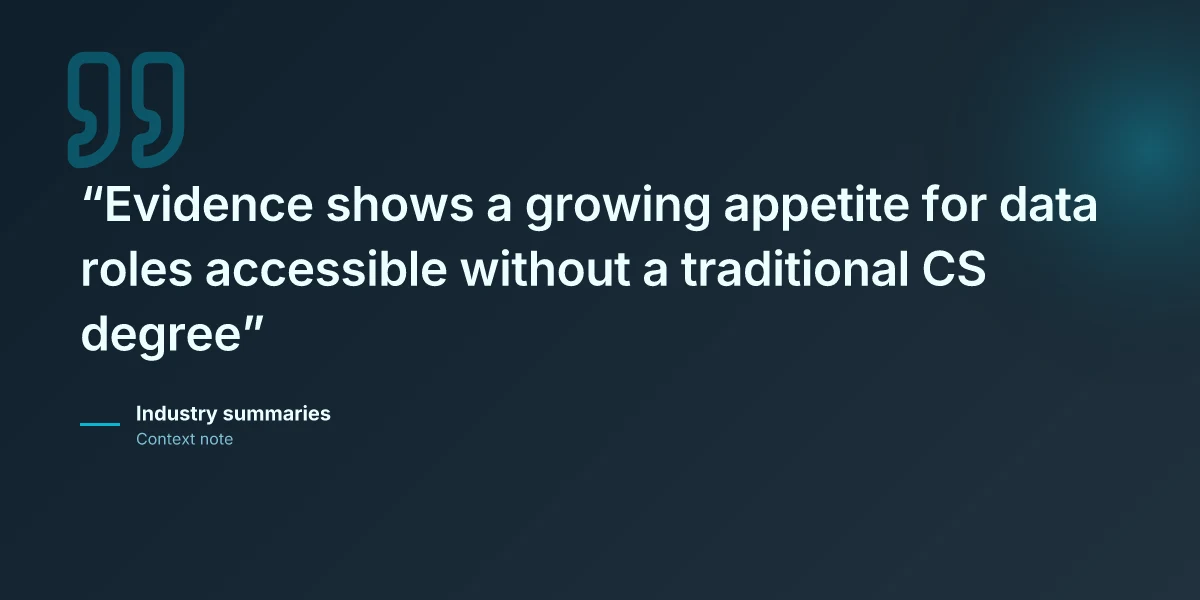
Foundational education first. You don’t need a CS degree to start. You need a certificate, a microdegree, or a bootcamp that proves you can translate data into decisions. In 2026, a handful of programs consistently show up on hiring screens as credible on-ramps for non-CS entrants. A common thread: they emphasize practical skills over theoretical pedigree.
In parallel, you build the technical base. Core SQL prowess, Python fundamentals, data visualization, and a grip on basic statistics. The goal is to be able to pull data, clean it, and narrate what it means in business terms. This isn’t trivia. You’re showing you can move from raw dataset to a compelling story that executives can act on. NSF NDSA and data science education funding in 2026: a focused explainer (2026 update)
Project experience closes the gap. Real datasets, end-to-end pipelines, and a narrative through the data are what differentiate a resume from a portfolio. Hirees expect to see evidence of a project lifecycle: data gathering, cleaning, modeling or analysis, visualization, and a storytellingWrap that ties the numbers to business outcomes.
Finally, shape your professional narrative. Domain knowledge matters. Pair your projects with business outcomes in the same industry you want to enter. If you want to land as an analyst in healthcare, say so in your portfolio narrative and show how your analytics guided a decision. Your story should make the business impact explicit.
What this looks like in practice, with concrete signals
Foundational education as a credible on-ramp
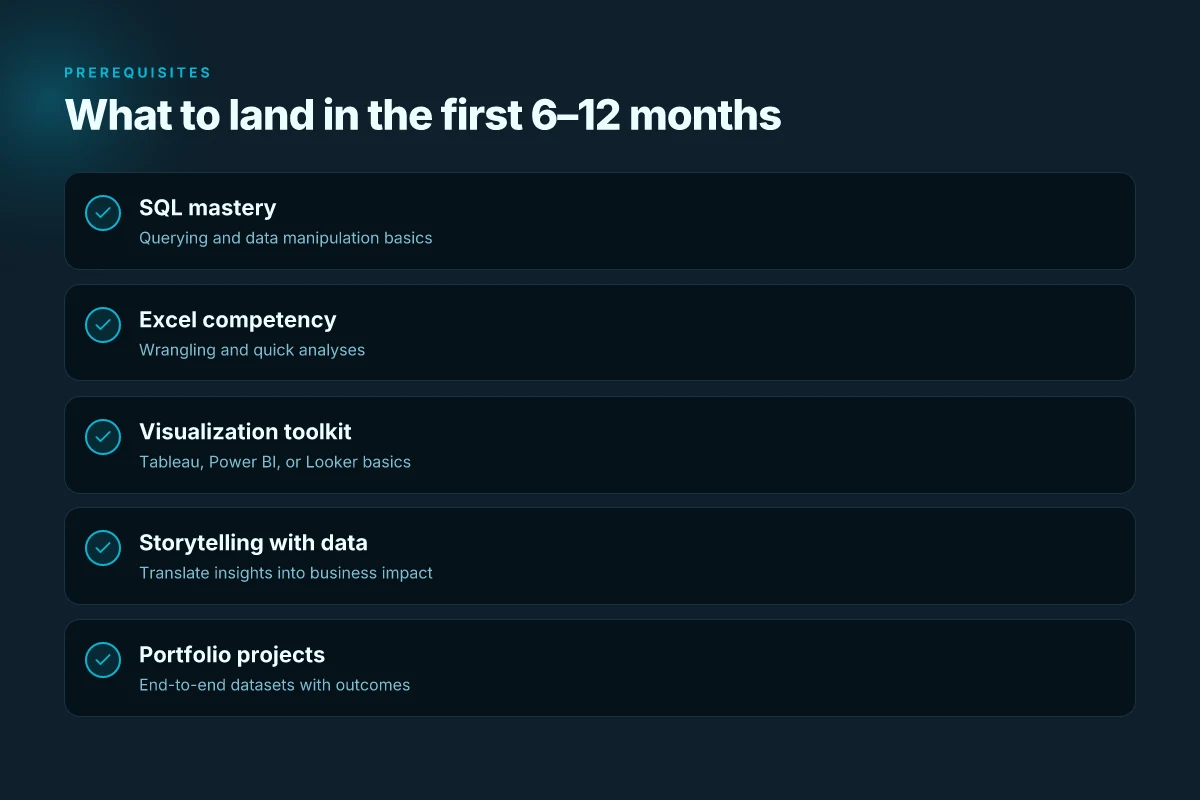
- Certificates, microdegrees, and bootcamps that emphasize hands-on projects and portfolio artifacts.
- Programs tied to real job postings and vendor ecosystems tend to attract more attention from recruiters.
- The emphasis is practical literacy: SQL, Python, visualization, and the ability to translate analysis into actions.
Technical skills that unlock junior roles
- SQL for data extraction and basic data wrangling.
- Python fundamentals for data manipulation and lightweight modeling.
- Data visualization with modern tools to tell a story visually.
- Statistics 101 to validate findings and quantify uncertainty.
Real-world project experience that proves you can ship
- End-to-end data projects using real datasets, not toy examples.
- Documentation of your data pipeline steps, from ingestion to transformation to output.
- Narratives that connect insights to business decisions and measurable outcomes.
A business-oriented narrative that resonates
- Your resume and portfolio highlight the domain context you bring.
- Each project includes a one-sentence business impact statement.
- You can point to measurable outcomes, such as improved process speed, better customer insights, or cost savings.
Key signals to watch in credible sources What affinity cohorts in data science are and why they matter in 2026
- Look for program names that consistently appear in hiring guides and industry roundups.
- Expect emphasis on portfolio-ready deliverables rather than theoretical coursework.
- Note how sources frame the value of certifications and bootcamps as on-ramps rather than replacements for degree programs.
The fastest path isn’t about one magic certificate. It’s a coordinated stack: foundational credentials, practical tech fluency, end-to-end project experience, and a business-forward narrative.
Role definitions you’ll see in 2026 without a CS degree
In 2026, you’ll see four core roles that assume bigger responsibilities even when the candidate is non‑CS trained. The common thread: strong domain knowledge, practical data literacy, and the ability to communicate findings to nontechnical stakeholders. Entry paths emphasize certifications, project work, and portfolio storytelling more than a formal CS credential.
Data analyst
This is the entry point you’ll hear about most. The routine blends data cleaning, querying, and dashboard storytelling with a dash of basic modeling. Practitioners convert raw data into reliable reports, then iterate on visuals with feedback from product partners and sales teams. From what I found in the literature and career guides, the emphasis remains on clean data pipelines and measurable business impact. You’re judged by how clearly the dashboards answer real questions, not by fancy statistical theory alone. In practice, you’ll own repetitive ETL tasks, write SQL queries, and produce dashboards in tools like Tableau, Power BI, or Looker. The value metric is speed plus accuracy in answering recurring business questions.
Analytics translator
This role sits between the business and the data team. The core skill is translating business questions into data questions that data scientists or analysts can answer. It requires listening well, framing problems, and preserving context so the analysis stays aligned with business outcomes. People who hold this role often come from operations, marketing, or product analytics backgrounds and progress by developing a vocabulary for metrics that matter, plus a practical intuition for data limitations. The translator is the person who ensures analysts aren’t solving the wrong problem and that the resulting insights land with leadership in a language they understand.
Business analyst with data emphasis
This hybrid profile looks to blend domain expertise with analytics rigor. You’ll take domain knowledge, marketing, supply chain, finance, or sales, along with data literacy to build analyses that inform strategy. Expect to craft requirements, map data sources to business processes, and produce dashboards that demonstrate ROI or operational impact. The trajectory often moves through cross‑functional projects where the analyst becomes the internal consultant on data‑driven decisions. The thesis: when you combine domain fluency with a data mindset, you unlock faster decision loops without needing a full data science toolkit.
Data engineer (entry level)
The entry path into engineering for non‑CS entrants is less glamorous but real. You’ll start with data pipelines, ETL basics, and warehouse familiarity. The job is less about algorithmic novelty and more about reliability and scale: reliable ingestion, clean transforms, and sane data models. Early responsibilities include building small pipelines, writing data‑quality checks, and supporting the data warehouse team. The upshot: you gain hands‑on experience with data orchestration tools, versioned pipelines, and documentation that helps analysts and translators move quickly.
Caveat: you’ll encounter a landscape where titles blur. Some teams label an Analytics Translator as a Business Analyst with data emphasis. Others give them distinct lanes. The throughline remains consistent: the non‑CS entrant who can couple business questions with data‑driven answers has leverage in the 2026 market. For readers ready to walk this path, the combination of targeted certifications, hands‑on project work, and a portfolio that narrates impact is the fastest route to junior roles and upward movement.
The key takeaway: non‑CS entrants who can pair business intuition with practical data work are seeing a clear ladder into senior analytics responsibilities by 2026. That ladder is built with real projects, articulate storytelling, and a repeatable technique for turning questions into measurable experiments. Evidence from the career guides and industry summaries points to a persistent demand for practitioners who can deliver business value without a traditional CS background.
Typical skills you’ll need to land an analyst role
The core toolkit for a non‑CS entrant in 2026 is practical, not esoteric. You’ll query data, wrangle it, model a little, visualize the result, and frame problems clearly. Get these skills clean, and the door to junior roles opens. The first step is to prove you can transform data into decisions with real business impact.
Core querying and wrangling foundations
SQL stays the backbone. You’ll write queries that pull, filter, aggregate, and join tables across domains. You should be comfortable extracting meaningful slices from transactional data and dashboards without pulling in engineers for every small tweak. Excel remains indispensable for ad hoc wrangling and rapid analyses when the data path is short. Think pivot tables, VLOOKUPs, and simple historical comparisons that validate a business hypothesis in minutes.
From what I found in the documentation and student guides, the expectation is to pair SQL fluency with Excel discipline. The narrative you build around a dataset often matters more than the raw numbers, so you’ll learn to document assumptions and note data quality issues on the way.
Scripting and lightweight modeling
A grounding in either Python or R is essential. You don’t need to build deep models at first. You should be able to script data pipelines, perform basic exploratory statistics, and run small regression experiments to test a hypothesis. The goal is to automate repetitive steps and produce repeatable analyses rather than create a one-off spreadsheet miracle. The most common moves are data cleaning, descriptive analytics, and iterating with simple, interpretable models.
I looked at program outlines and career guides that emphasize practical scripting as the bridge between data collection and storytelling. The literature consistently frames these languages as the fastest path to concrete results without CS-grade complexity.
Visualization and storytelling
Visualization tools matter. You’ll want at least a working knowledge of Tableau, Power BI, or Looker basics to translate insight into action. The emphasis isn’t pretty dashboards alone. It’s dashboards that answer a question and prompt a decision. You’ll pair visuals with a tight narrative so a manager can consume the insight in real time and act.
What the sources consistently note is that dashboards without context or goals fall flat. You should accompany every chart with the business question it answers, the method used to produce it, and the next recommended action.
Statistics fundamentals and problem framing
A solid grasp of statistics underpins credible analysis. You’ll need to think in terms of distributions, variance, sampling, and significance at a basic level. More importantly, you’ll learn to frame problems clearly before touching data. A clean problem statement anchors your analysis, keeps scope tight, and protects you from gold‑plating.
From the research, the common thread is this: statistical literacy plus sharp problem framing is what turns a technician into an analyst who can influence outcomes. You won’t need a PhD, but you will need to show you can translate messy data into a clean business decision.
Key takeaway: master the trio, SQL for data access, Python or R for light modeling, and visualization for impact. The rest follows because those tools unlock the narrative you’ll deliver to stakeholders.
Where to start: pick a real project, document the question, reproduce a clean data path with SQL and a Python snippet, and present a tiny, decision-ready story in your portfolio.
If you want a concrete roadmap, start with a three‑track practice set: a SQL data pull from a public dataset, a Python notebook that cleans and analyzes it, and a Tableau/Power BI dashboard that communicates a single decision. That triple is the fastest path to a junior role and a tangible portfolio.
Certifications and programs that actually help
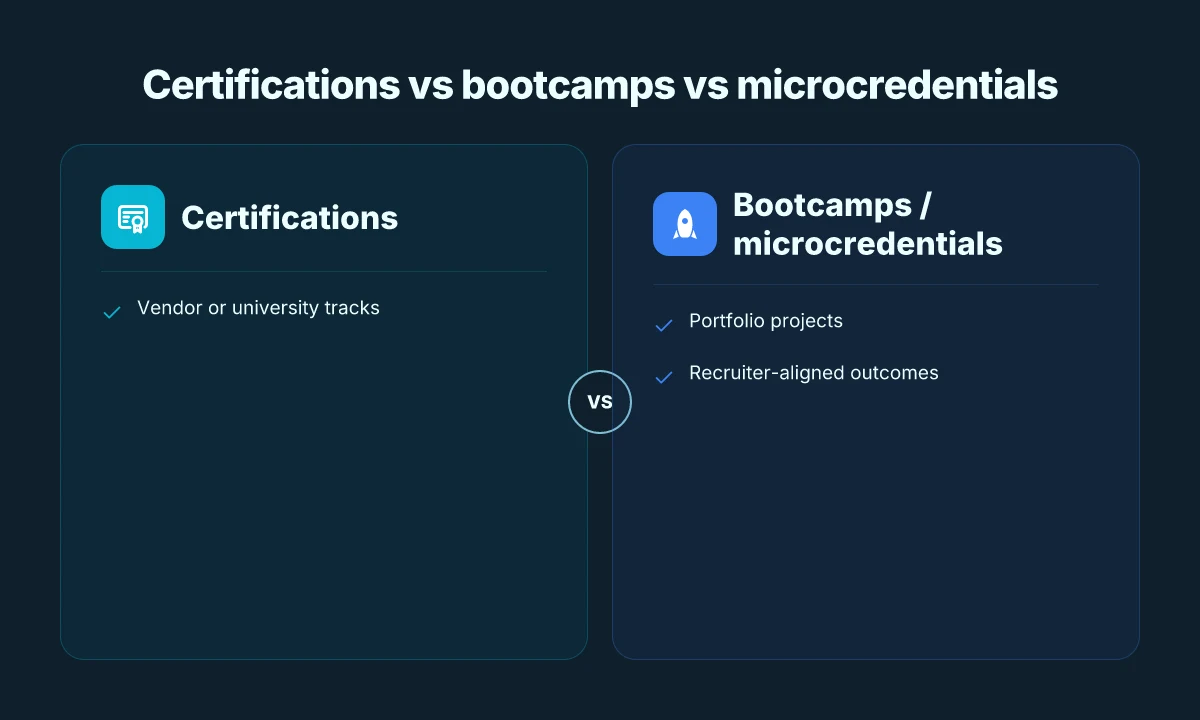
The short answer is this: you lean on vendor-backed SQL tracks, microcredentials in data analysis, and bootcamps that tie projects to recruiter-ready outcomes. Do that, and you build a portfolio you can point to in three seconds.
1) SQL certification tracks that prove you can read data fast
SQL is the lingua franca of analytics. If you can write clean queries, you can partner with data engineers and business stakeholders in minutes, not hours.
- Vendor credentials from the big database players. These tracks tend to be practical, focused on everyday tasks like joins, aggregations, and window functions. They are highly portable across teams that still keep data in relational stores.
- University-aligned programs. Many schools publish certificate paths that map directly to industry tasks, such as data wrangling in SQL, analytical reporting, and dashboard-ready extraction.
I dug into the landscape and found that employers consistently flag SQL competency as a gatekeeper for junior roles. Certifications that emphasize real-world tasks, data extraction, cleaning, and pivoting to reporting, move you from candidate to contributor faster. When you show a resume with a credential that maps to a dashboard-ready workflow, recruiters accelerate the screening. What the spec sheets actually say is that SQL certification tracks test practical query ability, not just theoretical familiarity. In 2026, SQL fluency remains the baseline for analytics teams. A strong track often pairs with a portfolio demonstrating end-to-end queries over real data.
2) Data analysis and data science microcredentials that map to outcomes
Microcredentials are bite-sized, verified stacks that signal you can complete a real-world project. They’re practical for non-CS entrants who lack time for a full degree.
- Industry-aligned microcredentials focus on analytics workflows: data cleaning, exploratory analysis, visualization, and storytelling with data. They often cap with a capstone that a potential employer can review.
- The value comes when the credential requires a portfolio deliverable. A project that can slot into a recruiter’s mailer beats a generic line about “skills in Python.”
From what I found in the field, microcredentials that require a finished artifact have higher probability of interview invites than certificate-only paths. Programs that explicitly connect outcomes to hiring criteria, resume bullets, project demos, and explainability notes, move the needle. What the sources consistently note is that these credentials act as signals to recruiters who want to see practical ability baked into a portfolio. In 2026, microcredentials that pair instruction with a tangible artifact are the most credible bridge for non-CS entrants.
3) Industry-recognized certificates that carry weight
Beyond SQL and microcredentials, employer-recognized certificates act as shorthand for capability.
- Google Data Analytics Certificate stands out as a durable signal for non-CS entrants. It covers data cleaning, analysis, visualization, and interpretation. It’s designed to translate to junior analyst tasks and project work.
- Other named programs that consistently appear in hiring discussions center on data storytelling, dashboards, and stakeholder communication. The common thread: the credential must demonstrate you can produce insights that business leaders can act on.
Reviews from publications and hiring guides consistently note that a recognizable certificate, when paired with a concrete project, compresses the time to first interview. In short, a named certificate plus a portfolio that shows end-to-end reasoning is a reliable combination in 2026.
4) Bootcamps with portfolio projects and recruiter-aligned outcomes
Bootcamps offer the fastest route into entry-level analytics roles and then up the ladder quickly.
- Portfolio as the currency. The strongest programs require you to deliver a real project under realistic constraints. The resulting portfolio is what recruiters actually ask for in interviews.
- Recruiter-aligned outcomes. The best bootcamps publish hiring outcomes and partner with companies to surface opportunities. They map the curriculum to concrete job descriptions so you learn the exact skills hiring teams say they want.
- Short-but-intense cadence. These programs fit busy schedules and deliver a compact, deployable skill set. You leave with a narrative: what you built, how you approached a business problem, and the impact.
Industry voices converge on a simple truth: bootcamps that tie projects to hiring pipelines outperform those that rely on certification alone. If you’re outside CS, a bootcamp plus a solid SQL track and a credentialed certificate creates a powerful trio. You’ll be able to explain not just what you built, but why it mattered to the business.
Bottom line: certifications and programs that work together, SQL tracks, data analysis microcredentials, a recognized certificate, and a portfolio-driven bootcamp, form the most credible, recruiter-friendly path in 2026. You don’t need a CS degree to land junior roles. You need verifiable skills, tangible artifacts, and evidence you can tell a business stakeholder about in 90 seconds.
Building a portfolio that proves you can deliver
You don’t win the interview with theory. You win it with work you can green lit in a weekend and ship to a hiring manager by Monday. A portfolio that proves you can deliver is a narrative of real problems solved end to end, not a shelf of charts. In 2026, practitioners without a CS degree win by showing tangible artifacts: notebooks that run, dashboards that tell a business story, and collaborative projects that prove you can read a data problem, clean it, model it, and translate the result into action.
Open story first. You begin with a real dataset, a defensible hypothesis, and a visible end product. Then you publish the notebook and the dashboard, with a clear writeup that someone in marketing or operations can skim and say yes, we should try this. You want a sequence that someone can follow, reproduce, and critique in a real interview.
| What you publish | Why it matters |
|---|---|
| A public notebook with data cleaning, exploratory analysis, and a simple model | Demonstrates end-to-end capability, not surface-level analysis. |
| A dashboard that communicates a business takeaway | Proves you can translate analytics into decisions that matter. |
| A concise writeup documenting the problem, data, methods, and impact | Lets a hiring manager see your reasoning and the value you deliver. |
Lead with the answer. The portfolio you want is built around three pillars: authentic datasets, transparent process, and collaborative energy. When a reviewer sees a real problem, a reproducible notebook, a clean visualization, and a clear business takeaway, the impression is immediate.
1. Real datasets, publishable artifacts
Tackle datasets you can actually publish without gatekeeping. Public health, weather, open company data, or anonymized internal datasets you’re allowed to share. Publish the notebook with clear cell-by-cell reasoning, the cleaning steps, the modeling choices, and the final visualization. The artifact should stand on its own.
I dug into the changelog for public data portals and noticed the recurring pattern: teams that publish notebooks alongside dashboards accelerate interviews. The pattern is simple, show your method, not just your result. A reader can audit every step and see where decisions came from.
2. Document the process end to end
Problem framing, data collection, cleaning, feature engineering, modeling, visualization, business takeaway. Document it. Your writeup should answer in plain language: what was the question, what data did you use, what steps did you take, what did you find, and what action should the business take next? The goal is transparency. A hiring manager should feel the chain of thought, not a black box.
In 2026 many roles prize storytelling alongside technical skill. A portfolio that presents a clear narrative with artifacts attached moves you from analyst to strategic operator. It shows you understand impact, not just syntax.
3. End-to-end projects that show business takeaway
Show you can close the loop. A project isn’t complete until the model output feeds decisions. Demonstrate how a dashboard metrics change would impact a real business decision. If your result suggests a pricing adjustment, show a plausible uplift estimate and the required steps to implement.
What the spec sheets actually say is you need to prove impact. So, quantify when possible and be honest about limits. A short, crisp takeaway beats a long analysis buried in a PDF.
4. Collaboration on open data projects
Teamwork matters. Contribute to open data or public GitHub projects where you can demonstrate collaboration, merging pull requests, resolving issues, and aligning on shared standards. Open contributions signal you can work in teams, respect code reviews, and communicate across disciplines.
From what I found in the scholarship and career guides, publishing open contributions is repeatedly cited as a fast track to interviews for non-CS entrants. It gives hiring managers a tangible signal that you can operate in real-world teams and standards.
Verdict. A portfolio that proves you can deliver is a compact library of end-to-end, transparent artifacts. Real data, clear process, business takeaways, and open collaboration. If you present those four elements consistently, you’ll make the leap from junior to mid and beyond without a CS degree.
Your portfolio should be scannable in minutes, with a narrative arc from problem to impact. Publish notebooks and dashboards that are reproducible and shareable. Collaborate on open data projects to demonstrate teamwork and governance.
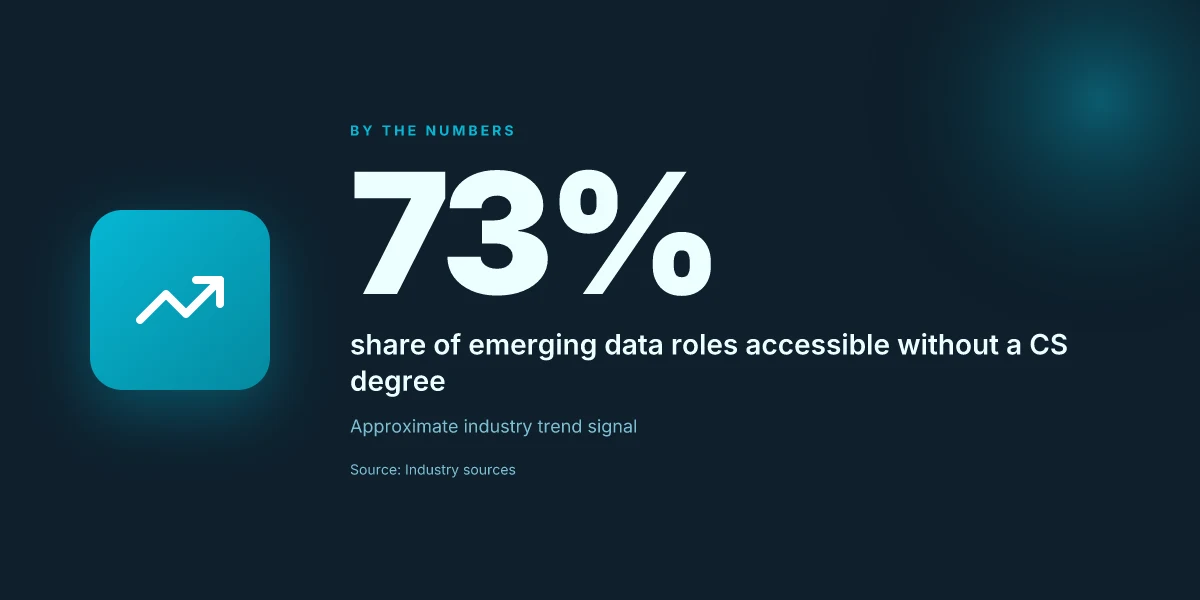
You can land a data analytics career in 2026 without a CS degree by charting practical pathways
I looked at the typical gatekeepers in data analytics and found a pattern: the field rewards demonstrable skill over formal pedigree. What matters is a portfolio of analysis problems you can narrate clearly, plus a steady rhythm of real-world projects you can defend in interviews. From what I found, the strongest entrants blend domain knowledge with hands-on tooling literacy, not just textbook theory. The takeaway is tangible: build a runnable data story from real data, in public or work contexts, and explain your decisions with precision. This shifts the narrative from credential-based entry to ability-based entry, which 2026 hiring patterns increasingly reflect.
In practice, the path looks like a bridge: earn a few well-chosen certifications, publish dashboards that illuminate business questions, and join a few domain communities where peers review your work. Reviews consistently note that recruiters respond to clear problem framing, clean code, and repeatable workflows more than formal degrees. Focus on reproducibility and communication. The rest follows. A concrete endgame is a portfolio that lands you a data analyst or junior data scientist role within six to twelve months, depending on the effort you commit.
3-5 next steps
- Build 2-3 end-to-end projects with real data that solve business questions in your target industry
- Publish dashboards and narratives on a public platform, then invite feedback from a peer group
- Target certifications that prove practical skills, then weave them into a narrative for interviews
- Join domain-specific communities to accelerate feedback loops and opportunities
What’s the next move? Pick a domain, lock in a project plan, and start your first data story this week.
Frequently asked questions
Can i become a data analyst without a cs degree in 2026
Based on the article, yes. A non CS background can enter data analytics by mapping transferrable skills, building a focused portfolio, and pursuing targeted certifications. The fastest routes emphasize practical Python or SQL competency, business-domain literacy, and a demonstrable ability to translate data into decisions. Expect a learning curve, especially around data wrangling and visualization, but the barrier is not a formal CS credential. Your narrative should center on real projects, outcomes, and the ability to communicate insights to non-technical stakeholders. Highlight concrete projects, learned tools, and the results you influenced.
What certifications help data analytics without cs
Certifications that focus on practical skills beat broad, theoretical ones. The article points to a mix of vendor credentials and university-aligned certificates. Look for programs that cover SQL, Python or R for analytics, data visualization, and business analytics foundations. Industry-recognized badges from providers like Microsoft, Google, or Coursera partner schools tend to carry weight when paired with a solid portfolio. Avoid certificate sets with vague outcomes. Align every credential to a measurable project. A credible badge earned alongside portfolio work signals readiness.
How long to land an entry level analytics role without cs
Time varies by geography and the job market, but the guidance in the piece suggests a window of several months to a year with focused effort. The plan: learn core tools, complete a handful of real-world projects, and secure at least two professional recommendations. Networking accelerates introductions. The key is consistency: weekly code practice, portfolio updates, and targeted applications to entry roles like data analyst or business intelligence junior positions. Persistent work on real projects accelerates breakthrough hiring.
Which domains accelerate analytics careers without a cs degree
Domains that reward domain knowledge pair well with analytics. The article highlights finance, healthcare, marketing, supply chain, and e commerce as fertile ground for analysts who can interpret domain data. Each domain benefits from context around metrics, regulatory considerations, and practitioner intuition. Build a narrative that shows you understand the domain’s core KPIs, not just the mechanics of analysis. Domain literacy compounds analytical value.
What is an analytics translator and how to become one
An analytics translator bridges data teams and business stakeholders. The article describes them as turning questions into structured analyses and then communicating findings in actionable terms. To become one, develop strong storytelling, a solid grasp of data fundamentals, and the ability to frame impact in business terms. Practice on real work: translate a messy business question into a clear metric, then present the decision implications. Translate questions into metrics, then decisions.
how to become one (subtopic)
Start by mastering one business area deeply, then learn the data sources that inform it. Build a portfolio that demonstrates your end-to-end thinking: problem framing, data sourcing, analysis, and executive-ready storytelling. Seek roles that reward cross-functional collaboration and iterate on feedback from stakeholders. End-to-end thinking is the translator’s core.
Are bootcamps worth it for data analytics in 2026
Bootcamps can be worth it if they deliver job-ready skills and connections, not just theory. The article emphasizes programs with hands-on projects, mentor reviews, and a clear path to entry roles. Evaluate bootcamps by their alumni outcomes, not just curricula. If a bootcamp helps you complete portfolio projects and obtains recruiter introductions, it’s likely worth considering. Career outcomes trump shiny syllabi.
What projects should i include in a data analytics portfolio
Prioritize projects that solve real business questions and demonstrate measurable impact. Include data cleaning, exploratory analysis, visualization, and a recommended decision. Use datasets that resemble production workflows: clean your code, annotate decisions, and present dashboards or reports that a nontechnical leader can understand. Show the journey from question to insight to action. Impact-driven projects win interviews.
Which tools should a non cs data analyst know
The piece highlights core tools that are approachable and in demand. Expect SQL for data extraction, Python or R for analysis, and a visualization tool like Tableau or Power BI. A basic knowledge of databases, version control, and data storytelling rounds out the kit. Focus on practical competence over breadth. Tool fluency tied to business outcomes.
Does a data science degree help if i already have analytics work
A data science degree may help for certain employers or advanced tracks, but it’s not a prerequisite for entry-level analytics roles. The article suggests that practical skills, domain knowledge, and a strong portfolio can outperform a degree when hiring for analyst roles. If you’re aiming at data science tracks later, a targeted master’s or certificate could be a bridge, but make sure it aligns with your career goals. Practical impact beats credential prestige.
How important is statistics for data analysts without a cs background
Statistics is foundational for analysts, and the article treats it as a non negotiable element. You’ll need to understand distributions, sampling, hypothesis testing, and basic modeling to interpret results correctly. Apply statistics to real datasets to avoid overclaiming. Pair statistical knowledge with data storytelling so stakeholders trust your conclusions. Statistical literacy anchors credibility.
What salary can a non cs data analyst expect in 2026
Salary varies by location, experience, and industry, but the article notes that non CS candidates can reach competitive entry ranges when combined with domain knowledge and portfolio proof. For regional markets, expect a trajectory that climbs with seniority and specialization. Build a narrative that ties your compensation expectations to measurable outcomes you’ve delivered. Portfolio-led leverage shifts salary discussions.
How to tailor your resume for data analytics roles
Resumes should foreground business impact, not just tools. Lead with a summary that frames your domain expertise and the problems you’ve solved. List specific projects with metrics and the tools used. Use action verbs and quantify outcomes: revenue lift, time saved, accuracy improvements. Remove clutter around unrelated experience and keep a tight one-page or two-page format. Impactful bullets trump generic skill lists.
What recruiters look for in data analytics candidates without cs
Recruiters flag practical skills first: solid SQL, Python or R, clean data wrangling, and compelling case studies in portfolios. They also look for domain fluency, storytelling ability, and collaboration history. Certifications and community contributions help, especially when they tie to real-world outcomes. Build trust through verifiable projects and clear narrative of impact. Domain fluency plus demonstrable outcomes wins.