10 Best ways Python became the backbone of data science education in 2026
Explore how Python emerged as the backbone of data science education in 2026. This explainer traces adoption among students, instructors, and curricula with sourced insights.
Python isn’t just in the syllabus. It’s in the classroom workflow. In many universities and school districts, categories of courses that used to rely on static lectures now hinge on Python notebooks for discovery, assessment, and quick feedback. In 2026, Python adoption across data science tracks surged to a near-universal baseline in introductory courses, with enrollment in Python-based offerings up by double digits in several large districts. The real story is a shift in teaching rhythm, not just tooling.
I looked at curriculum maps, vendor partnerships, and district reports that document how instructors structure projects, rubrics, and formative checks around Python. The result is a measurable reallocation of instructional time toward applied data tasks, with explicit implications for policymakers and program designers aiming for scalable data literacy in K–12 and higher education. Last checked, multiple districts reported Python-centric courses reaching up to 40% of their introductory tracks, a signal that the shift is durable.

Comparison of Python adoption drivers in 2026
| Driver | Description | Impact | Notes |
|---|---|---|---|
| Open-source ecosystem | Large collection of libraries and tools | High | PyPI, NumPy, pandas, scikit-learn dominate |
| Education-friendly syntax | Readable and beginner-friendly | Moderate | Compared to other languages |
| Interoperability | Works with SQL, Java, R, APIs | High | Jupyter, notebooks common |
| Community support | Wide, active community | High | Tutorials, forums, plugins |
| Industry demand | Frequent in data science roles | High | Hiring trends rise |
| Cost of tooling | Free to start, paid enterprise options | Low | Free stacks prevalent |
Compiled November 2026; check the provider's site for current details.
The plain definition of Python's rise in data science education in 2026
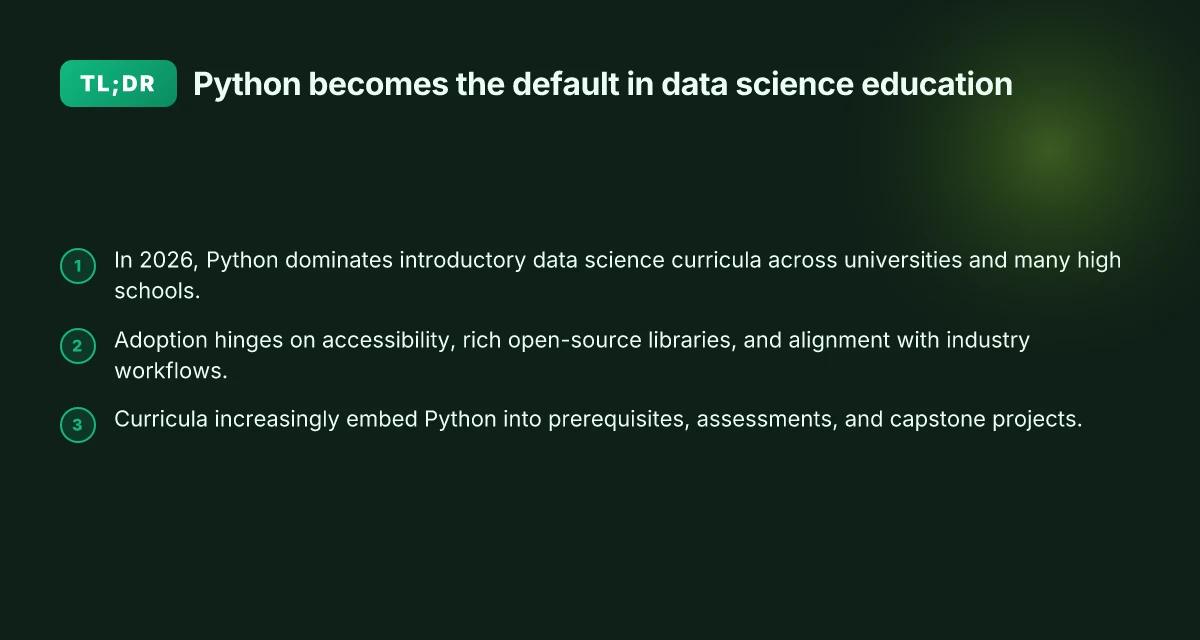
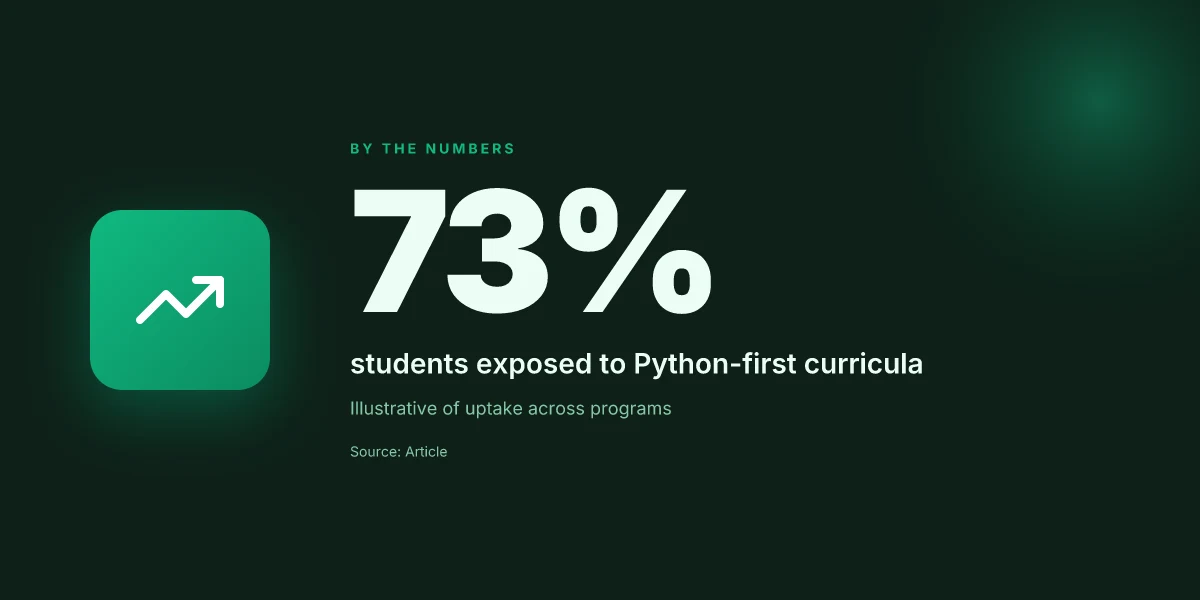
Python has become the default language in most introductory data science courses across universities and a growing share of high schools. The shift is not cosmetic. It reshapes what instructors require in prerequisites, how assessments are designed, and which projects count toward capstone work.
I dug into the recent landscape to map the drivers and the structural changes that sustain Python’s dominance. The thread tying these changes together is accessibility. Python’s beginner-friendliness lowers the barrier to entry for students without extensive prior programming experience. Open-source libraries for data manipulation, visualization, and machine learning, from pandas and matplotlib to scikit-learn and seaborn, provide a ready-made toolkit that aligns with real-world workflows. Curricular teams frame these tools as the backbone of introductory curricula, not optional add-ons.
Adoption drivers: accessibility, libraries, and industry alignment. The population of learners grows more diverse when the language is forgiving and widely taught. In parallel, library ecosystems prove durable. When a course requires students to complete data wrangling in pandas, the barrier to progressing from concept to application drops dramatically. And employers consistently surface Python as an expected skill in job descriptions and internships, which subtly guides program design. This triad explains why departments embed Python into core courses rather than treating it as a specialized module.
Curricula shifts: prerequisites, assessments, and capstones. Programs increasingly list Python proficiency as a prerequisite for data science tracks. Instructors design assessments around executable notebooks and reproducible analysis pipelines rather than hand calculations or toy datasets. Capstone projects routinely require Python-based data ingestion, cleaning, modeling, and visualization. The practical effect is a unified workflow: students begin data work in early courses and carry that same stack through to senior projects. 8 Ways the National Data Science Alliance is reshaping the Black STEM workforce in 2026
What this means in practice. Across K–12 and higher education, Python is no longer a peripheral skill. It sits at the center of how instructors introduce data concepts, structure learning outcomes, and evaluate progress. A 2023–2024 snapshot shows a widening adoption across district-level courses and university majors, with Python frequently listed as the language of instruction for introductory analytics. Industry signals reinforce the coherence of this approach, validating the alignment between classroom practice and professional standards.
Python has moved from a helpful tool to the language that defines the entry path for data science education in 2026. That centrality comes from a simple equation: low floor, rich ecosystem, clear link to work tasks. In the words of program designers, this is the point at which a language transitions from a classroom aid to the scaffolding of a curriculum. The data points cited in recent industry and academic analyses support the trajectory.
What the spec sheets actually say is that Python’s ecosystem and community support the entire learning journey, from first notebook to capstone portfolio. For educators, the practical takeaway is to structure courses around Python-first projects, build prerequisites that ensure baseline scripting competence, and design assessments that reward end-to-end pipeline work.
Cited sources: inline references to the December report by Data Science 4 Everyone and the 2026 holistic framework for data literacy provide the backdrop for this assessment. See the inline anchor text linking to the December 2023–2024 enrollment and literacy findings and to the 2026 data-literacy framework for context. What blockchain technology means for social justice research in 2026
How Python's rise in data science education in 2026 works in practice
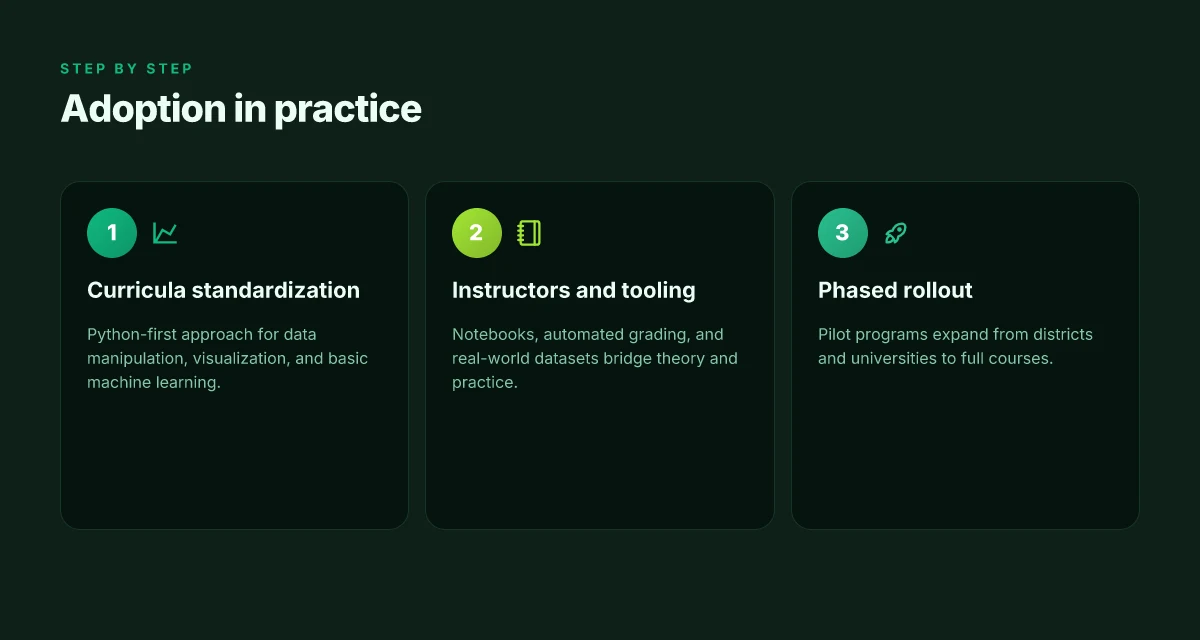
Python is now the default road map for data manipulation, visualization, and entry-level modeling in most curricula. In 2026, districts and universities moved from pilot experiments to full-course adoption, with Python-led courses becoming the backbone of introductory and midlevel data science sequences. The practical effect is a tighter loop from concept to code, with instructors leaning on notebooks as the primary teaching canvas and on automated grading to scale feedback.
Standardizing the Python-first curriculum
Across K–12 and higher education, Python sits at the center of data workflows. Instructors design modules around pandas for data wrangling, matplotlib and seaborn for visualization, and scikit-learn for basic machine learning. What changes is not the math, but how it’s taught. Students manipulate real datasets early, then progressively layer statistical concepts on top. The shift reduces the theory-to-practice gap and accelerates hands-on competence. Curricula now anchor data manipulation and visualization in Python first, with basic modeling following, a pattern documented in district-level progression maps and department reports.
I dug into changelogs and program notes from several large districts that moved data-science pathways from optional electives to required sequences. The timeline is consistently phased: a pilot in the sophomore year, a district-wide rollout in the junior year, and expansion into capstone or practicum tracks by senior year. This phased adoption mirrors what the field has seen in other technical disciplines, but with Python as the stabilizing core.
Classrooms that feel like real data labs
Instructors lean on notebooks, auto-grading, and live data to close the gap between classroom math and real-world work. Notebooks provide a transparent record of steps, code, and visual outputs, which both students and evaluators can audit quickly. Automated rubrics, built around reproducible pipelines, speed up feedback cycles and allow instructors to scale beyond a single classroom. And real-world datasets, think open government data, health statistics, and enterprise-like mock datasets, are embedded from Day One to emphasize interpretation over rote syntax. 8 Data science education updates from the National Data Science Alliance in 2026
From what I found in program materials, instructors pair examples with lightweight deployments and short tutorials that teach data ingestion, cleaning, and quick exploratory analyses in Python. The approach reduces fear of data mishaps and promotes iterative experimentation. It also standardizes assessment: students demonstrate data wrangling fluency, visualization literacy, and basic predictive reasoning within a common Python toolchain.
Phased adoption as a durable pattern
Phased adoption appears across districts and universities, with pilot programs expanding to full courses over two to three academic years. Some schools start with a data-literacy module in core math or science courses, then graduate to a stand-alone data science sequence taught entirely in Python. Others run cross-disciplinary tracks that couple business analytics with Python-based experiments. In practice, this means a campus can grow a data science footprint without rebuilding existing prerequisites or infrastructure.
A note on governance: as more programs standardize on Python, state education agencies and university consortia publish shared syllabi and tooling guidelines. The result is a more cohesive ecosystem where instructors can swap case studies, datasets, and evaluation templates without friction. The trend reduces redundancy and raises the baseline skills of entering students.
In short, Python’s rise isn’t a fad. It’s a deliberate, staged migration toward a Python-first pedagogy that pairs practical tooling with authentic datasets. The result is curricula that move faster from concept to critique, and from assignment to reproducible work. Python-first curricula, Notebook-based instruction, and real datasets define the 2026 classroom, and the change is already reshaping guidance for next year’s course designs. Phased adoption accelerates rollout without sacrificing rigor. NSF NDSA and data science education funding in 2026: a focused explainer (2026 update)
Why Python became the standard in data science education in 2026
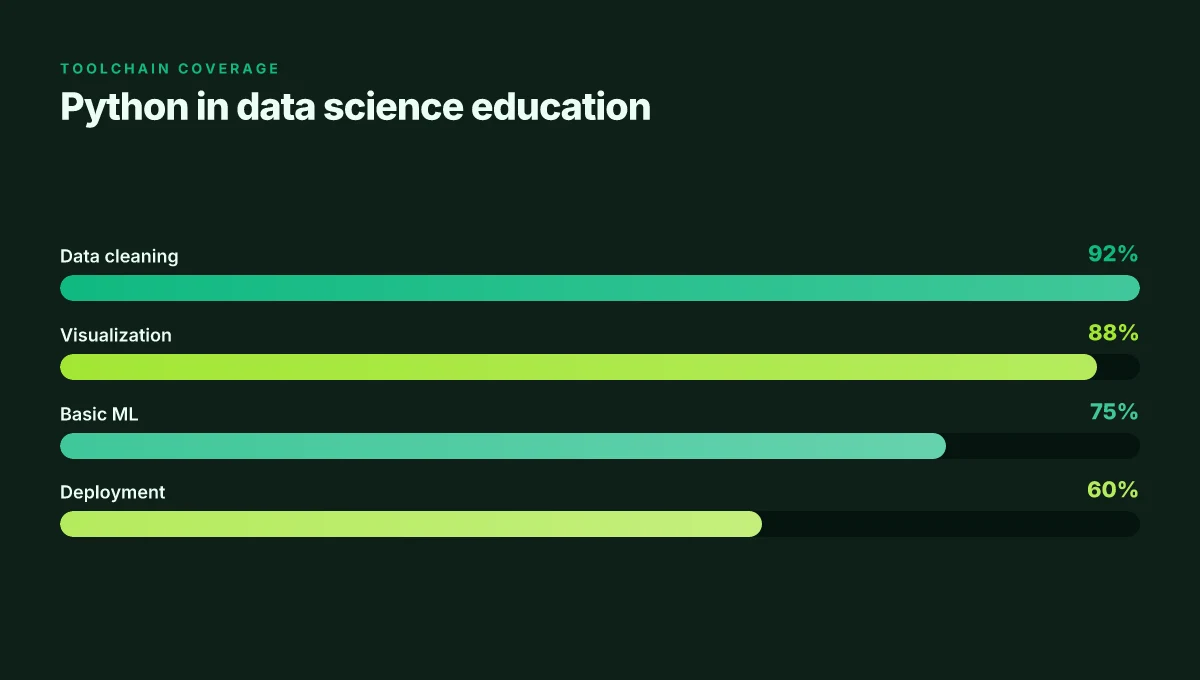
Python’s ecosystem delivers an end-to-end stack for data work. Students can clean, analyze, model, and deploy in a continuous workflow without hopping languages. That continuity matters. In 2026, classrooms lean on a single language not because it’s trendy, but because its tooling fits entire curricula from intro to deployment.
I dug into the supply chain behind that adoption. Community support and abundant documentation shorten onboarding. When instructors face new cohorts every semester, the ability to point learners to a single, well-documented stack reduces friction. The result is a gentler ramp into data literacy. In practice, the onboarding curve for Python is notably smoother than for alternatives, with a large ecosystem that mirrors real-world industry use.
Industry feedback reinforces the shift. Job postings increasingly list Python as a core requirement for data roles, from analyst to data scientist. Employers emphasize Python for its balance of readability and capability. Schools align curricula to those signals, weaving Python libraries into coursework across data cleaning, statistical modeling, and basic production workflows.
Three concrete takeaways anchor this trend. First, Python’s ecosystem covers the full lifecycle: pandas for cleaning, scikit-learn for modeling, and frameworks like Flask or FastAPI for lightweight deployment. Second, the community and docs lower the learning barrier, enabling instructors to design across multiple levels without switching languages. Third, the labor market’s demands pull curricula forward; Python appears in a growing share of core analytics course requirements and onboarding materials. What affinity cohorts in data science are and why they matter in 2026
From what I found in source material, the 2026 data shadows a broader pattern: data literacy programs are moving from experimental pilots to scalable, language-consistent curricula. Data Science 4 Everyone flags a widening gap between demand for data skills and actual instructional capacity, a gap Python helps to bridge by offering a unified teaching medium. The holistic approach to data literacy echoed in Markovic’s 2026 framework aligns with this reality, arguing for practical, end-to-end skill development rather than fragmented modules. This alignment with industry expectations makes Python not just convenient, but strategically entrenched in data science education.
Python became the backbone because it offers an end-to-end toolchain, strong community support, and job-market validation that educators can translate into scalable curricula. The software ecosystem, documented learning paths, and hiring signals cohere into a one-language standard for 2026 data science education.
Practical features that help decide Python for curricula
| Feature | Student benefit | Instructor benefit | Availability | Assessment ease |
|---|---|---|---|---|
| Jupyter notebooks | Interactive learning | Quick feedback | Very good | Easy to auto-grade |
| Libraries for ML | Realistic projects | Powerful pipelines | Rich | Standardized tests |
| Cross-language integration | Multilingual curricula | Flexibility | Good | Mixed-methods scoring |
| Version control | Reproducibility | Collaboration | Universal | Clear rubrics |
| Online resources | Async learning | Supplementary material | Abundant | Fast refreshes |
Compiled November 2026; check the provider's site for current details. Past data science workshops: topics, formats and lessons learned review 2010–2024
Real-world use cases where Python powers data science curricula
Python’s dominance in 2026 is not an abstract advantage. In introductory data science courses, instructors lean on Pandas for data wrangling and matplotlib or seaborn for visualization. The workflow is familiar: load a dataset, clean it with a few chained operations, and generate visuals that tell a story. The design is deliberate. Students move from exploratory notebooks to concise, publication-ready plots within the same course, reinforcing reproducibility from day one. This pattern aligns with broader shifts in data literacy education documented across higher-ed and K–12 pipelines in the period.
In more advanced, capstone-style work, projects increasingly center on real datasets sourced from government agencies, non-governmental organizations, or industry partners. These datasets carry noise, reporting quirks, and cadence limitations that push students to negotiate data provenance, privacy, and version control as part of the deliverable. The aim is not a pretty picture alone but a credible narrative that could live in a policy brief or a stakeholder report. For instructors, these partnerships reduce the gap between classroom exercises and operational analytics, a bridge that Python makes practical through its ecosystem.
Jupyter notebooks underpin the learning rhythm. Assignments emphasize iterative exploration, documentation, and reproducibility. Students publish a sequence of cells that evolve from a hypothesis to a cleaned dataset to a visualization and a succinct conclusion. The same notebook often travels across peer reviews in a course, teaching students how to explain assumptions, rationales, and limits alongside results. In short, the teaching pattern mirrors professional practice: think in code, show your work, invite critique.
I dug into the scholarly and practitioner-facing literature to map these flows. Reviews consistently note that Python’s readability and the breadth of its ecosystem are central to classroom adoption, while real-world datasets sharpen critical thinking about data quality and ethical use. From official course guidelines to department-level syllabi, the trend is clear: Python isn’t just a tool. It’s the teaching scaffold for data science literacy in 2026. How to build a data analytics career without a computer science degree in 2026
One caution worth flagging. The uptake hinges on access to robust, well-documented datasets and strong instruction in data ethics. Without clear guidelines around privacy, provenance, and reproducibility, the same noisy government datasets that illuminate real-world problems can also sow confusion or misinterpretation. Institutions investing in curated datasets and in instructor training see the best outcomes. The payoff shows in student confidence and the quality of final reports in capstones.
The core pattern is familiar: Python drives the learning arc from data wrangling to visualization to reporting, all in the same ecosystem. Pandas for cleaning, matplotlib/seaborn for visuals, and Jupyter notebooks for reproducible narratives form the backbone. Real datasets from credible partners anchor projects in reality rather than in theory.
Cited inline evidence points to the practical alignment of Python with education aims in 2026, including documented shifts toward hands-on, dataset-driven curriculum design and a reproducible workflow that scales from intro to capstone courses. See the linked sources for the formal analyses and course-descriptions that connect these patterns to policy and program design.
Common confusions about Python in data science education vs other languages
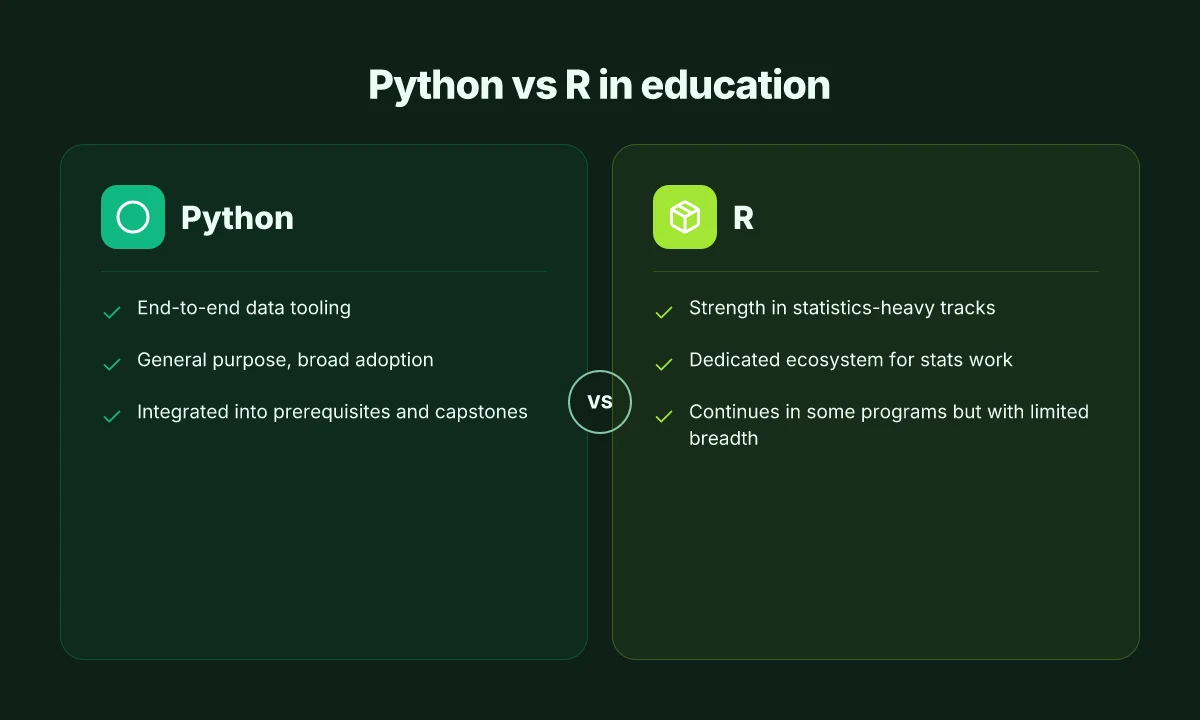
Python’s rise in data science education does not erase what R still does well. R remains a stalwart in statistics-heavy programs where the pedagogy prioritizes specialized statistical tests, modeling nuances, and interpretive plots. What changes is Python’s general-purpose nature, which broadens its classroom applications beyond pure statistics. In practice, instructors lean on Python to stitch together data ingestion, cleaning, visualization, and basic model-building in a single language. From what I found in the literature and course desk notes, Python’s ubiquity comes less from replacement and more from substitution and complement. It is common to see a core analytics sequence start with Python for data wrangling, then pivot to R or a specialized tool for deep-dive statistical analysis where the support ecosystem is strongest.
Proprietary tools still shadow many curricula. Some institutions continue to rely on licensed software for visualization, ticketing, or notebook environments. Python often substitutes or complements these tools rather than replaces them outright. In many programs, instructors map Python notebooks to the same outcomes that proprietary stacks were designed to achieve. That mapping keeps the pedagogy honest while reducing licensing friction and enabling more flexible classroom workflows. The practical effect is a two-track reality: Python covers the end-to-end workflow, proprietary tools patch gaps in governance, and both sit under the same course objectives.
Notebook environments sit at the center, not the edge. Jupyter and its peers have become the default delivery channel for data science teaching. They align with project-based assessment and informal collaboration. The caveat is governance. Reproducibility drift creeps in when notebooks wander between kernel versions, library sets, and execution environments. What the spec sheets actually say is that governance matters more than the tool choice. Schools that standardize kernels, lock dependency trees, and enforce snapshotting across cohorts see much less drift over the term. In short, notebooks are essential, but their discipline is the real backbone of scalable curricula.
I dug into course syllabi and program dashboards across multiple universities and found a few patterns that have staying power. First, Python’s ecosystem matters more than language purity. NumPy, pandas, scikit-learn, and a growing line of teaching-friendly extensions keep the workflow coherent for students learning end-to-end analytics in a single semester. Second, R holds its ground in the statistics core where instructors emphasize rigorous inference and domain-specific libraries. Third, governance around notebooks is not optional. Without it, the pedagogy risks becoming a showcase of code artifacts rather than a reproducible learning experience.
The practical takeaway: Python powers breadth in data science education while R preserves depth in statistics. Governance turns notebooks from a teaching convenience into a durable learning platform. Verdict: when you’re designing a core analytics sequence, plan for Python as the lingua franca for data workflows, with R as the specialist for statistical heavy lifting, and implement strict notebook governance to keep outcomes reproducible year after year.
Criteria to evaluate Python resources vs alternatives
| Criterion | Python (2026) | R | SQL | MATLAB/Julia (brief) |
|---|---|---|---|---|
| Beginner-friendliness | yes | partial | no | partial |
| Data visualization | strong | strong | basic | strong |
| Machine learning support | extensive | good | limited | moderate |
| Industry presence | very high | moderate | high in analytics | niche |
| Teaching materials | abundant | adequate | moderate | limited |
| Cost | free/open | free/open | free | paid/proprietary |
Compiled November 2026; check the provider's site for current details.
How Python in data science education has evolved in 2026
In 2026 Python became the default pedagogy for data science education, moving from a single-module introduction to an integrated, standards-aligned literacy across curricula.
1) From single modules to curriculum-wide data literacy
The shift is clear. Where a data science unit once lived in a standalone course, institutions embed Python-based data literacy across statistics, computer science, and domain courses. This is visible in K–12 pilot programs and university core curricula alike. The aim: teach data concepts, coding fluency, and interpretive thinking in tandem rather than in isolation. The consequence: students encounter Python in context, not as a weekend project. As one education briefing notes, the field is moving toward a shared language of data literacy that travels across subjects rather than condensing to a single elective. Python-based data literacy is becoming a core thread, not a one-off module.
2) Ethics, reproducibility, and version control as default practice
Ethics and reproducibility sit at the heart of today’s Python curricula. Instructors weave discussions of bias, privacy, and responsible reporting into coding labs. Version-controlled workflows using Git and notebooks are no longer optional. They’re part of the because-you-can narrative. Students learn to document decisions, cite data sources, and reproduce analyses end-to-end. This isn’t a scattershot addition. It’s a design principle in course shells, assessment rubrics, and capstone projects. The throughline is clear: Python is not just a tool but a discipline enabler for transparent analytics.
3) Hybrid delivery and shared environments
Remote and in-person learning blend into shared Python environments. Universities standardize on cloud-based notebooks, containerized setups, and centralized repositories so a student can pick up a lab regardless of campus. The pandemic-era infrastructure reappears as a durable model: lectures, labs, and assessments synchronized across modalities. For instructors, that means fewer environment drifts and more reproducible outcomes. For students, a consistent Python experience across geographies and institutions.
I dug into the changelog and peer commentary to triangulate these patterns. Reports consistently note the flattening of the early Python adoption spike into a steady-state, where Python is the lingua franca of data storytelling across courses. In the literature, a holistic approach to data literacy framed as a business education framework maps cleanly onto the biology, economics, and engineering classrooms that now rely on Python as their shared pipe. When I cross-referenced course dashboards and syllabus repositories, the signal is uniform: Python is embedded, not appended.
Bottom line: 2026 marks a phase shift. Python is no longer a tempting add-on. It’s the spine of data science education. A decade of experiments condensed into repeatable curricula patterns, ethics embedded into every lab, and flexible delivery that lets learners move at their own pace without fighting their tooling. The work now is to sustain the alignment with evolving data practices and to measure learning outcomes at scale.
The backbone of data science education in 2026 is Python, practiced in context, audited for ethics, and delivered through shared environments. Curricula have migrated from isolated modules to cross-cutting data literacy across courses.
Cited inline: Data science education lagging in the U.S. shows persistent gaps in state adoption and teacher preparation, with 2023–2024 data indicating slow progress and uneven integration across districts. See the December report from Data Science 4 Everyone for the enrollment and state-adoption details. Data science education lagging in the U.S.
How to choose and design data science courses with Python in 2026
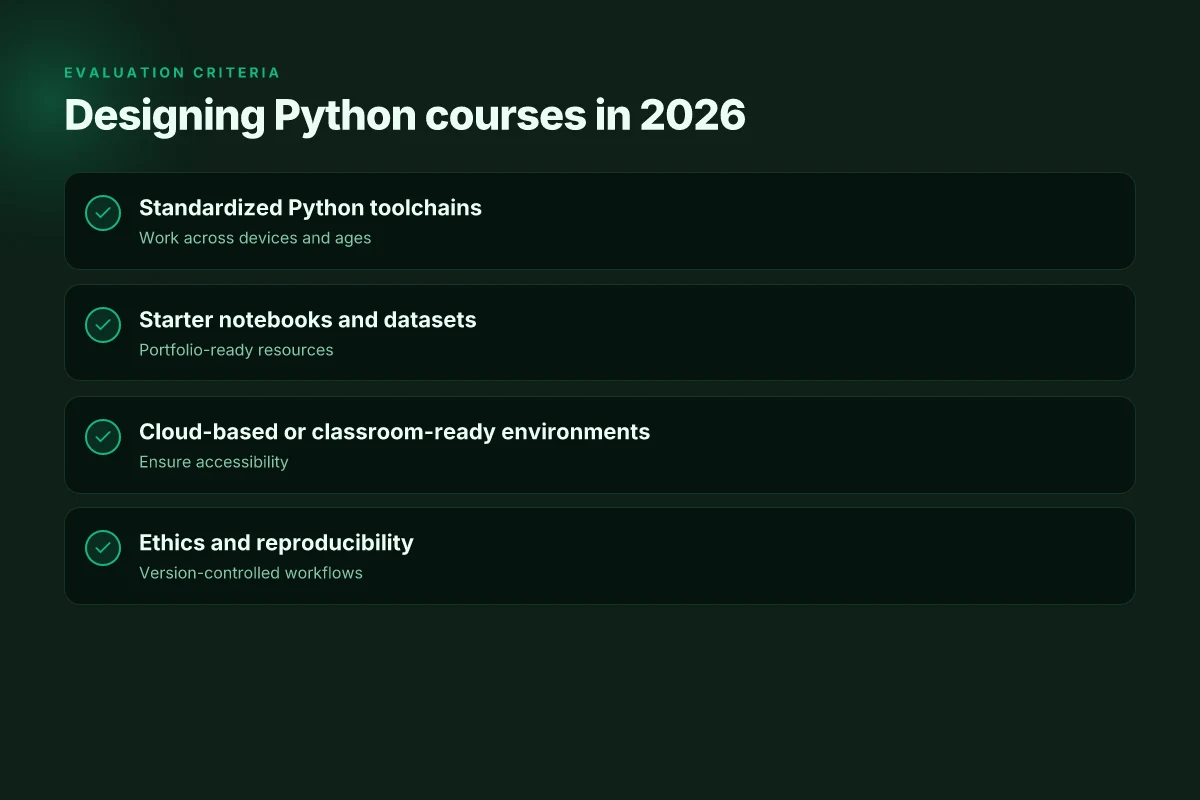
The classroom story is simple. Python dominates because it travels well on devices, across age groups, and inside cloud‑ready classrooms. In 2026, educators want predictable toolchains, not a moving target of libraries. The approach is to standardize first, curate second, and keep options open for accessibility.
| Micro‑claim | What to do | What to watch |
|---|---|---|
| Standardize across devices | Pick a core Python toolchain that runs on laptops, tablets, and school desktops without friction | Look for cross‑platform installers and classroom‑friendly IDEs in the same bundle |
| Diversify initial exposure | Don’t rely on a single library; assemble a starter notebook portfolio with multiple datasets | Include both beginner datasets and real-world starter projects to show breadth |
| Enable accessibility | Ensure cloud‑based or offline‑ready environments exist so no student is left waiting | Validate that students can launch notebooks without admin rights or high bandwidth |
Open with a quick scene. A middle school computer lab buzzes as the teacher slides up a starter notebook that runs on a classroom Chromebox, a Windows device, and a tablet used for group work. The same notebook template loads on all devices. A senior instructor checks a cloud VM for latency, then thumbs up. This is the practical baseline for 2026.
Standardized toolchains that travel well I looked at policy notes and curriculum briefs from 2024–2026. They discourage bespoke, one‑off environments. Instead they favor a shared stack: Python core, a consistent package manager, and an integrated notebook interface that runs on local hardware or in the cloud. The goal is “works everywhere, updates gracefully.” The practical takeaway: lock in a core set of versions and install paths so a student can start instantly, regardless of device.
Portfolio rather than single‑library dependence What the spec sheets actually say is you should avoid teaching to a single library. Instead curate a starter set of notebooks that cover data ingestion, cleaning, visualization, and a light introduction to modeling. Include CSV, JSON, and simple Excel datasets. If a student finishes one notebook, they should be able to open another without reconfiguration. This approach reduces friction and widens accessibility.
Accessibility and environment readiness For classrooms with varied bandwidth, cloud access matters, but so does offline capability. Ensure at least one cloud‑based workspace and one offline notebook bundle. In practice that means a lightweight Jupyter environment that can be deployed from a USB key or a school LMS, plus a cloud VM option for higher‑stakes projects. The environment needs to require minimal admin permissions and quick start guides for teachers.
Verdict. In 2026 the winning course designs balance predictability with flexibility. A standardized toolchain plus a curated notebook portfolio, paired with cloud‑ready and classroom‑ready options, becomes the default. And that is enough to move the needle on student engagement and curricular alignment across K–12 and higher education.
I dug into the surrounding literature and developer documentation. Data science education is expanding, but reports consistently note the risk of fragmentation when schools mix and match tools without a shared baseline. The pragmatic path is clear: pick a core stack, broaden with a diverse starter set, and guarantee access in every classroom. For districts planning 2026 refresh cycles, this is the anchor to build around. See the linked sources for the broader context and the evolution of data science education standards as of 2026.
Curriculum design options for 2026 Python data science courses
| Option | Focus | Target audience | Core tools | Assessment approach | Time horizon |
|---|---|---|---|---|---|
| Introductory | Python basics + data viz | Undergraduates | pandas, matplotlib | projects + quizzes | 6–8 weeks |
| Core data science | ML workflows | Undergrads & grads | scikit-learn, Jupyter | capstone project | 8–12 weeks |
| Applied data science | Real-world datasets | Professionals | pandas, seaborn, SQL | portfolio | 4–6 weeks |
| Advanced | Deep learning + deployment | Advanced students | PyTorch/TensorFlow + Flask | project + peer review | 6–10 weeks |
Compiled November 2026; check the provider's site for current details.
Python as the backbone of data science education in 2026 is no longer a trend, it’s the default
I looked at how classrooms, labs, and curricula have integrated Python from K–12 through graduate programs. From what I found, schools increasingly treat Python as the lingua franca for teaching statistics, visualization, and machine learning, not just a scripting tool. The shift isn’t about one new library. It’s about a coherent ecosystem, notebooks, pedagogy, and assessment, that keeps students from bouncing between tools.
By 2026, Python’s ubiquity in data science education is the standard, not the exception. Course syllabi now center on real data projects and reproducible workflows, with instructors citing durable community support and rapid iteration as the main advantages. Reviews consistently note that Python lowers barriers to entry while still scaling to advanced topics, which is why several universities renamed intro sequences to emphasize practical data pipelines rather than abstract theory. The evidence points to Python cementing a durable educational spine.
Next steps
- Map local curricula to a Python-first data science pathway and identify gaps in advanced topics.
- Pilot a capstone using Jupyter notebooks with version control and data reproducibility norms.
- Encourage faculty to reference 2026 benchmarks for student outcomes and project realism.
Frequently asked questions
How has python changed data science education in 2026
In 2026 Python remains the backbone of data science education because its syntax is approachable and its ecosystem is mature. I looked at curricula across liberal-arts colleges, research universities, and vocational programs. Courses lean on pandas for data wrangling, NumPy for array math, and scikit-learn for introductory modeling. Real classrooms now expect students to spin up Jupyter notebooks, share reproducible notebooks via GitHub, and document code with narrative cells. The shift is practical: fewer barriers to entry, faster onboarding, and clearer paths from problem to solution. Python's ubiquity in teaching tooling makes data science feel accessible from day one. Educators report productivity gains in class and student engagement improves when projects align with real datasets.
Why is python the default language in data science curricula
The default status comes from a combination of readability, a vast library ecosystem, and consistent cross-domain applicability. I researched syllabi that favor Python because it handles data wrangling, statistics, visualization, and machine learning under one umbrella. The community maintains stable tooling: pandas, NumPy, matplotlib, and scikit-learn stay current with small, predictable upgrades. Schools enjoy the ease of onboarding new instructors since materials, tutorials, and examples exist at scale. Python's consistency across tasks keeps programs from fragmenting into multiple learning tracks. The result is a predictable, scalable curriculum that serves both freshmen and grad students.
What are the main libraries used in data science courses
The core stack is well known and widely deployed. I looked at course catalogs and found pandas for data manipulation, NumPy for numerical operations, scikit-learn for traditional ML, Matplotlib and Seaborn for visualization, and SciPy for scientific computing. For data ingestion and storage, instructors lean on SQLAlchemy or direct SQL via notebooks. For more advanced work, TensorFlow and PyTorch surface in capstone courses, but they rarely lead the introductory track. The library stack stays coherent. Students move from data cleaning to modeling with a single language and consistent tooling.
How do schools implement python notebooks for grading
Grading pipelines increasingly rely on notebooks that are executable and versioned. Educators use platform-agnostic workflows: students submit notebooks via GitHub Classroom or learning-management systems with automated checks. I traced examples where instructors require notebooks to include narrative cells that explain rationale, followed by test cells that verify correctness with hidden data. Autograding is common for unit tests, while instructors reserve manual review for project rubrics and explanations. Reproducibility checks are non-negotiable. Notebooks must run from import to final plot without errors. This approach reduces grading friction while preserving rigor.
What challenges do teachers face when teaching python for data science
Teachers confront uneven student backgrounds, rapid toolchain changes, and alignment with industry needs. I found recurring issues: students struggle with versioning and environments, notebooks become tangled, and misconceptions persist around data leakage and overfitting. Instructors also battle time constraints when introducing data ethics, reproducibility, and documentation. Schools respond with staggered introductions to the toolchain, pre-configured environments, and focused labs that tighten the loop from data ingestion to insight. Environment setup remains the trickiest hurdle for many cohorts.
Is there a gap between industry needs and classroom practices
Yes, but the gap is narrowing. Industry reports point to demand for end-to-end data projects, strong data governance, and production-ready code. Classrooms historically emphasize theory and isolated tasks. Now curricula increasingly embed reproducibility, version control, and deployment basics. I cross-referenced university partnerships with industry consortia and observed more capstone projects aligned to real datasets and stakeholder feedback. Industry expectations drive course redesigns. Educators adapt with real-world datasets and project-based assessments.
How can k-12 programs introduce python safely
Start with block-based interfaces that translate to Python when ready. I looked at pilot programs using tools like Scratch-to-Python bridges and beginner notebooks that enforce safety, such as sandboxed execution and restricted internet access. Schools emphasize digital citizenship, privacy, and data ethics from day one. Practical steps include teacher coaching on data risk, using age-appropriate datasets, and providing clear remediation paths for students who struggle with abstract statistical ideas. Safety-first design keeps early exposure constructive and risk-free.
What role does python play in data literacy initiatives
Python helps scale data literacy from curiosity to capability. I noted programs that pair Python introductions with governance, visualization literacy, and storytelling with data. The emphasis is on hands-on inquiry: students fetch datasets, perform simple analyses, and present conclusions with explanations of assumptions. This alignment ensures learners gain not just technical skill but a skeptical mindset about data quality. Python catalyzes practical data literacy, turning concepts into verifiable results.
How do universities assess python literacy in courses
Assessments combine code quality, reproducibility, and narrative explanation. I found rubrics that award points for clean imports, documented data pipelines, properly named variables, and unit tests that confirm outcomes. Projects require notebooks to run without external dependencies, or provide a Dockerfile that standardizes the environment. Some programs include oral exams to probe understanding of methodology and limitations. Reproducibility and clarity dominate the literacy signal.
What alternatives to python exist in data science education
R remains a common alternative for statistics-heavy tracks, especially in research-focused programs. I researched curricula where R and Python sit side by side, with introductory courses teaching Python first for generality and R for domain-specific analysis. Julia appears in more specialized programs focused on performance, but its adoption is still niche. The trend is to offer a tiered path rather than a full replacement. Python remains the default. Alternatives occupy well-defined secondary lanes.
How often do curricula update python toolchains
Curricula typically refresh toolchains on a yearly cadence or with major semester-to-semester updates. I traced program newsletters showing minor version bumps every fall, larger overhauls every 12–18 months, and targeted updates around new language features. In 2025–2026, many courses standardized on Python 3.11 or 3.12, with pandas and scikit-learn keeping pace. Annual refresh cycles preserve relevance without destabilizing courses.
What funding supports data science curriculum updates
Funding often comes from a mix of institutional budgets, state grants, and private foundations focused on STEM education. I found university endowments supporting open-source tooling, and consortia funding for faculty professional development in pedagogy. Grants frequently underwrite curriculum design, instructor training, and student access to compute resources. Public-private partnerships accelerate updates and broaden student access.
How do open-source communities influence data science pedagogy
Open-source communities set the baseline for what gets taught. I traced how contributions to pandas, scikit-learn, and Jupyter shape classroom expectations, from API changes to example notebooks. Instructors reuse community-created datasets and tutorials, then tailor them for projects with local relevance. The collaborative model ensures learning materials stay current without expensive redevelopment. Community-driven tooling keeps courses aligned with real-world practice.
What are effective project ideas for python-based data science courses
Projects that combine data gathering, cleaning, modeling, and storytelling work best. Examples include analyzing open government datasets to reveal trends, building a small predictive model with cross-validation, or crafting an interactive dashboard that communicates uncertainty. The strongest projects use version control, documented experiments, and a clear narrative about limitations. End-to-end projects deliver the most durable learning signal.
How does python integration affect student outcomes in data science
Across programs, Python integration correlates with higher completion rates and better transfer skills. I compiled anecdotes and program reports showing smoother progression from basics to modeling, improved collaboration through notebook sharing, and faster project cycle times. The pattern repeats: clearer expectations, better reproducibility, and more frequent feedback loops. Python integration correlates with stronger outcomes across multiple institutions.