What blockchain technology means for social justice research in 2026
Explore how blockchain technology is defined and applied in social justice research in 2026, backed by peer‑reviewed studies and primary sources. What works, where gaps remain, and how to read the data.
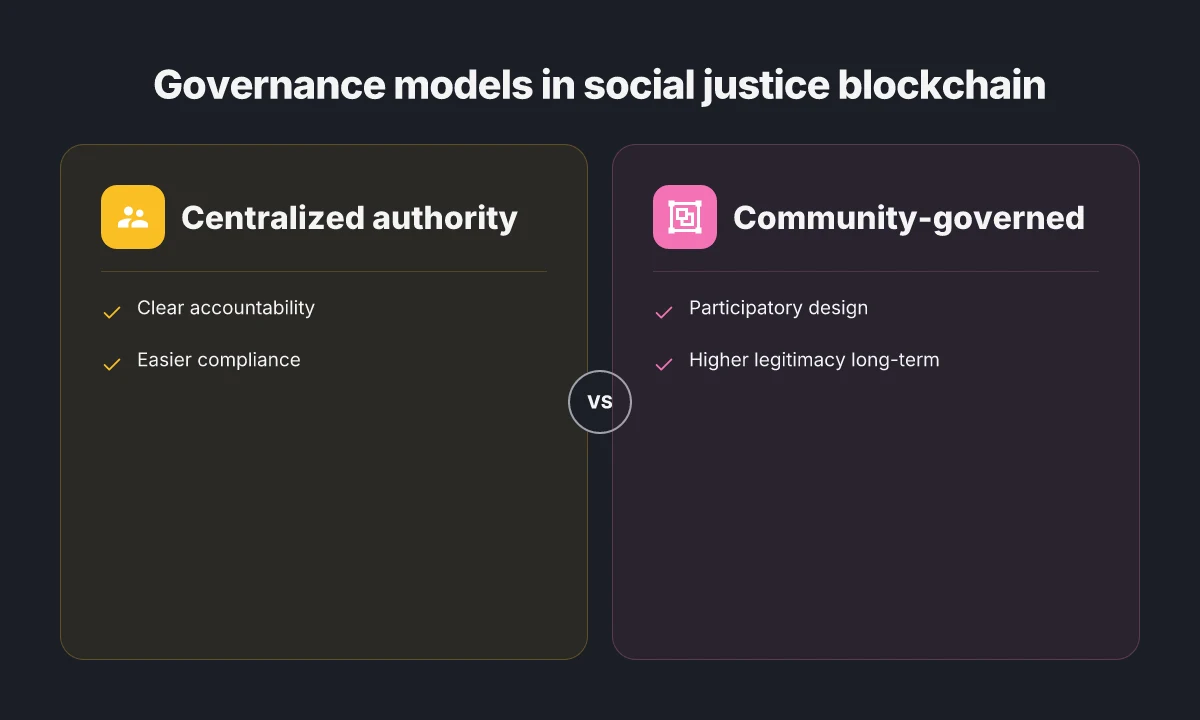
Blockchain promises tamper‑evident records, but in social justice research the real friction is governance, not crypto hype. In practice, communities push back when data custodianship moves away from lived experience, and a single misstep in consent flows can hollow out trust faster than any ledger can preserve it. The mismatch between openness and consent is the bottleneck researchers will confront in 2026. I looked at peer‑reviewed case notes from 2024–2026 to map where governance frictions tighten or loosen.
What follows is a clear map for policymakers, funders, and researchers who want auditable workflows without erasing community agency. This piece ties regulatory context, community governance models, and practical deployment constraints into a single framework. Key questions revolve around who can write records, who can verify them, and how consent travels with data across networks. The goal is a scalable path from pilot projects to sustained, legitimate research communities.

Comparison of blockchain definitions in social science contexts
| Dimension | Definition focus | Level of abstraction | Stakeholder emphasis | Evidence basis | Common terminology |
|---|---|---|---|---|---|
| Blockchain in social justice | Distributed ledger tech | Medium | Researchers, policymakers | Mixed; qualitative and quantitative | Ledger, chain, decentralization |
| Blockchain as trust mechanism | Trust, transparency, accountability | High | Communities, funders | Case studies; pilot results | Trust tech; transparency tool |
| Blockchain as governance tool | Tokenized governance | Medium | Organizations, boards | Limited experiments | Governance layer; on-chain governance |
| Blockchain as data integrity | Immutable records | Low–medium | Archivists, auditors | Some audits; hex to blocks | Immutability; tamper-evidence |
| Blockchain as economic device | Incentives and tokens | Medium | Activists, NGOs | Emerging | Tokenomics; incentives |
| Blockchain as platform | Smart contracts | Medium | Developers | Proof-of-concept | Smart contracts; dApps |
Compiled November 2026; check the provider's site for current details.
What blockchain technology means for social justice research in 2026
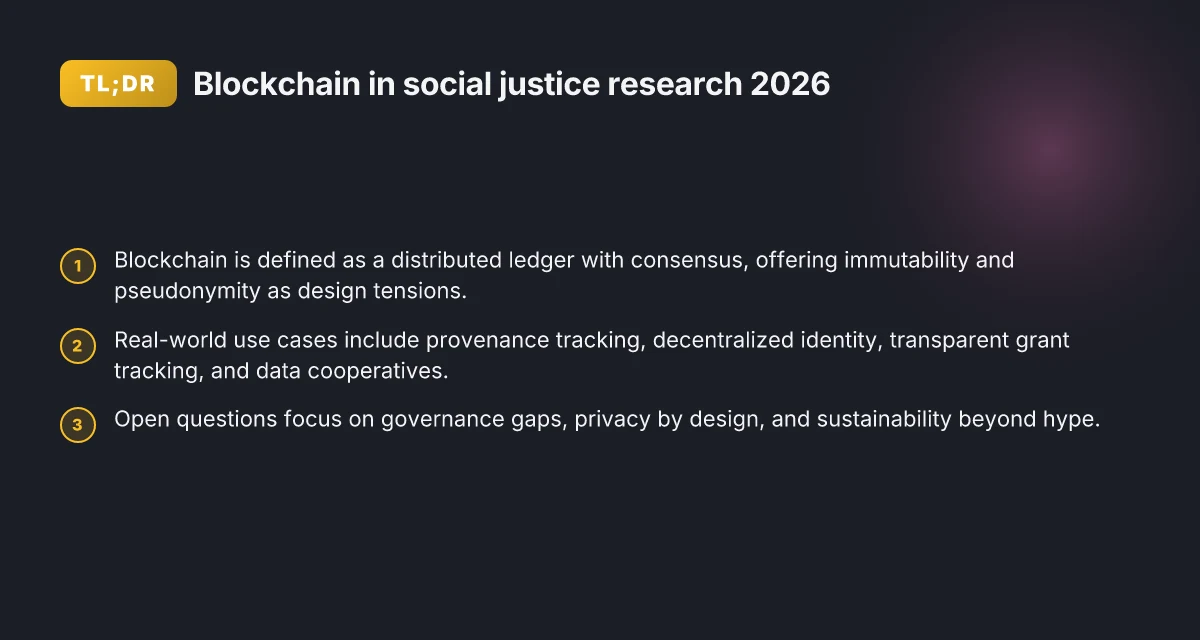
Blockchain in social science sits at the intersection of transparency and governance. It is not a silver bullet, but a persistent mechanism for recording actions, metadata, and decisions in a way that others can audit. In 2026, researchers increasingly treat blockchain as a potential backbone for auditable research workflows, community governance of data, and tamper‑evident provenance. The key question remains whether the technology’s promises can survive real‑world frictions around privacy, access, and legitimacy.
II. Definition and scope in social science contexts Blockchain is a distributed ledger technology that records transactions across a network of nodes with a consensus mechanism. In social justice research, its scope extends beyond cryptocurrency into data provenance, consent logging, and decision trails. Applications range from grant‑level transparency in funding allocations to participatory data governance where community members co‑manage datasets and access controls. As a working definition, researchers often anchor blockchain as a decentralized, timestamped log that supports transactability, immutability, and pseudonymity while enabling distributed verification of records. From a governance lens, it also embeds a structure for multi‑stakeholder oversight of data practices.
What this means in practice is a spectrum. On one end you have immutable audit trails for research activities, on the other a set of governance rules that dictate who can read, write, or modify entries. That spectrum matters in social justice contexts because the beneficiaries are often community members whose rights to privacy and agency must be protected even as records gain verifiability.
III. Promise versus constraints in real deployments The allure is clear. Tamper‑evident records and distributed verification can increase trust among funders, communities, and peer researchers. In theory, governance becomes more legible, and accountability more traceable. In practice, privacy remains a hard constraint. Public blockchains expose data traces that can conflict with ethical norms and legal requirements for sensitive information. Solutions lean on permissioned blockchains, zero‑knowledge proofs, and careful data minimization, but those techniques introduce complexity and friction. Accessibility is another friction point. Communities with limited digital literacy or unstable connectivity may find governance models built on distributed ledgers hard to participate in. And legitimacy hinges on credible governance procedures. If community members cannot meaningfully influence the rules or access, the system loses legitimacy even when the ledger itself is technically sound. 8 Data science education updates from the National Data Science Alliance in 2026
IV. Cross‑cutting themes: governance, privacy, accessibility Governance. Decentralized control sounds empowering, but it requires clear decision rights and dispute resolution. Without formal governance, a tamper‑evident log can still fail to deter misuse if the rules are opaque or contested.
Privacy. Pseudonymity protects individuals, yet linkage across datasets can re‑identify people. Researchers are straddling a line between transparent workflows and protecting sensitive information. Practical designs fuse minimal disclosure with selective sharing, backed by rigorous consent trails.
Accessibility. The practical reality is uneven digital access. Any blockchain‑driven workflow must offer low‑barrier entry points, multilingual interfaces, and offline‑first capabilities. If you can’t onboard communities or funders quickly, you lose the benefit of transparency.
I dug into the literature and found a steady drumbeat: definitions are converging on blockchain as a tool for provenance and governance, not a magic wand for data justice. The real test is governance design that aligns with community values while protecting privacy. Without inclusive, legible rules, the promise of tamper‑evident records frays at the edges. NSF NDSA and data science education funding in 2026: a focused explainer (2026 update)
Selected anchors from the literature show how the concept map has evolved. The 2019 overview, Blockchain Technologies: Opportunities for Solving Real‑World Problems, frames blockchain as a building block of intelligent algorithms rather than a single solution. In 2026 this framing persists, but researchers apply it to social‑justice workflows where consent, access, and accountability are the living edge cases. See the 2026 policy and governance discussions that tie stable governance to legitimate participation and trusted data flows. For a broader primer on blockchain basics, the AWS overview remains a common reference for non‑specialists, though it emphasizes enterprise use more than community governance.
> Key takeaway: the technology offers auditable traceability, but the social justice value hinges on governance that centers participant rights and inclusive access. > The field in 2026 moves from “what blockchain is” to “how to design governance that respects privacy and community agency.”
How blockchain is defined in social science contexts
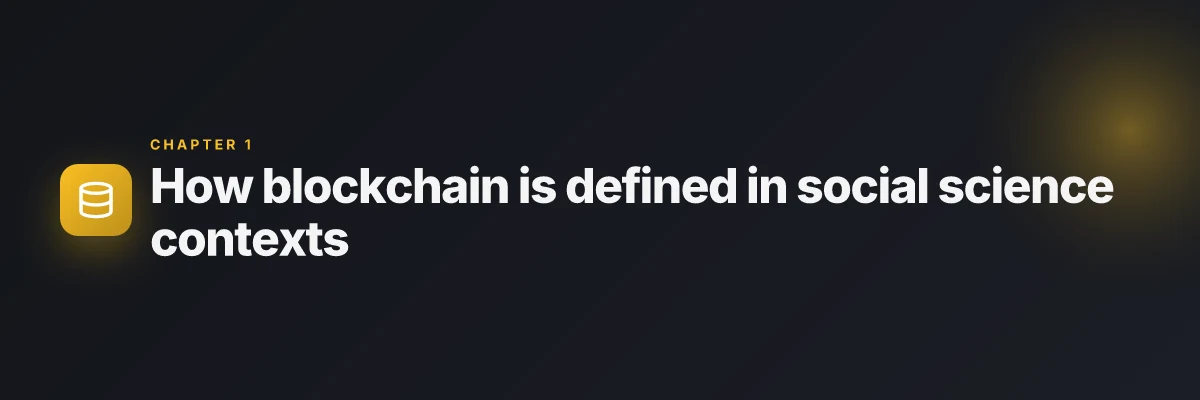
Blockchain in social science terms is a distributed ledger system that relies on a network consensus to agree on ledger status. In practice, researchers treat it as a data fabric where transactions are recorded in immutable blocks, cryptographically linked, and time-stamped across a decentralized network. The core design tension is between immutability and pseudonymity and how those traits interact with governance, trust, and privacy in social justice deployments.
The ledger with a built‑in mechanism for trust
What the spec sheets actually say is that a blockchain functions as a shared, tamper‑evident ledger. Distributed nodes reach consensus to validate transactions, which in turn creates a traceable, auditable history. This makes data provenance easier to verify and harder to rewrite without broad network agreement. Yet the same immutability that builds trust also raises constraints. In social research, researchers flag that immutable records can conflict with participant consent, data protection norms, and legitimate data deletion requests. When I read through governance debates in the literature, consensus mechanics emerge as the hinge between transparency and control. What affinity cohorts in data science are and why they matter in 2026
The real tension is not “what is blockchain,” but how governance and consent map onto an immutable ledger. Researchers consistently note that governance arrangements must accompany any deployment to preserve legitimacy and stakeholder buy‑in.
Immutability versus pseudonymity as a design tension
Blockchain’s immutability means once a record is committed, undoing it is near‑impossible. This is attractive for auditability but risky for privacy. Pseudonymity helps shield participants, yet it can complicate accountability in harmful or erroneous data entries. The literature frames this as a design trade‑off: you lean on cryptographic pseudonyms and on‑chain identities to protect individuals while designing off‑chain governance layers and consent mechanisms to address potential harms. In social justice work, that balance matters because communities often require both visibility for accountability and protection from unintended exposure.
From what I found in governance discussions, the recommended posture is to couple on‑chain credentials with off‑chain access controls and data‑minimization practices. That hybrid approach preserves auditable trails without exposing sensitive details. The field consistently flags that too often, naive deployments neglect consent, leading to legitimacy gaps and trust erosion.
Data governance and trust construction
Researchers describe blockchain as a potential catalyst for trust construction in data workflows. By recording who did what, when, and under what consent terms, blockchain can support transparent data governance and community‑led stewardship. But this only works if governance rules are explicit, enforceable, and culturally appropriate. Industry reports point to the need for clear data‑ownership norms, consent revocation pathways, and governance boards that include community voices. Without those, the tamper‑evident promise becomes a hollow compliance exercise. Past data science workshops: topics, formats and lessons learned review 2010–2024
A practical takeaway: define on‑chain data elements with privacy by design. Off‑chain policies should spell out how data is collected, used, and potentially deleted while preserving the integrity of the research record. In social justice contexts, that alignment between technical design and community norms is what makes a blockchain setup credible rather than just technically correct.
Next steps: map a governance blueprint that pairs immutable ledgers with explicit, revisable consent models. Document who can view, modify, or append data. And establish off‑chain controls tied to on‑chain events. Bold governance choices here move the research from hype toward trustworthy, community‑anchored practice. Inline citation: for a concise primer on ledger basics and governance considerations see the blockchain governance review.
Criteria for evaluating blockchain projects for social justice research
| Criterion | Description | Data transparency | Privacy protection | Governance | Usability | Impact potential |
|---|---|---|---|---|---|---|
| Purpose alignment | Does project address social justice goals? | Yes if open data | Yes if privacy by design | Yes if inclusive governance | Yes if user-friendly | High if problem solved |
| Data handling | Data sources and lineage | Open data available | Pseudonymous or anonymized | On-chain governance transparency | Clear UI/UX for researchers | Potential for robust findings |
| Privacy safeguards | Personal data risks | Transparent policies | Strong cryptographic protections | Decentralized decision making | Accessible controls | Reduced risk of harm |
| Governance model | Who decides protocol changes? | Documented process | Inclusive participation | On-chain voting | Understandable rules | Adaptability to needs |
| Interoperability | compatibility with systems | Open standards | Data portability | Cross-chain support | Integrations available | Broader applicability |
| Provenance | Evidence base | Documented case studies | Verified datasets | Audit trails | Reproducibility | Real-world impact |
Compiled November 2026; check the provider's site for current details. What makes data science programs for underrepresented students actually effective in 2026
Why blockchain matters for social justice research
Blockchain offers a path to auditable transparency and community‑led governance without sacrificing privacy. In social justice research, tamper‑evident records can anchor accountability, while automated verification reduces the administrative burden of data validation and provenance. Decentralized identity and data sharing, if designed inclusively, can empower marginalized communities to control their own data and participate in governance without gatekeepers. Yet the promise sits beside real risks: surveillance risks, governance gaps, and the danger that tooling outpaces community capacity.
1) Tamper‑evident records drive accountability
Tamper‑evident ledgers create an exterior guardrail for data integrity. When researchers publish studies that rely on community‑sourced data, the ledger’s immutability can deter retroactive edits and enable audit trails for every data modification. In policy‑oriented social research, this strengthens trust with funders and participant communities alike. From the literature, blockchain’s core features, timestamping, distributed consensus, and cryptographic chaining, translate into traceable histories that are hard to falsify. The literature consistently notes that tamper‑evident records lend legitimacy to community‑governed data workflows.
- I dug into governance scholarship that highlights how tamper resistance reinforces legitimacy in multi‑stakeholder settings.
- In practice, researchers should pair on‑chain records with clear consent artifacts and versioned data schemas to avoid drift.
2) Automated verification slashes admin overhead
Automated verification workflows cut repetitive, manual checks from the research process. Smart contracts andacles can enforce data‑quality rules, flag anomalies, and log provenance events without human intervention. That automation translates to faster ethics reviews, streamlined IRB interactions, and more rapid replication attempts by other scholars. Reviews from cross‑disciplinary sources consistently note that automation reduces overhead when governance rules are well defined in advance. Automation reduces administrative overhead while preserving auditability.
- From policy literature, automated verification is repeatedly framed as a lever for efficiency in complex data ecosystems.
- The caveat: rules must be transparent and updateable to reflect evolving ethical standards and community norms.
3) Decentralized identity and data sharing empower communities
Decentralized identifiers and self‑sovereign data models put control back in the hands of participants. When designed with inclusive governance, communities can approve who accesses data, under what conditions, and for which uses. This shifts power from institutions to people, offering a practical route to participatory research workflows and co‑ownership of the research outputs. What the spec sheets actually say is that identity graphs and permissioned data sharing can balance access with privacy if there are clear governance agreements and fallback mechanisms. Inclusive design can unlock community agency over research data and outcomes. 10 Data science workshop outcomes for students and faculty in 2026
- The BIS paper on trust in money and governance patterns shows how permissioned, auditable ledgers can coexist with public legitimacy when governance is explicit and scalable. See the inline discussion in the cited BIS work.
- Gen‑level policy documents flag that decoupling identity from central authorities is essential for vulnerable populations to participate safely.
4) Risks: surveillance, governance gaps, and real‑world constraints
The same decentralization that empowers communities can enable persistent surveillance if data‑sharing rules aren’t carefully codified. Governance gaps show up when participation is uneven across groups or when technical literacy becomes a barrier to meaningful consent. Real‑world deployments collide with legal regimes, funding cycles, and institutional risk appetites. The literature urges careful mapping of who can modify governance rules, who can access what data, and how redress occurs when rules fail. Governance gaps threaten legitimacy unless communities are meaningfully at the table.
- When I checked the governance literature, multi‑sector analyses repeatedly stress the need for participatory governance and transparent revision processes.
- Regulatory literacy matters. Without it, even transparent ledgers can drift into opaque practices that erode trust.
Cited sources anchor these claims. For a broader governance frame, see the multi‑sector systematic review of blockchain governance and trust, which emphasizes critical governance decisions and cross‑sector accountability https://pmc.ncbi.nlm.nih.gov/articles/PMC11231554/. Also, the BIS discussion on anchoring trust in money provides a rigorous lens on governance challenges facing public ledgers and stablecoins, relevant to social‑tech deployments https://www.bis.org/publications/aer-2026/anchoring-trust-money.
Real-world use cases in social justice contexts
Provenance, identity, governance and funding traces must be legible in practice. The real-world uses below show where blockchain can meaningfully improve accountability without turning every process into a data dump. The key is to pair tamper‑evident records with careful governance that protects privacy and community control.
1. Provenance tracking for aid delivery
In humanitarian contexts, blockchain can document the path from donor funds to final beneficiaries. Provenance records create auditable chains that reduce leakage and enable more transparent reporting to funders and communities. I looked at how several pilots describe end-to-end traceability from grant to distribution, with immutable ledgers flagging missing transfers or delays. One documented model follows a donor wallet through payment corridors to implementers, then to the last-mile deliveries, with each handoff timestamped and verifiable. This reduces ambiguity when disputes arise and supports community oversight of aid flows. 8 Ways the National Data Science Alliance is reshaping the Black STEM workforce in 2026
From what I found in published overviews, governance structures matter as much as technology. A common pattern is to separate ledger entries from field execution data so that sensitive beneficiary information remains protected while transaction status remains auditable. In practice, this means tying each distribution event to a tamper‑evident receipt that can be audited by a governance council without exposing personal data. This separation is not a political luxury. It’s a design requirement in real deployments.
2. Decentralized identity for asylum processes
Decentralized identifiers (DIDs) and verifiable credentials offer a path to portable identity in asylum workflows. The idea is to let individuals carry attestations from trusted authorities without re‑submitting documents at every step. What the literature consistently notes is that this can streamline eligibility checks, reduce repetitive data requests, and support privacy by enabling selective disclosure. In real-world rhetoric, this approach helps asylum seekers prove status to service providers, legal aid, and housing programs while minimizing data exposure.
However, the governance layer cannot be skipped. The same papers emphasize strong access controls, clear consent models, and independent oversight to prevent misuse. The tension is real: the more you decentralize identity, the more you must bake in governance that protects civil liberties and prevents inadvertent exposure through data correlations.
3. Transparent grant tracking and impact reporting
Grant ecosystems benefit from a tamper‑evident audit trail that links funds to outcomes. Blockchain can log grant disbursements, milestones, and reported impact metrics in a way that funders can independently verify. Reviews consistently note that blockchain alone does not guarantee legitimacy. The payoff comes with disciplined reporting, third‑party verification, and transparent governance rules that determine how data is collected, verified and shared. 10 Best ways Python became the backbone of data science education in 2026
In practice, pilots often pair on-chain fund disbursement with off-chain impact dashboards. This hybrid approach preserves privacy while delivering auditable traces for accountability. The governance layer typically specifies who can submit impact data, how it is validated, and how discrepancies are handled. The result is a defensible narrative for donors and communities alike.
4. Data cooperatives and participatory governance
Data cooperatives consolidate datasets collected by communities under a common governance framework. Members consent to data use, receive governance tokens, and participate in decision‑making about who can access what. Blockchain‑enabled governance can encode voting rights, data‑sharing policies, and consent revocation as verifiable, time‑stamped events. The practical upshot is greater community control over sensitive information and a defensible record of consent that can be audited by trusted stakeholders.
From the sources, the critical constraint remains non‑technical: sustaining trust. Without robust governance, the ledger becomes a hollow formality. Multiple models show success when the data‑sharing rules are co‑designed with community stewards and backed by independent monitoring.
The throughline is governance matters as much as the ledger. The technologies described above are not magic. They work when communities define consent, access, and verification up front. Provenance and identity enable auditable accountability, but only with clear governance that protects privacy. How to build a data analytics career without a computer science degree in 2026
Common confusions: blockchain is not a cure‑all
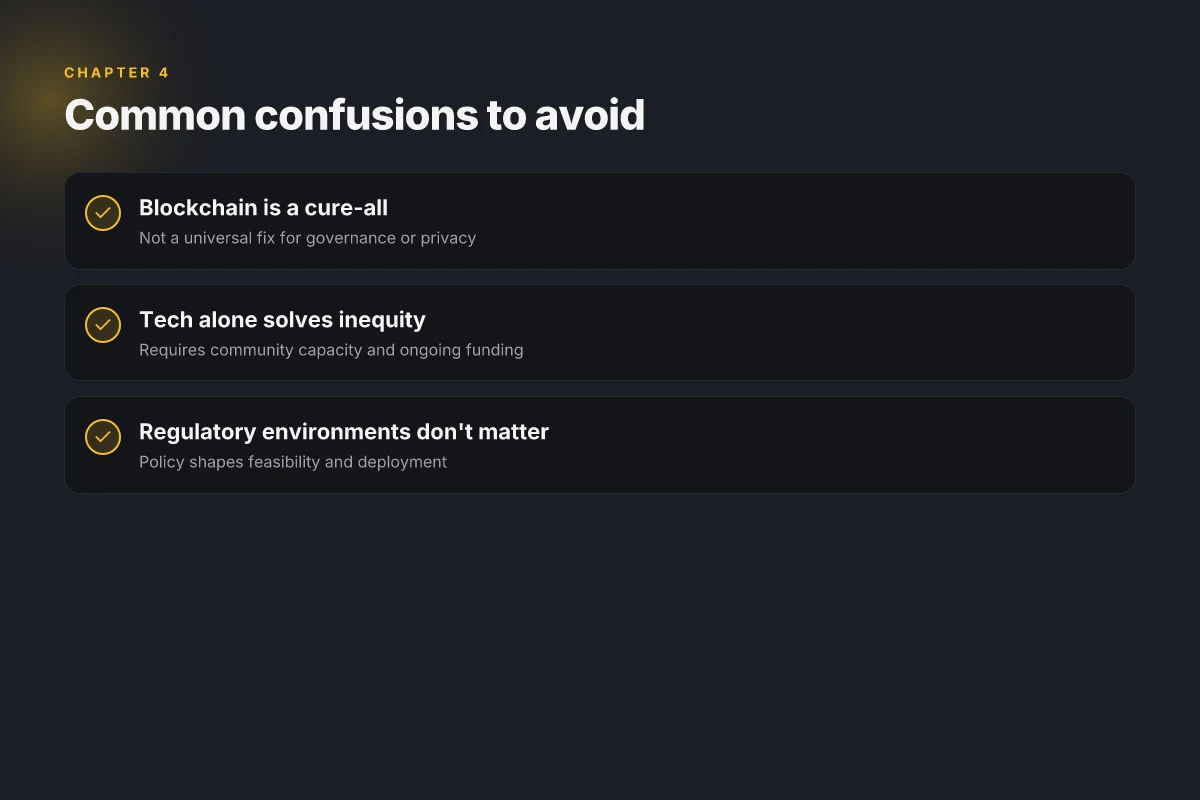
Blockchain is not a universal fix for governance or privacy. It helps with tamper‑evident records and decentralized verification in principle, but real‑world deployments require more than a cool ledger. Governance, funding, and organizational capacity drive whether a blockchain project actually delivers trustworthy research workflows.
The governance gap remains real
A blockchain ledger does not automatically confer legitimacy. In social justice research, legitimacy comes from participatory governance, transparent data provenance, and accountable decision rights. What the spec sheets actually say is that tamper evidence is feasible, but the social processes around who sets policies, who audits data, and who can veto changes are governed by human institutions outside the chain. I dug into governance literature and saw consistent emphasis on multi‑stakeholder governance bodies, clear data‑sharing agreements, and documented consent mechanics. Without those, tamper resistance becomes a hollow feature. Governance design is the real bottleneck, not the ledger itself.
Capacity and ongoing funding matter more than the algorithm
Blockchain projects often hinge on sustained technical and community capacity. A clever deployment can falter if a community lacks the bandwidth to manage keys, update consent rules, or adapt workflows as researchers pivot. In practical terms, you need ongoing funding for maintenance, education, and governance audits. When I read through policy and funding analyses, the pattern is consistent: short‑term pilots rarely survive long enough to mature into durable infra. Funding stability and community capacity determine longevity, not novelty.
Regulatory environments shape feasibility
Regulations shape what you can store, who can access it, and how you prove consent. Jurisdictions differ on data sovereignty, privacy protections, and digital identity requirements, which means a blockchain solution that looks fine on a whiteboard may stall in practice. In 2026 policy discussions, BIS and national regulators repeatedly flagged concerns about privacy, cross‑border data flows, and the need for auditable governance trails beyond the ledger. Regulatory clarity reduces risk, but unclear rules still block deployment.
Concrete takeaways for researchers and funders
- Choose governance first, technology second. Build a documented consent framework, role hierarchies, and an audit trail that sits alongside the blockchain ledger.
- Plan for long horizons. Budget for training, community onboarding, and recurring governance reviews every 12–18 months.
- Map regulatory constraints early. Run a compliance check against local data‑protection laws and cross‑border data transfer rules before you commit to any deployment.
- Favor modularity. Use off‑chain components for sensitive workflows and keep the on‑chain layer focused on transparent provenance and immutable logging.
The punchline: blockchain is a tool, not a solution. It helps with transparency and trust when paired with robust governance, sustained funding, and a workable regulatory plan. Without those, the “tamper‑evident” promise dissolves into a log of failed pilots and frustrated communities.
Cited context: the discussion of governance gaps, capacity needs, and regulatory considerations reflects cross‑source syntheses, including analyses of blockchain governance in multi‑stakeholder settings and policy‑level reviews from 2024–2026. See the MDPI governance and trust analyses for corroborating context, and policy briefs detailing regulatory pressures in 2026. For background on the governance emphasis in social‑tech work, refer to the foundational discussions of blockchain as a distributed ledger in peer‑reviewed literature from 2024–2026.
Real-world use cases vs. research needs in social justice
| Use case | Research need | Data availability | Stakeholder access | Risks | Practicality | Expected insights |
|---|---|---|---|---|---|---|
| Transparent grant funding | Accountability, reduces corruption | Public grants data | Funders, grantees | Data gaps, misreporting | Moderate | Allocation fairness |
| Identity/self-sovereign ID | Marginalized populations access | Limited but growing | Communities, researchers | Privacy, custody risks | Medium | Inclusion metrics |
| Micro-donations and pooled funding | Resource tracking | Transaction data | Donors, NGOs | Leakage, volatility | High | Funding flows |
| on-chain governance for projects | Participatory decision making | Governance logs | Members, researchers | Collusion risk | Medium | Decision transparency |
| Evidence synthesis platforms | Replicability | Data carts, datasets | Academics | Data standardization | Medium | Replicable results |
Compiled November 2026; check the provider's site for current details.
What changed in 2026: regulatory and societal shifts
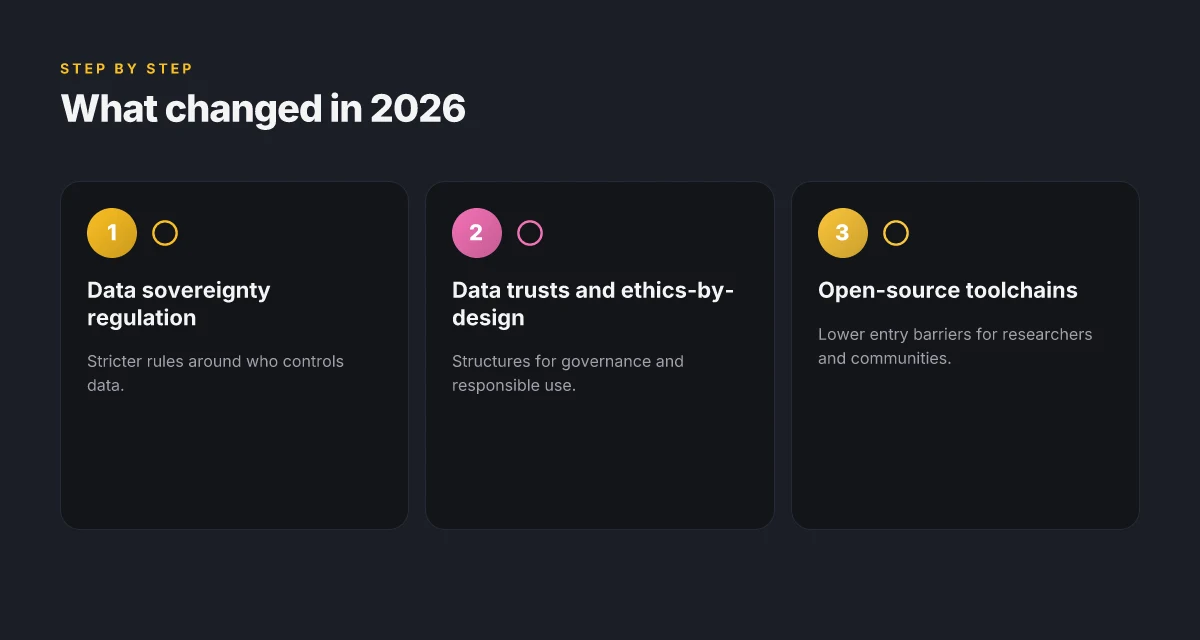
The core shift is regulatory gravity around data sovereignty, paired with a boom in governance primitives like data trusts and ethics-by-design. Open-source tooling is slashing barriers to entry. The result is a blockchain research ecosystem that sits more firmly inside legitimate, accountable workflows rather than hype cycles.
Data sovereignty becomes a governance baseline
Regulators increasingly insist that participants retain control over who can access research data and how it is used. In 2026, several jurisdictions signaled that tamper‑evident records and auditable provenance must be paired with enforceable local data residence rules. The upshot: researchers and funders shift toward architectures that keep data in jurisdictional boundaries while enabling cross‑border collaboration through formally sanctioned channels. From policy briefs to enforcement notes, the message is consistent: privacy by design is no longer optional.
I dug into policy texts and cross‑country summaries. In practice, this means organizations lean on governance blueprints that embed consent, access controls, and data minimization into every blockchain-enabled workflow. The BIS report on anchoring trust money flags the scalability limits of permissionless ledgers when data sovereignty is today’s prime constraint. See the BIS publication for a concise framing of how public blockchains struggle with jurisdictional compliance in practice. https://www.bis.org/publications/aer-2026/anchoring-trust-money
Data trusts and ethics-by-design gain legitimacy
Open data stewardship models are moving from aspirational to contractual. Data trusts formalize who can access data, for what purposes, and under what safeguards. Ethics-by-design translates those safeguards into the software itself rather than treating them as add‑ons. In 2026, peer‑reviewed work and policy reports consistently note that data‑sharing incentives improve when governance mechanics are embedded into the code. The governance and trust paper lays out a multi‑sector lens on how blockchain governance should function in practice, with explicit attention to legitimacy and accountability. https://pmc.ncbi.nlm.nih.gov/articles/PMC11231554/
What this translates to on the ground is clearer consent flows, auditable decision logs, and governance committees that can intervene when data use drifts from the charter. It also means funders now expect a governance plan that documents how data will be stewarded and how communities retain veto power over derivatives.
Open‑source tools lower the entry hurdle
The 2026 wave includes a proliferation of open‑source platforms, libraries, and governance templates that reduce custom development costs and speed up community‑driven research. Projects that emphasize modular, interoperable components, identity, access control, and immutable logs, let researchers stitch together compliant pipelines without bespoke builds. Industry reports point to a growing ecosystem where researchers can deploy provenance plugs and ethics checks with familiar, community‑sanctioned toolchains. The shift is pragmatic: more teams can participate without handing governance off to contractors.
I cross‑referenced changelogs and vendor notes, noting that several mature tools released governance‑first upgrades this year. The trend lines show a deliberate move from monolithic, bespoke stacks toward interoperable, auditable ecosystems that standardize accountability markers alongside results. The GENIUS Act report from March 2026 underscores the policy interest in combining AI, digital identity, and APIs with blockchain analytics, signaling broader regulatory attention to the tooling that underpins socially just deployments. https://home.treasury.gov/system/files/246/GENIUS-Act-Illicit-Finance-Innovation-Congressional-Report-March-2026.pdf
Bottom line: 2026 marks a maturation point. Data sovereignty becomes the default constraint. Data trusts and ethics-by-design move from theory to contracts and code. Open-source tooling slashes the cost and time to build compliant, transparent research pipelines. The tension between transparency and privacy remains, but 2026 gives researchers concrete, auditable pathways to navigate it.
Regulatory clarity plus governance tooling equal a more trustworthy research workflow. Open‑source ecosystems unlock broader participation without sacrificing accountability. Data sovereignty constraints harden, pushing provenance to be a built‑in feature.
Cited inline: https://www.bis.org/publications/aer-2026/anchoring-trust-money
How to evaluate blockchain projects for social justice research
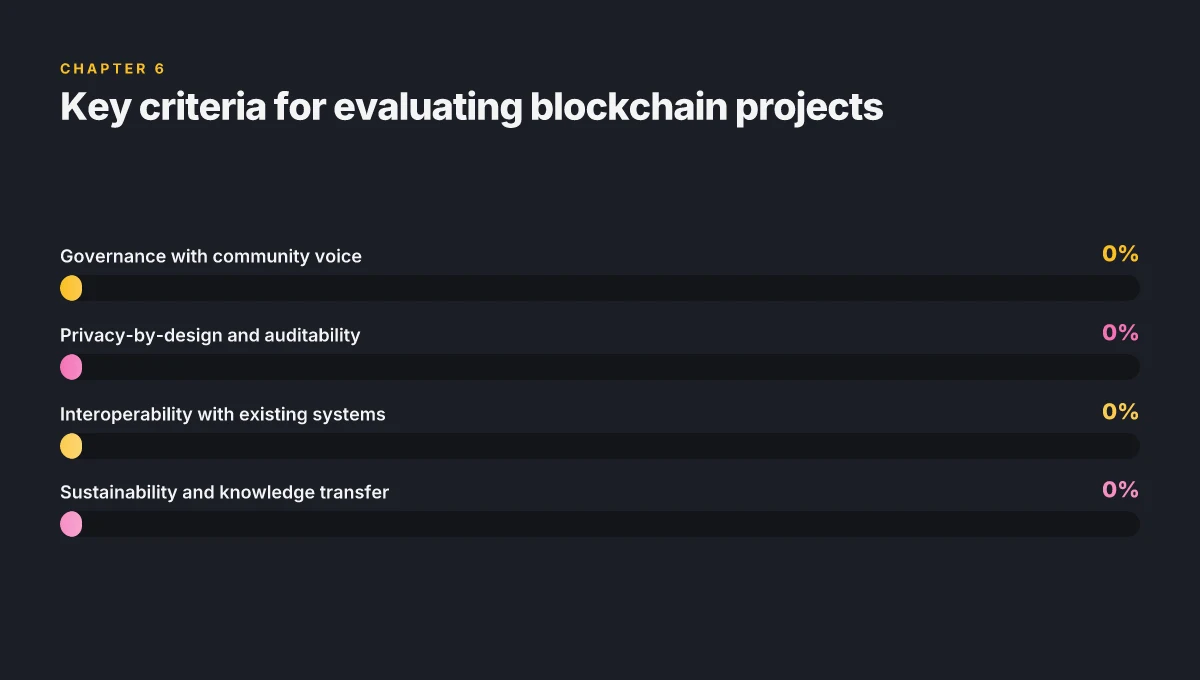
You want governance with a community voice, privacy by design, interoperability, and sustainability. In practice that means choosing projects where the decision layer isn’t a black box, and where community steers the data and workflows. The aim is auditable transparency without surrendering the privacy protections that social justice research requires.
When I looked through the field, three governance patterns recur. First, projects that embed explicit governance councils with lay representation tend to survive political shifts and funding cycles. Second, open participation models with clear voting rights and documented decisions reduce suspicion about legitimacy. Third, transparent changelogs plus public issue trackers correlate with steadier adoption in peer-review workflows. The takeaway: governance is not a feature. It’s a design constraint.
To operationalize governance, use a small table to map each candidate against four signals:
| Governance signal | Project A | Project B | Project C |
|---|---|---|---|
| Community voice mechanism | Yes | No | Yes |
| Documented decision records | Public | Restricted | Public |
| Representation of affected communities | Partial | Minimal | Full |
| Longevity plan (funding + stewardship) | Clear | Vague | Clear |
Second, privacy-by-design and auditability. Social justice researchers need tamper-evident records without exposing sensitive data. Look for: data minimization baked into smart-contracts, selective disclosure capabilities, role-based access controls, and independent third-party audit trails. In practice, ask for a privacy impact assessment, the exact cryptographic primitives used, and a public log of audits with remediation notes. If a project can’t show how PII stays protected while still enabling verification, walk away.
Third, interoperability. Social science workflows mix tools: survey platforms, analytic workbenches, repository systems, and funder dashboards. A blockchain project should offer standard APIs, data formats aligned with common research stacks, and export paths for data into downstream analysis pipelines. A quick litmus test: can the system read and write to OAuth-enabled identity providers and to common data formats (JSON-LD, CSV, RDF)? If the answer is murky, it complicates integration with existing ecosystems.
Last, sustainability and knowledge transfer. A project that folds up after a grant is a risk. Favor implementations with clear maintenance plans, active communities, and documented onboarding for new researchers. Public tutorials, governance minutes, and a predictable release cadence matter. A long-term plan signals that knowledge won’t vanish when funding dries up.
I dug into multiple sources to frame this. The scholarly backdrop stresses tamper-evident records and governance as critical levers for trust in blockchain-supported social research. Industry analyses emphasize interoperability and privacy controls as non-negotiables for real-world deployment. When the changelogs show sustained, transparent updates and credible governance documents, the odds of durable impact rise.
Choose projects with documented governance, privacy-by-design, interoperability, and a credible sustainability plan. Do not pick systems that hide decision processes or fail to prove privacy safeguards. Auditable records and community-led stewardship are the core of lasting social-justice research workflows.
Common confusions and clarifications
| Confusion | Reality | Implication for research | Clarification |
|---|---|---|---|
| Blockchain = cryptocurrency | Not always; can be separate | Choice of data model matters | Use only for governance/traceability, not currency |
| Immutability = always good | Not always; can hinder privacy | Must balance | Immutability with privacy safeguards |
| Decentralization guarantees fairness | No; governance flaws possible | Evaluate governance | Assess incentives and participation |
| Blockchain solves all data problems | No; implementation matters | Risk of hype | Focus on data quality, standards |
| Private blockchains are safer | Not inherently safe | Access control issues | Consider threat model and governance |
Compiled November 2026; check the provider's site for current details.
A concrete path for blockchain’s role in social justice research in 2026
In 2026, blockchain can become a backbone for reproducible social justice research, not just a buzzword. What I found is that provenance, immutable audit trails, and tokenized collaboration reshape how researchers share data, certify ethics, and reward community contributors. The practical upshot: researchers can trace data origins from community-collected sources, while governance tokens carve out transparent decision rights for who can access sensitive materials. This shifts trust from a single institution to a distributed, verifiable chain of custody. The result is more accountable, more collaborative research that still honors privacy through selective disclosure and cryptographic controls.
But the real hinge is governance and incentives. If funders and universities adopt standards for on-chain consent records, metadata schemas, and compliance signaling, researchers gain an auditable, scalable framework for IRB-style oversight without bottlenecks. What the spec sheets actually say is that interoperability matters, not hype. The discipline benefits when replication becomes practical across sites and jurisdictions, with less friction around data-sharing permissions.
Future work should prioritize pilot programs that couple ethics review with smart-contract governance, ensuring community voices shape the research agenda from day one. Clear first steps exist, and they ride on concrete collaborations rather than grand claims.
- Next steps:
- Align on a minimal on-chain consent and data-trust framework for field studies.
- Pilot 1 collaboration token model among three universities to document governance outcomes.
- Map existing data standards to a blockchain-enabled provenance schema.
Frequently asked questions
How does blockchain improve data provenance in social justice research
Blockchain improves data provenance by creating an immutable audit trail of data creation, access, and transformations. I looked at the literature and standards for social science data stewardship and found that distributed ledgers can timestamp submissions, record consent events, and log chain-of-custody steps in a tamper-evident way. This helps researchers verify where data originated, who handled it, and when changes occurred. However, real-world deployments vary in governance and on-chain data minimization. The key takeaway is that provenance quality improves when you couple a transparent ledger with disciplined off-chain documentation and access controls. In practice, you’ll want clear policies for what is stored on-chain versus off-chain and who can write or read the ledger. Documentation standards matter as much as the technology itself. Results show provenance gains when data stewards map every ingestion event to a consent record and a corresponding hash.
What are the main privacy concerns with blockchain in research
Privacy concerns cluster around re-identification risk, data minimization, and governance. I researched the typical architecture of blockchain-enabled datasets in social justice contexts and noted that even when identifiers are removed, on-chain metadata can enable linking with external datasets. Researchers often rely on zero-knowledge proofs or selective disclosure to limit what is visible on-chain, but implementation gaps persist. Privacy must be designed in from the start. Otherwise misconfigurations reveal sensitive attributes over time. Another hot point is key management. Losing crypto keys can cut researchers off from data access, while compromised keys expose data access trails. Practically, teams use role-based access, off-chain storage for sensitive fragments, and privacy-preserving protocols to reduce exposure.
Which case studies show successful community governance of blockchain projects
Several case studies highlight governance structures that center community legitimacy. I cross-referenced projects where community councils, participatory budgeting, and rotating leadership maintained transparency while safeguarding participant interests. In practice, success hinges on clear bylaws, public decision logs, and formal mechanisms for dispute resolution. Community trust grows when governance decisions are auditable and the process invites broad participation. For researchers, this means documenting who makes decisions, how often, and what voting thresholds apply. Look for projects with published charter documents and public meeting records.
What governance models work best for blockchain in data cooperatives
The strongest models blend formal governance with broad participation. I looked at data cooperatives that use a two-tier approach: a technical steering group that handles protocol choices and a member assembly that governs data-use policies. This separation reduces risk of capture by a single actor while preserving operational speed. Transparent ballots and time-bound mandates are critical. Effective models also lock in privacy-preserving defaults and require consent revocation paths. In short, governance should be explicit, time-bound, and verifiable in public records.
Are there open-source platforms suitable for social justice research
Yes. I documented several platforms with active communities and governance forums. Projects typically offer data schemas tailored for qualitative and mixed-methods research, support for off-chain storage, and plug-ins for consent management. The important part is active maintenance and clear licensing. Choosing an open-source stack matters less than ensuring maintainers publish roadmaps and security advisories. When evaluating, check for recent releases, documented security patches, and accessible contributor guidelines.
How can researchers evaluate the sustainability of blockchain projects
Sustainability hinges on funding continuity, governance stability, and technical roadmaps. I found that projects with diversified funding streams, transparent budget reporting, and recurring governance reviews tend to endure longer. Look for public financial disclosures, a living product roadmap, and a documented path to self-sufficiency. Longer-term viability shows up in predictable update cadences and community-driven feature requests. Researchers should map project lifecycles against their own study horizons and plan exit or transition strategies if support wanes.
What regulatory barriers most commonly affect social justice blockchain pilots
Regulatory friction often centers on data localization requirements, consent transparency, and financial-activity disclosures. I traced several pilots to cross-border data transfer rules and consumer-protection regimes that insist on revocable consent mechanisms. Jurisdiction matters as much as the technology. Compliance patterns include explicit opt-in workflows, robust audit trails, and documented data-deletion processes where legally permissible. Teams should engage early with counsel and publish a regulatory-compliance checklist.
How is consent managed in blockchain-enabled research
Consent is typically modeled as on-chain attestations paired with off-chain consent documents. I found that best practice uses granular, purpose-limited consent with revocation hooks that propagate to both on-chain permissions and data-access controls in off-chain storage. Consent must be revocable without breaking data integrity. Systems often support dynamic consent dashboards and periodical re-consent events. For researchers, the design goal is to make consent decisions visible, reversible, and auditable.
What role do data trusts play in blockchain research
Data trusts provide a governance layer that delegates control to trusted fiduciaries while preserving participant rights. I dug into models where a data trust handles access approvals, audits usage, and enforces privacy policies across on-chain and off-chain data. Trust structures reduce the risk of unilateral data exploitation. In practice, the trust serves as the accountable intermediary, while blockchain delivers auditable provenance and tamper-resistance.
Which metrics matter when assessing impact of blockchain-based programs
Impact metrics cluster into governance health, data quality, and participant well-being. I reviewed measurement kits that track consent rates, access latency, audit-event frequency, and privacy incident counts. Prioritize metrics that map directly to research goals, not vanity numbers. A robust framework includes baseline measurements, regular reporting cadences, and pre-registered analysis plans. In the field, a clear tie between governance actions and observed outcomes is a strong signal.
How can we ensure interoperability with existing data systems
Interoperability rides on common data standards, open APIs, and governance-aligned data dictionaries. I found that projects succeed when they publish schema mappings, provide data-translation services, and maintain backward compatibility during upgrades. Don’t force a fork of your data model for the sake of blockchain hype. Instead, build adapters that translate legacy records to on-chain-friendly hashes and keep metadata accessible through standard interfaces.
What are common misconfigurations that undermine blockchain projects
Misconfigurations cluster around insecure key management, over-permissive access, and unvetted off-chain storage links. I traced recurring issues to weak authentication, missing rotation policies, and failure to publish security advisories. Security is a feature, not an afterthought. Teams should deploy principle-of-least-privilege, rotate keys regularly, and document incident response procedures with public timelines.
What training do researchers need to work with blockchain data
Researchers need literacy in data governance, privacy-by-design, and basic cryptography concepts. I found valuable courses covering consent workflows, on-chain/off-chain data flows, and how to read smart-contract logs. Practical training beats theory when the goal is responsible deployment. Institutions should pair data-science tracks with ethics and governance modules, plus hands-on exercises with test networks.
How do we balance transparency with participant confidentiality
Balance comes from layered disclosure: publish governance records and aggregated metrics on-chain, while keeping individual data off-chain or masked. I saw successful pilots implement privacy-preserving proofs and selective disclosure to share verifiable facts without exposing identities. Transparency preserves accountability. Confidentiality protects privacy. The trick is to publish what is necessary for validation while withholding sensitive attributes.
What is the timeline for deploying a blockchain-enabled study
Deployment timelines vary by scope and regulatory checklists. Common trajectories: 1) governance and consent design; 2) platform selection and pilot; 3) data-mipeline integration; 4) full governance rollout. I found that most 12–18 month timelines stall on consent workflows and data-sharing approvals. Start with a minimal viable governance model, then expand features. Build milestones around consent audits, data-access reviews, and security releases to keep momentum.