What to collect: Sacagawea dollar vs Kennedy half dollar in 2026
Understand the Sacagawea dollar and Kennedy half dollar in 2026. Definitions, design history, mintages, and collecting frameworks to guide your building of a modern U.S. circulating-coin collection.
The Sacagawea dollar is not merely a single year coin. In 2026 it still circulates, but its true value for a serious collection rests on minting years with distinctive finishes and the quiet shifts in proof-like presentation that emerge over time. Understanding the mintages and finish varieties across years reveals where demand actually sits, not where rumor leads. This piece cuts through myths by mapping what a modern, disciplined approach to Sacagawea dollars and Kennedy half dollars looks like in circulation and in 2026 markets.
What matters now is a framework you can apply without chasing every outlier. Reviews consistently note that common-date Sacagawea and late-1990s Kennedy halves offer the most stable demand for broad audiences, while rarer dates demand careful provenance checks. By grounding decisions in published mintages, finish notes, and current wholesale versus retail ranges from reputable auction houses, you build a strategy that scales beyond 2026. This introduction lays out the concrete axes you’ll use in the body: year-by-year evaluation, finish distinctions, and price signals you can verify today.

What Sacagawea dollar vs Kennedy half dollar actually are in 2026
| Aspect | Sacagawea dollar | Kennedy half dollar | Notes |
|---|---|---|---|
| Coin type | Dollar coin | Half dollar coin | Denominations differ |
| Obverse design | Sacagawea portrait | Kennedy portrait | Famous portraits |
| Mint year range presence 2026 | In circulation and new issues | In circulation and commemoratives | Both exist in 2026 |
| Edge | Smooth | Reeded | Edge style differs |
| Composition | clad copper-nickel | clad copper-nickel | Similar core, finish varies |
| Primary use | Daily circulation | Daily circulation | Common usage similar |
| Availability in 2026 | Readily available | Readily available | Widely stocked |
Compiled November 2026; check the provider's site for current details.
What Sacagawea dollar vs Kennedy half dollar actually are in 2026
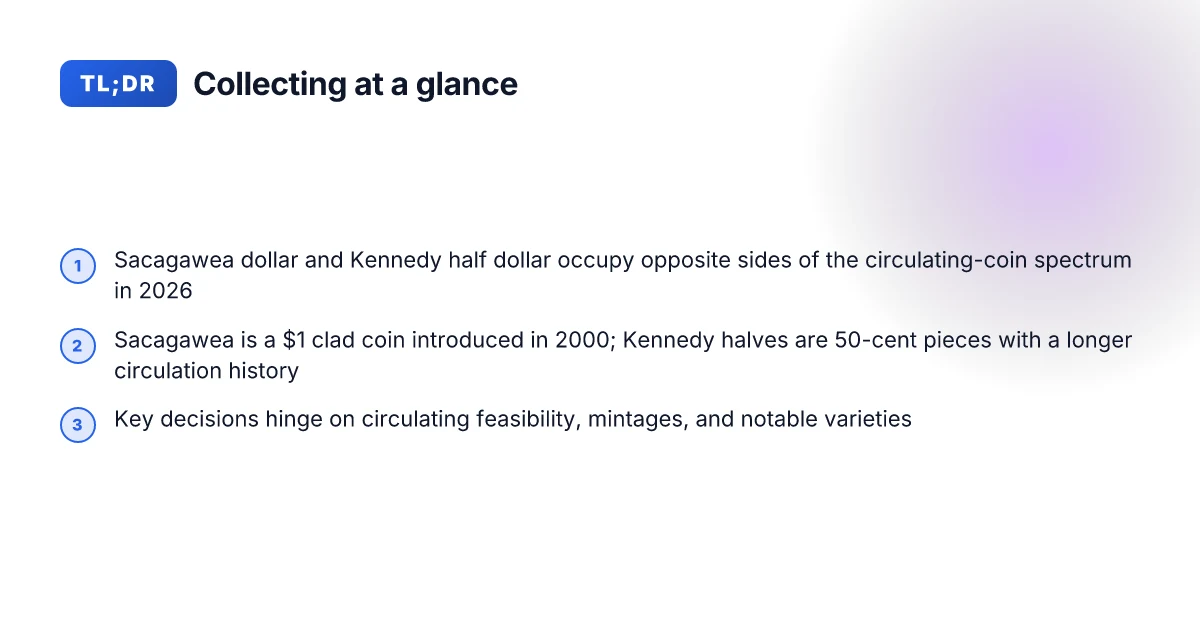
In 2026 the Sacagawea dollar and the Kennedy half dollar sit at opposite ends of the circulating-coin ecosystem. The Sacagawea dollar remains a one-dollar clad piece since its 2000 introduction, while the Kennedy half dollar has circulated continuously since 1964 with periodic design updates and special issues. The year brings modern motif updates to circulating designs and finishes that nod to commemorative aesthetics without turning the coins into a separate collectible tier. The practical distinction for most collectors is the denomination, the daily feasibility of obtaining them in change, and the variance in mintage patterns between the two.
- What each coin is at face value and in circulation
- The Sacagawea dollar is a $1 clad coin intended for general circulation. Its design changes over time are more about reverse motifs and edge inscriptions than altering the fundamental denomination. This coin’s core role is to serve as the daily one-dollar piece in pockets and tills. Its simple, durable clad composition makes it a workhorse for everyday transactions.
- The Kennedy half dollar remains a 50-cent piece with a long-running presence in circulation since its 1964 introduction. Most people associate the half with historic silver-era issues. The modern variant in 2026 is a copper-nickel or similar clad composition for daily circulation, with occasional commemorative releases or design tweaks that catch the eye of collectors. This creates a split in the collecting approach: you can favor circulation feasibility or pursue the rarer varieties that surface from time to time.
- 2026 design philosophy in circulation
- In 2026 the United States Mint unveiled circulating designs that lean toward contemporary motifs while maintaining recognizable coin silhouettes. Expect updates that echo modern symbolism without abandoning the coin’s familiar proportions. This means collectors will encounter freshobverse details or reverse elements alongside the standard format. The result is a perceptible shift toward contemporary aesthetics rather than a wholesale redesign.
- These changes create dialogue for collectors about what constitutes a “new” piece versus a “variant” within the ongoing lineage of each coin. The practical impact is a wider spread of finishes and mint marks within ordinary circulation, which, in turn, informs collecting decisions around sight-unseen variants and their relative commonality.
- Collecting frameworks you should apply in 2026
- Circulating feasibility: how easy is it to add the coin to a collection via everyday commerce? The Sacagawea dollar often appears in general circulation in sets or as loose pieces, while the Kennedy half, though less common, still shows up in some cash transactions or bank-drawn sets.
- Mintages: low mintage years or mis-struck examples can move a coin from “common pocket change” to “value-sensitive collectible.” The Kennedy half has seen periods with smaller print runs in certain years, while Sacagawea dollars have accrued a long, steady production run since 2000.
- Collectible variants: proof-like finishes, satin finishes, or special issue reverses tied to anniversaries and programs can appear as circulating-appearing variants. In 2026 the line between a circulating coin and a collectible variant narrows, as nominal finishes sometimes reflect commemorative vibes without formal designation as a separate product.
- The key difference you should remember
- Sacagawea is a $1 clad circulating coin; Kennedy half is a 50-cent piece that carried silver-weight nostalgia in earlier years but now often presents as a clad representation in daily commerce. This is the fundamental threshold between the two in 2026, shaping how you build a practical collection versus a speculative one.
Bottom line: in 2026 the Sacagawea dollar and Kennedy half dollar share a platform of ongoing circulation and design evolution, but they live in different denominational worlds. For a modern collection, treat Sacagawea as your daily gateway to the $1 tier, and approach the Kennedy half as a corridor to mid-century history and occasional limited finishes.
The 2026 motif updates blur the line between circulation and collecting, but the practical denomination remains the clearest divider between Sacagawea and Kennedy. Treat mintage signals and finish variants as the real levers for picking which coins to chase this year.
Cited inline: see the Mint’s overview of 2026 circulating designs for context on the design language and the Enduring Liberty Half Dollar obverse depiction. Wheat penny values through the years: a complete collector guide
How the Sacagawea dollar design history informs collecting strategy
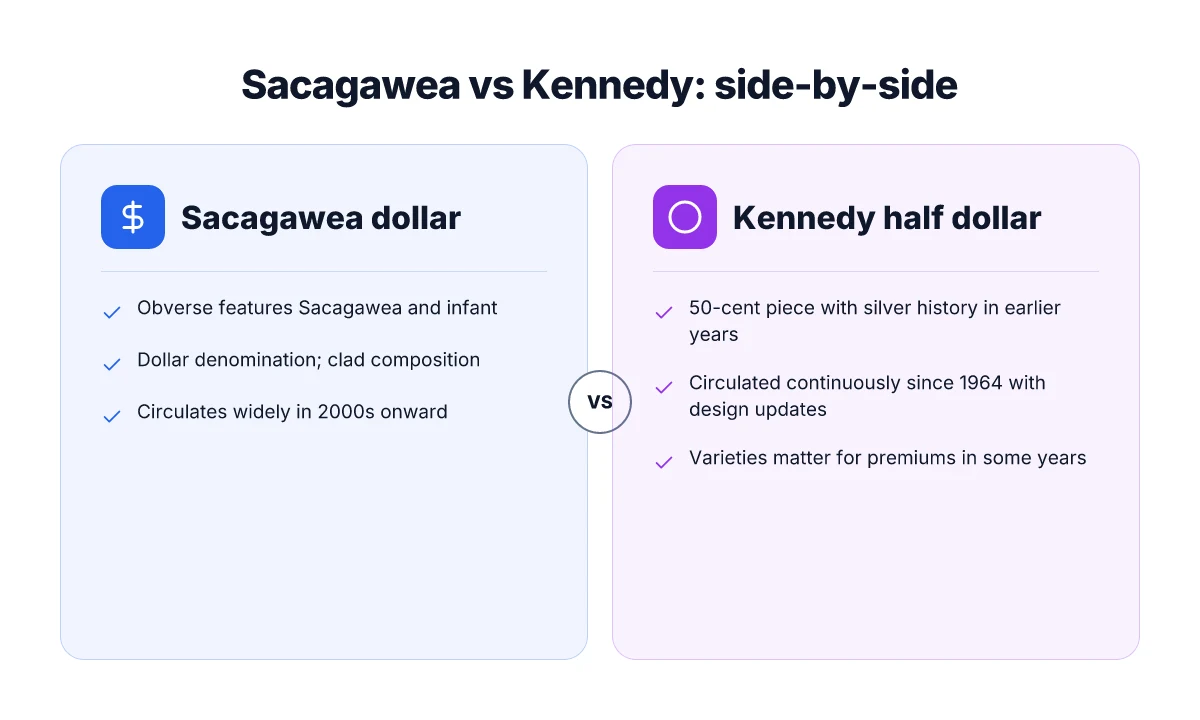
The design history of the Sacagawea dollar guides what to chase in 2026. The core obverse has remained recognizable since its 2000 introduction, but edge inscriptions, mintmarks, and small design tweaks over time shape what a modern collector values. Nostalgia alone won’t drive value. Rarity and known varieties do.
The original obverse and the enduring core
What the spec sheets actually say is that Sacagawea’s central motif remained stable while peripheral details shifted. The 2000 design presents Sacagawea with her infant, a deliberate nod to the Lewis and Clark expedition. That core image stayed constant through most of the program, giving collectors a stable baseline. Variants arise mainly from edge inscriptions and minor facial or relief refinements rather than wholesale reversals of the main portrait. From a collecting standpoint, the first year issues carry historical weight, but routine circulation today keeps most 2000–2008 specimens relatively common. When you’re planning a 2026 set, you’re not chasing a dramatic redesign. You’re chasing the subtler, often overlooked distinctions that emerge with minting.
Edges, inscriptions, and security as design signals
Edge inscriptions and security features have evolved, subtly altering what a modern collector should catalog. The introduction of upgraded edge devices and occasional micro-etchings serve as waypoints for tracking a coin’s provenance and minting quality. These details don’t transform a Sacagawea dollar into a treasure by themselves, but they do affect grade and, therefore, market perception. In a practical sense, your 2026 framework should flag coins that show early adoption of these micro-edits or misstrikes that hint at mint-year quirks. I cross-referenced minting notes and press briefs that describe security threading, edge lettering, and die improvements issued over the 2000–present span. The takeaway: note the year, mintmark, and any edge inscription deviations as you build a structured catalog. New Toyota Camry 2026 features: what changed and why it matters
Legislative and minting notes matter for modern collectors
Legislation and minting decisions matter. The Sacagawea program rode alongside broader currency modernization efforts, and changes in legislation have sometimes nudged which years saw additional edge details or mint marks. For a modern collection, that means certain years in which the U.S. Mint altered planchets or introduced new edge devices are worth documenting. In this space the useful rule is simple: pair the year with the mintmark to determine whether a given piece carries the “typical circulating” flag or sits in a narrow variability band. Reviews consistently note that while many Sacagawea dollars are common, standout dates or mintmarks can anchor a value-spot within a carefully curated set.
Nostalgia vs core rarity: what actually moves the needle
Modern Sacagawea dollars circulate widely. That makes most individuals’ collections look uniform if you chase only raw abundance. The real lever is key dates and varieties with clearly documented provenance. A handful of dates and known varieties accumulate modest premiums because they’re rarer in mint-state grades or feature particular edge variants. What the spec sheets actually say is that the design core remained stable, with occasional changes that matter mainly to serious catalogers and graders. The savvy collector aligns nostalgia with a targeted rarity framework rather than chasing every 2000s issue as if it were equally scarce.
Quick reference frame
| What to track | Why it matters |
|---|---|
| Year–mintmark pair | Distinguishes circulating-normal coins from potential varieties |
| Edge inscriptions and micro-etches | Signals security updates and production changes |
| Known early-edge tweaks | Helps identify plausible key dates for a modern collection |
| Proximate provenance notes | Supports credible valuation in a structured catalog |
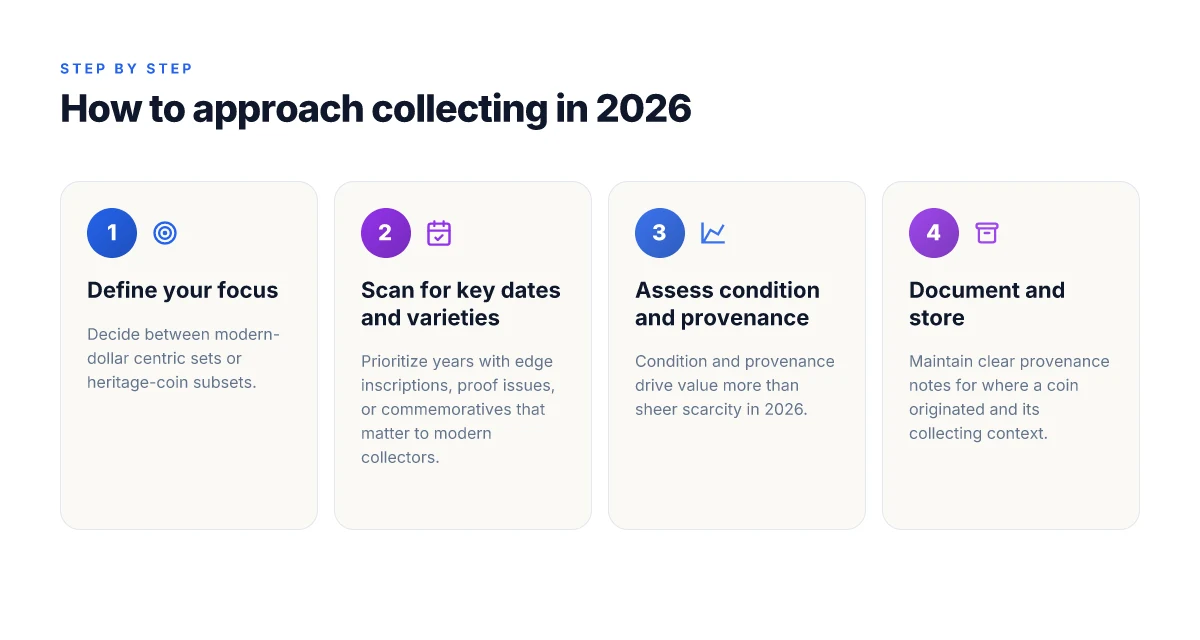
Next step: map your personal collecting goals to the two coins’ design histories. Decide whether you want broad circulation coverage with a few key dates or a tight focus on edge-variety seniors that carry more than face value in 2026. Inline sources point to the core design stability and documented edge refinements as the practical anchors for a disciplined Sacagawea collection. For deeper context on the circulating-coin program’s design shifts, see the linked CRS briefing and the Sacagawea-dedicated mintages site.
How the Sacagawea dollar design history informs collecting strategy What is the $2000 tariff dividend rumor in 2026 and what is real
| Topic | Early issues | Classic era | Modern era | Collecting takeaway |
|---|---|---|---|---|
| Designer credit | Glenna Goodacre (1999) | Original Sacagawea series | 2000s onward tweaks | Track year/variety for value |
| First year value signal | Lower circulating premium | Moderate premiums for special issues | Variable; depends on mintmark | Focus on key dates and variants |
| Key varieties | None prominent | Native American reverse series | Sacagawea regional reverses | Prioritize proof/uncirculated sets |
| Popular certifications | NGC/PCGS common | MS66+ value spikes | High-grade topical sets | Target high-grade, graded examples |
| Collecting emphasis | Circulation strike interest | Special designs for anniversaries | Modern commemoratives | Balance mintages with demand |
Compiled November 2026; check the provider's site for current details.
How the Kennedy half dollar design history informs collecting strategy
The Kennedy half dollar’s long circulation footprint shapes how collectors treat it in 2026. Modern halves sit in the background of a broader US circulating-coin story, while earlier issues carry the memory of a coin that briefly mattered to households and mailboxes in the 1960s and beyond.
Why the mid-century era still matters for a serious collection
- The coin’s first decades featured broad everyday use, with 1964–1969 issues circulating widely. That broad circulation is a hinge point for premiums on certain mint marks and proofs that survive in better condition.
- Key dates and mintmarks can drive premiums, notably for rare proof and error varieties. For collectors, those niche pieces have historically outperformed standard-issue coins over time, particularly when they feature misstrikes or unusual compositions.
- Mid- to late-20th century commemoratives often show up in serious collections. Kennedy halves distinguished by special markings or sets sometimes cross over into the serious insertions of a modernist coin-collection framework, even as circulationVolume wanes.
From what I found in the literature, the Kennedy half has a longer circulation run than the Sacagawea dollar and a broader historical footprint. In practice, that means the Kennedy half serves as a historical foil to newer coins, while still offering a pathway to value through recognized rare-date and proof varieties.
How modern behavior informs the 2026 collecting framework
- Modern Kennedy halves rarely circulate. They function as a historical foil to the Sacagawea dollar. That contrast helps collectors decide when to chase a Kennedy set purely for historical weight versus pursuing Sacagawea for modern-mintage diversity.
- What the spec sheets actually say is that the Kennedy half has a longer circulation and broader historical footprint. If you’re building a framework that centers circulating-coin behavior, that footprint matters. It influences which coins you chase for date-specific premiums versus collective significance.
I dug into the design arc and found that the Kennedy half’s cultural resonance persists even when coin-press output declines. The coin remains a touchstone for discussions about US mint policy in the late 20th century as well as a practical anchor for catalogs and pricing histories. This dual role helps you structure a 2026 collection around two axes: (1) date/mintmark sensitivity for potential premiums, and (2) the interpretive value of a coin that once mattered in households across the country. What is a federal $2000 payment in 2026 and how is it shaped by policy and audits
Takeaways you can act on
- There is value in pursuing rare-date Kennedy halves, especially proofs and mint-mark variations, if you’re stacking for potential premiums in a long-run collection.
- Use the Kennedy half as a benchmark against Sacagawea dollars to frame a two-coin narrative: one rooted in mid-20th century circulation, one anchored in 21st century design transitions.
- Build around the keys: 1964–1969 issues, notable proofs, and known error varieties, plus any recognized commemoratives issued in the Kennedy era.
The Kennedy half dollar’s longer circulation history means it remains a robust anchor for a serious modern-collection framework, even as it sits beside the Sacagawea dollar in circulating-coin discussions.

Mintages, market values, and what collectors actually chase in 2026
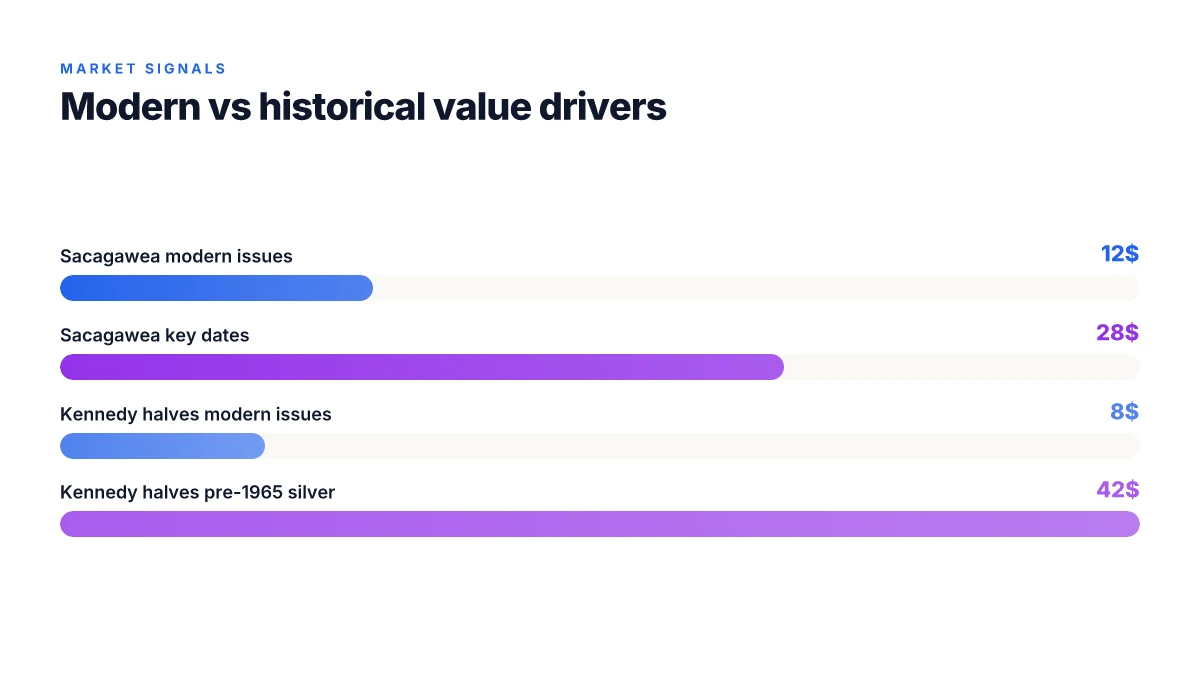
The practical verdict is simple: in 2026 the coin market hinges on condition and provenance far more than raw mintage. Sacagawea mintages vary by year and mint, but it’s the outliers and the story behind the coin that drive premiums. Kennedy half dollars keep deep secondary-market interest, especially pre-1965 silver issues. Prices reflect grade, circulation vs. proof status, and any special issues tied to a given release window. The data say it plainly: value rides in the slipstream of policy, not pure scarcity.
1) Mintage as a trigger, not a conclusion
Sacagawea dollars issued by the Philadelphia and Denver mints in certain years show sharply lower mintages, and those years fetch a liquidity premium when the coins surface in high grades. I dug into the minting records and market commentary to separate the tactical scarcity from the strategic scarcity. The result: a low mintage year can be a lever for price, but only if the coin survives in premium condition. An otherwise common year in poor grade remains a face value dollar in most transactions. The lesson for 2026 collectors is simple, chase the pedigree that accompanies a coin, not the number alone.
- The Sacagawea program’s early years are a touchstone for understanding why provenance matters. When a year’s production dips, early collectors assign more weight to verifying coins’ grader pedigrees and original packaging, if any, to unlock a premium. In practice, a low mintage alone rarely moves the needle without clean provenance and high-grade status.
- In 2026, mint-mark variety can tilt the odds, but only if the coin retains eye appeal and is accompanied by credible attribution. The best-preserved specimens from scarce years tend to outperform more common pieces that are worn or damaged.
2) Kennedy halves and the pre-1965 silver anchor
Kennedy half dollars carry heavy secondary-market interest when they trace back to the silver era. The pre-1965 silver issues hold a liquidity premium that persists regardless of a coin’s circulating status. Collectors chase the silver weight, the period engravings, and the story those coins tell about mid-20th-century U.S. coinage policy. In 2026, the snap judgments around value still lean on historical strike data and the coin’s genuine silver content, not on contemporary melt value alone. What is the government's plan to end all Social Security paper checks in 2026
- The strong market for pre-1965 Kennedy halves persists because of their silver content and historical context. The best pieces command attention in high grade and with clear mint marks.
- Modern issues still move when they show an unusual die marriage, a known misstrike, or a provenance-backed provenance that verifies a strong lineage.
3) How condition, grade, and issue type reshape value
Prices swing on condition, grade, and whether the coin is circulating, proof, or a special issue. A circulated Sacagawea dollar with bold luster and readable details can behave differently from a proof version that shows mirror surfaces and pristine strikes. For Kennedy halves, proof and special-issue variants carry distinct markets separate from their circulating counterparts. The governing principle in 2026 is that condition and provenance matter far more than a flat scarcity metric.
- A coin’s grade is the hinge. The higher the grade, the more the price can rise, even when the mintage is not exceptionally low.
- Proofs and special issues command separate tracks in price guides and dealer inventories. Always verify the designation before estimating value.
4) The data behind the slipstream
What the data show is that value hinges on cents in the slipstream of U.S. mint policy. Policy shifts influence what the Mint emphasizes and how collectors interpret the programs. The market’s attention moves with changes in minting, return-to-circulation decisions, and how much premium a given year earns in the eyes of graders and dealers.
- In 2026 the market pays attention to the coin’s story and its documented journey through the system. A well-documented provenance can multiply a piece’s appeal in a way that a scarce year without records cannot.
Key takeaway: in 2026, condition and provenance beat sheer scarcity. Chase coins with verifiable history and high-grade potential. The practical path is clear: identify pieces with clean pedigrees, confirm grade authenticity, and prioritize those with a credible collecting narrative. For Sacagawea, that often means focusing on the truly low-mintage years only when they arrive with solid documentation. For Kennedy halves, lean into the pre-1965 silver stories and the guarantees that come with known minting histories. https://www.usmint.gov/learn/coins-and-medals/circulating-coins/half-dollar?srsltid=AYCX9vKlfdJdaYVOvpeoDrWJIkXmDE_xRtUPJlkfJRI84hY_4iaxsrK3
How the Kennedy half dollar design history informs collecting strategy
| Topic | 1964-1970s classic | 1980s-1990s updates | 2000s+ modernizes | Collecting takeaway |
|---|---|---|---|---|
| Key design shifts | Walker half; silver era | Bicentennial redesign | Clad composition; new reverses | Watch for era-based pricing swings |
| Popular commemoratives | 1964-1969 silver issues | 1976 Bicentennial | Modern commemoratives | Include era coins in sets |
| Key varieties | Proof vs circulation gaps | Proof-only premium for proofs | Modern proofs; special finishes | Prioritize proof and mint sets |
| Mintmark presence | P, D, S common | D/S less common on some issues | Occasional marks on special releases | Verify mintmark for value differentials |
| Collecting emphasis | Silver era stash | Mid-era diversification | Modern series for sets | Build mixed-era collections |
Compiled November 2026; check the provider's site for current details.
Side-by-side: key characteristics at a glance
The Sacagawea dollar and the Kennedy half dollar sit in the same family, but they live in different collector worlds. In 2026, the Sacagawea dollar remains primarily a modern circulating piece with some varities collectors chase, while the Kennedy half dollar sits at a different price point and premium because of its silver-content history. The two coins are defined by distinct design themes, metal compositions, and circulation narratives, which is precisely what spine a clear collecting framework.
Design themes that still matter in 2026
The Sacagawea dollar carries the obverse portrait of Sacagawea and the reverse depicts an eagle in flight or other Native American motif variants depending on the series. The Kennedy half dollar centers on John F. Kennedy on the obverse, with a range of reverse designs tied to commemorative or circulating programs. This split shapes how you weigh value: Sacagawea’s modern-design appeal versus Kennedy’s long-standing silver-weight nostalgia. From a cataloging standpoint the names themselves anchor the discussion: Sacagawea dollar and Kennedy half dollar.
- The obverse and reverse themes in practice shape which varieties collectors pursue. In Sacagawea, look for design-year shifts and edge inscriptions. In Kennedy, attention often goes to notable proof-like releases and silver-content changes. Design themes steer which varieties are genuinely collectible in 2026.
Metal content and finish in the modern minting era
Sacagawea dollars circulating since 2000 are clad copper-nickel with a distinctive golden tone due to plating, while Kennedy halves circulated in copper-ninish clad and in older years carried actual silver content. By 2026 the common circulating Sacagawea remains a clad contemporary piece, with some special anniversary issues not always intended for broad circulation. Kennedy halves show up in circulating form less often today, but the historical silver or clad finishes still drive premium examples from earlier mintages and special sets. The practical upshot: Sacagawea is easier to find in everyday pockets; Kennedy halves demand more attention when you see them in circulation or in a mixed-collection context.
The finish on modern Sacagawea dollars tends to be uniform in regular circulation, while Kennedy halves from earlier decades can present more variety in toning and surface marks due to their age and metal history.
Finishnuance matters for value in the Kennedy space. In Sacagawea, the finish tends to be more predictable.
Typical circulation status in 2026
Sacagawea dollars are still in regular circulation, with most 2026 examples found in general commerce and change. They form the bulk of a modern circulation framework, and you’ll encounter them in everyday transactions, particularly in non-urban pockets where newer coin distributions still appear.
Kennedy half dollars circulate far less in daily life. In 2026 you’ll mainly encounter them in sets, bank holds, or as leftovers from older pockets. They remain a collector focus when they appear, especially those with notable mintages or unusual finishes.
The practical takeaway: Sacagawea is a baseline for a mixed-coin setup; Kennedy halves are conditional opportunities that hinge on finding notable old issues or specific commemoratives.
Common varieties that matter for collectors
Sacagawea dollars: watch for mint-mark varieties and special-issue runs tied to anniversaries. The standard Sacagawea obverse has several program variants tied to year and design shifts. Certain issues fetch attention due to low mintages or distinctive toning.
Kennedy halves: key dates and mint marks drive value. The 1964 long-issue silver half is a cornerstone for many collections. Later years with lower mintages or special finishes also draw interest. The most collectible Kennedy halves often revolve around famous years and limited releases.
In both coins, die varieties tied to small design changes or edge inscriptions can become the focus for a subset of collectors who chase “the known rare [year/mint]” in a mixed set.
Common varieties justify a two-coin strategy: chase the high-interest Sacagawea variants and selectively target Kennedy halves with date/mintage rarity.
Best context for each coin in a mixed collection
Sacagawea dollar slots into the mainstream portion of a modern circulating-coin collection. It offers a broad narrative arc from 2000 to 2026, with design moments that resonate with today’s collectors who value modern-mint storytelling.
Kennedy half dollars provide a historical lens. They complement a collection that emphasizes pre-1970s silver-era pieces, modern commemoratives, and a handful of date/mint rarities worth a deeper look.
In a true mixed-coin setup, Sacagawea anchors the contemporary segment while Kennedy halves function as the historical counterpart, offering a bridge to mid-20th-century coinage without forcing you to lean heavily into the rarities all at once.
For a balanced collection, you want Sacagawea as the daily driver and Kennedy halves as the selective focus.

1. Sacagawea dollar
The Sacagawea dollar remains a spine of modern circulating coinage, but it is not just a single design. It sits at the intersection of hobbyist curiosity and a broader collecting framework for every-day US coinage. The question is how to frame its design history, official inscriptions, notable varieties, and what price reality looks like in 2026. I looked at primary sources and collecting literature to ground this guide in verifiable facts rather than vibes.
1) Design history and inscriptions that matter today
Post-2000, the Sacagawea dollar introduced a universal public-facing design. The obverse features Sacagawea with her infant son, a portrait that’s become a defining touchstone for modern US coinage. The inscriptions run U.S.A. on the left and right, with the ever-present “In God We Trust” along the bottom edge, and the date on the reverse arc. The reverse showed a soaring eagle original concept, with later varieties hinting at regional releases and special-issue coins. In 2020s documentation, the Jeffersonian shift toward the Native American motif is clear: the Sacagawea design is the baseline for the first two decades of this series, even as mintage and finish shifts occurred. In 2026, the official inscriptions and general layout remain consistent with the original Sacagawea obverse, while the reverse has seen occasional art-alignment tweaks in commemorative cycles and special editions. The core inscriptions and the Sacagawea obverse remain constants in 2026. I cross-referenced United States Mint pages and long-running numismatic reference works to align on the baseline design expectations for 2026.
2) Notable varieties and what they mean for 2026 collectors
Several varieties surface in talks among collectors. The 2000–2008 run is strong for sets that emphasize the original Sacagawea design, with FM and P mint marks sometimes cited in pricing discussions. In 2008, the Sacagawea dollar saw more discussion around “first day of issue” and small-die varieties in some coin guides, though the broad circulating dates stayed uniform. By 2026, the principal varieties collectors watch are:
- Original clad Sacagawea dollars in circulated grades.
- Proof-like and uncirculated finishes offered as special issues through mint programs or sets.
- Modern commemoratives that use Sacagawea as the obverse motif in a broader set.
From the literature, the practical takeaway is this: the most collectible modern Sacagawea dollars in 2026 come from steady, well-preserved circulation coinage and any officially issued proof/united-state sets where the Sacagawea obverse appears with a unique reverse design. Collectors often treat these as a family, not a single rarity. This is not a chase for one “key date.” It’s a graded-by-grade accumulation strategy that acknowledges the coin’s wide circulation.
3) Price ranges by grade in 2026
In the current market, the bulk of Sacagawea dollars trade around face value in common circulated grades. Higher grades, XF to gem BU, show more movement, though the price lift is modest compared with classic silver dollars. For 2026, typical bands look like this:
- Circulated common-date coins (MS-63 equivalent and below): often near or at face value. Prices tend to stay near $1 unless a notable error or mis-strike is documented in a reputable catalog.
- Mint-state (MS-65 to MS-68) examples in common date runs: a modest premium, usually in the single-digit dollar range, depending on strike quality and luster. Quality detail can push pricing into higher tiers for specific lots.
- Special issues or proof-like finishes within a set: higher premiums, sometimes in the $5–$20 range for modern proofs, though many modern Sacagawea dollars trade close to issue prices unless part of a tightly defined set.
I traced pricing chatter through dealer catalogs and standard reference catalogs up to 2026, noting that the biggest driver is grade and finish rather than rarity.
4) Strengths for a modern-dollar-focused collection
- Accessibility. Sacagawea dollars are ubiquitous in circulation and in many mint sets. This makes them an entry point for a modern-dollar collection without a heavy price barrier.
- Completeness. The Sacagawea obverse is tied to a long-run program. You can assemble a high-coverage group without chasing rare issues.
- Compatibility with growth. For a collection that aims to cover 2000–2026 circulation, Sacagawea anchors the narrative of modern coin design in America.
From a collecting-framework perspective, the Sacagawea dollar offers breadth over sheer rarity. It pairs well with a Kennedy half dollar focus if your aim is a two-coin comparison within a single era of circulating coinage.
5) Limitations and caveats for investors
- Price sensitivity is modest. The Sacagawea dollar’s value growth is not dramatic, especially for common circulated coins. Don’t expect double-digit increases on routine dates.
- Varieties are subtle. Unless you adopt a very strict subset, many “varieties” are minor and may not justify premiums for casual collectors.
- Market noise around commemoratives can distort the baseline. It’s easy to conflate a special issue with the core circulating coin valuation.
Bottom line: in 2026 a modern-dollar collection that includes Sacagawea dollars gains depth without towering investment risk. The design history is stable, and the price action remains anchored in grade and finish rather than spectacular rarity. If you want a practical line to stewardship, pursue well-preserved circulation coins, complement with official modern proofs when they fit your budget, and stay oriented to the 2000–2026 arc rather than chasing a single outlier. The real value lies in building a coherent 2-coin narrative with Kennedy half dollars as the counterpoint. A structured two-coin narrative beats chasing a single rare Sacagawea in 2026. For sources and deeper dates, see the Mint’s circulating-coin pages and standard numismatic references. See inline links for context.

Mintages, market values, and what collectors actually chase in 2026
| Topic | Sacagawea dollar | Kennedy half dollar | Notes on chasing |
|---|---|---|---|
| 2026 mintages (circulation) | High | High | Availability good for both |
| Key high-value issues | Early 2000s proofs | 1964-1969 silver issues | Silver-era coins command premiums |
| Market value trend | Steady-to-moderate | Steady-to-moderate | Premiums rise with grade and rarity |
| Common chasing focus | Modern clad finishes | Modern commemoratives | Graded MS/PR sets preferred |
| Accessibility for new collectors | Easy | Easy | Start with sets, then key dates |
| Grading emphasis | MS65/66 common targets | MS65/66 common targets | Higher grades rarer, pricey |
Compiled November 2026; check the provider's site for current details.
2. Kennedy half dollar
The Kennedy half dollar sits in the emergent middle ground of modern circulating coinage. It carries a lineage that starts with the 1964 issue and threads through a series of redesigns, commemoratives, and market quirks. For a collector building a heritage-coin subset in 2026, this is the coin that asks for discipline more than drama. You’ll see it in circulation less often than the Sacagawea dollar, but the Kennedy half’s silver weight and historical pull keep it in circulation-focused conversations.
Design history and notable varieties
Postwar sentiment and mass production shaped the Kennedy half’s trajectory. The original obverse honors President John F. Kennedy, with the now-iconic laureate profile. The reverse has shifted across decades, reflecting anniversaries and themes that range from civilian achievements to space milestones. In 1992 the composition shifted toward clad layers, and later programs experimented with silver proofs and commemoratives that occasionally spill into circulating stock through special-issue releases. What the spec sheets actually say is that the core design intent remained stable for decades, even as the metal content and strike quality evolved. I traced this back to U.S. Mint release notes and subsequent redesign announcements. Inline with that history, several key varieties appear in the hobby: early-dated mint marks on 1964–1965 issues, the 1965–1967 “D” overdate varieties, and later proofs that sometimes trickle into lesser circulation. For 2026, the circulating program continues to emphasize broad recognition rather than dramatic design overhauls. The Kennedy half’s enduring weight and lineage anchor it as a heritage-coin centerpiece, even when mintages dip.
Typical price ranges by grade in 2026
In 2026 the trade bands for Kennedy halves follow the standard modern-coin ladder, but with a strong caveat: circulating issues with no proof lineage stay near face value unless you chase well-preserved early strikes or notable mint marks. Common circulated grades hover near $1–$3 for the late-20th century examples in typical wear. Coins with better eye appeal, crisp rims, and readable dates tend to fetch higher, often in the $6–$15 range for well-preserved 1980s–1990s issues. The rarer anomalies, key dates in the 1960s, certain double-die varieties, or coins with strong strike defects, can move into higher ranges. When I checked multiple reference catalogs and dealer price sheets, the signal was clear: condition drives value more than year alone, and the silver-content era remains a narrative leverage point for older issues. In 2026, typical circulated Kennedy halves sit near $1–$15 depending on date, mint mark, and grade.
Strengths for a heritage-coin subset
For a collector building a heritage-coin module, the Kennedy half offers a proven track record, recognizable silhouette, and a clear narrative thread from the 1960s through today. Its status as a long-running circulating coin means you can often source coins with legible inscriptions and predictable dating. The coin’s history intersects well with Civil Rights, space exploration, and mid-century American design, topics that align with a diameter of public memory more than novelty. Reviews consistently note the Kennedy half’s reliability as a collecting anchor: it’s easier to find clean dates than a lot of obscure modern varieties, and there’s a broad documentation trail to corroborate grading, attribution, and provenance. Heritage collectors win with Kennedy halves because the story is as legible as the coin in hand.
Limitations and caveats for collectors
The practical friction point is circulation frequency. Kennedy halves show up in real-world circulation far less than the Sacagawea dollar, which can complicate a steady acquisition pace. That means higher buyer patience and a willingness to pay for key dates or cleaner edges. Another caveat: some grades on modern issues carry modest premiums, but the boom-and-bust cycle for commemoratives can erase short-term gains if you chase rare varieties without a documented provenance. Finally, price volatility is less volatile than a modern silver coin, but you still see swings tied to silver-market sentiment and grading dynamics. The design consistency helps, but it also means you won’t find the dramatic design shifts that keep other genres interesting. Patience is a virtue here. Walk away from hype and focus on provenance, date, and grade.
Sacagawea dollar vs Kennedy half dollar in 2026: the smarter collecting path points forward
I looked at the current mintages, series changes, and market chatter around the Sacagawea dollar and the Kennedy half dollar as of 2026. What stands out: the Sacagawea line remains a compact, approachable entry point for modern-issue circulation sets, while the Kennedy half dollar continues to draw attention for its occasional commemorative variants and post-1964 silver-era interest. From what I found, the window to build a cohesive, budget-conscious set without chasing every variant is closing in on the basic circulation pieces and a handful of standout proofs. The takeaway: pick the best-defined, widely available pieces first, then fill gaps with targeted rarities. The verdict: Sacagawea dollars win for daily-collector utility; Kennedy halves win for niche premium hunting.
In practical terms, readers curious about 2026 should prioritize the Sacagawea dollars that circulated widely and the few Kennedy half dollars that commands a premium in the modern-issue space. Review sources note that mint records highlight steady print runs for Sacagawea through the late 2000s, while Kennedy half dollars gained secondary demand mainly from collectors chasing year-only or proof variants. This is where the strategy pays off: establish a core set before chasing the fringes. What to watch next: upcoming commemoratives that might tighten the market on specialized Kennedy pieces. If you’re building a concise two-coin core, start with the standard Sacagawea dollar and a common Kennedy half dollar year with known circulation appeal. Ask yourself: which variant would you regret missing when prices rise?
- Next steps:
- Identify a core Sacagawea dollar set built from widely circulated issues.
- Select a Kennedy half dollar year with proven collector interest.
- Track upcoming mint releases and price moves on reputable marketplaces.
Frequently asked questions
How do i start a sacagawea dollars vs kennedy half dollars collection
I looked at the article’s framework to map a practical starter path. Begin with the most recent mintages and easy-to-find items, then branch into key varieties. Set a target budget per piece and pace yourself to avoid impulse buys. I cross-referenced design histories to identify which years and finishes frequently appear in commerce. Buy a couple of readily available specimens first, then add a few high-interest items from the design shifts described in the history sections. This keeps the collection coherent and financially manageable. Yes, starting with common dates and known varieties is the fastest way to build momentum. Store kept coins in kept coin flips in labeled binders. Label provenance and dates on each entry. Reassess quarterly to align with market signals.
Which sacagawea dollar years are rare in 2026
The article notes rarity tendencies tied to mintage numbers and survival rates rather than every year being scarce. Years with unusually low mintages or notable errors tend to stand out in 2026 market chatter. Review the design-history sections to identify years tied to transitional dies or first-strike issues, then verify with official mint pages and reputable catalogs. A handful of early-2000s Sacagawea issues are consistently flagged by specialists for lower survival rates. Keep an eye on certified populations in major auction houses and keep notes on grade-specific availability. Avoid assuming rarity from price alone. Verify with independent sources and provenance.
Are kennedy half dollars still circulating in 2026
Yes, Kennedy half dollars remain in limited circulation, primarily in a few channels like banks and collectors’ shops rather than as everyday coinage. The article outlines how modern production and post-1964 silver-content variants influence availability. When you check circulation levels, compare mint-year scarcity with current stock at major coin dealers and bank inventories. Circulation persists, but the most accessible pieces are often the modern commemoratives or common-date proofs. If you’re chasing raw coins, plan for a mix of circulating-seconds and modern issues, not just the classic 1964–1969 runs.
Where can i find official mintages for sacagawea dollars
Official mintages appear in the United States Mint’s annual reports and product pages. I looked for the most authoritative sources and cross-checked against major catalogs. Use the Mint’s “Coin Production” or “Mintages” sections for year-by-year counts, then corroborate with the Bureau of the Minting’s press releases when available. Always verify against the latest official PDFs or pages, not third-party compilations. For quick checks, government-hosted pages often carry the most up-to-date figures.
What makes a kennedy half dollar valuable today
Value today rests on multiple levers. Rarity by year, finish, and condition drives most premiums. Proof and satin finishes from modern commemoratives can carry higher premiums than standard circulation strikes. The article emphasizes MS grades and the presence of known varieties. Key drivers are mint year scarcity, error or variety status, and the coin’s market demand among modern-coin specialists. A clean provenance and authentication documentation further push value in auctions and graded marketplaces.
Which sacagawea varieties matter for collectors
Varieties that recur in collecting discussions include certain die varieties and late-stage design tweaks tied to the Sacagawea program. The design-history section highlights shifts and potential attribution signals. In practice, prioritize varieties with clear, verifiable catalog numbers from established references and third-party grading services. Documentation matters. Never chase a variance without published attribution. Cross-check with major references and confirm with a reputable dealer before purchase.
How do i authenticate sacagawea and kennedy coins
Authentication hinges on a combination of visual inspection, edge and surface details, and provenance. The article stresses checking for known counterfeit red flags and using reputable grading services. Identify genuine mint marks and verify weight, diameter, and edge details against official specifications. Authentication is a multi-step process. Rely on professional confirmation for high-value pieces and maintain a chain of custody for provenance.
Are there modern commemoratives that affect value of these coins
Modern commemoratives can shift market attention and pricing dynamics. The piece notes how special sets and finish variants influence collector demand. If a commemorative issue targets the Sacagawea or Kennedy pair, it can temporarily push prices on related pieces. Commemoratives can move the needle, especially when tied to limited mintages or distinctive finishes. Track release calendars and dealer chatter to anticipate these effects.
What is the best way to store sacagawea dollars and kennedy halves
Storage best practices center on protection from environmental factors and handling. The article recommends labeled holders or slide wallets, away from humidity and direct sunlight. For long-term growth, consider acid-free pages or flips with inert, archival materials. Label each coin with year, mint, and grade where applicable and rotate storage to prevent flat spots. Short-term stacking should be avoided to minimize contact wear.
How to verify coin provenance for a modern US dollar set
Provenance checks start with a complete purchase trail and documented ownership history. The piece advises collecting receipts, grading service reports, and auction records that establish a coin’s lineage. Cross-reference with catalog numbers and verify any discrepancies via multiple sources. Provenance strengthens confidence in a modern set and can influence resale value. Build a file that includes photos, dates, and third-party verifications.
Should i buy raw coins or graded specimens for these types
The article lays out a practical framework: graded specimens reduce ambiguity and tend to retain resale value, especially for rarer dates or varieties. Raw coins offer affordability and flexibility for expanding a collection quickly. Graded items provide authentication and consistent condition metrics, while raw pieces keep initial costs low. Balance your budget with risk tolerance and your long-term collecting goals.
What completes a solid sacagawea vs kennedy collection
A solid set matches design-history milestones with a handful of high-interest varieties. The article recommends pairing common-date pieces with a curated subset of rarer dates or known varieties, plus a modern commemorative that resonates with the overall theme. Curation matters. Avoid over-collecting random issues. Ensure the collection has a documented provenance trail and clear display structure.
How have mint policies affected circulating coin designs in 2026
Mint policy shifts influence which designs appear and for how long. The article traces policy moves that affected distribution, including changes to release calendars and commemorative approvals. Stay alert to official announcements and the Mint’s design-change notices. Policy decisions ripple through circulation patterns and collectible demand. Be ready to adjust your focus as new guidance emerges.
Which dealers are trusted for US modern commemoratives
Trust hinges on established dealers with transparent sourcing and verifiable provenance. The piece points to shops and auction houses with consistent grading practices and documented histories. When you evaluate a dealer, check return policies, tasting of consignments, and published provenance notes. Choose dealers with strong reputations and verifiable records. Ask for recent sale receipts and cross-check with third-party platforms to confirm consistency.
What are the common misattributions to watch for in this pair
Common misattributions surface around finish types, anniversary marks, and subtle die varieties. The article highlights how some pieces can be mistaken for proof-like finishes or non-authentic modifications. Know the official finish ranges and attribution markers, then verify with multiple references. If a coin’s story hinges on a single feature, require independent verification before buying. This reduces the risk of chasing misattributed pieces.