New Toyota Camry 2026 features: what changed and why it matters

Explore the 2026 Toyota Camry features and official announcements. This explainer distills specs, design updates, and tech across trims with the latest Toyota press releases and reviews.
A bold redesign hides practical shifts: the 2026 Toyota Camry moves more styling mass into the profile while sharpening the drivetrain lineup, and the change lands hardest in the mid trims where the new 2.5-liter and optional turbo engines promise crisper response on daily commutes. That pairing matters because styling alone doesn’t move the needle. The real payoff shows up in efficiency and ride comfort. The headline figures are there, but the details you’ll care about live in the trim-specific options and the chassis tweaks that Toyota quietly stitched in.
In 2026, Toyota trimmed cabin noise in the upper trims and refreshed the infotainment stack, while the powertrain lineup adds a more efficient base engine and a stronger-feeling turbo option. Industry notes flag that the drive experience hinges on suspension calibration and tuning across trims, not just badge changes. By the time you reach the body of this piece, you’ll know which Camry matches your daily routes, fuel goals, and budget, with concrete comparisons across the lineup.

Trims comparison at a glance
| Trim | Starting price | Notable features (brief) | Efficiency (mpg/city/highway) |
|---|---|---|---|
| L | $25,000 | Basic safety tech, cloth seats | 28 / 38 |
| LE | $26,500 | Advanced audio, improved seats | 29 / 39 |
| SE | $29,000 | Sport tuning, digital cluster | 28 / 37 |
| XLE | $32,000 | Leather, premium audio | 27 / 37 |
| XSE | $33,500 | Sportier look, handling | 27 / 36 |
| Nightshade Edition | $34,500 | Blacked-out styling, unique wheels | 26 / 36 |
Compiled November 2026; check the provider's site for current details.
The 2026 Camry features: what changed in the lineup and why it matters
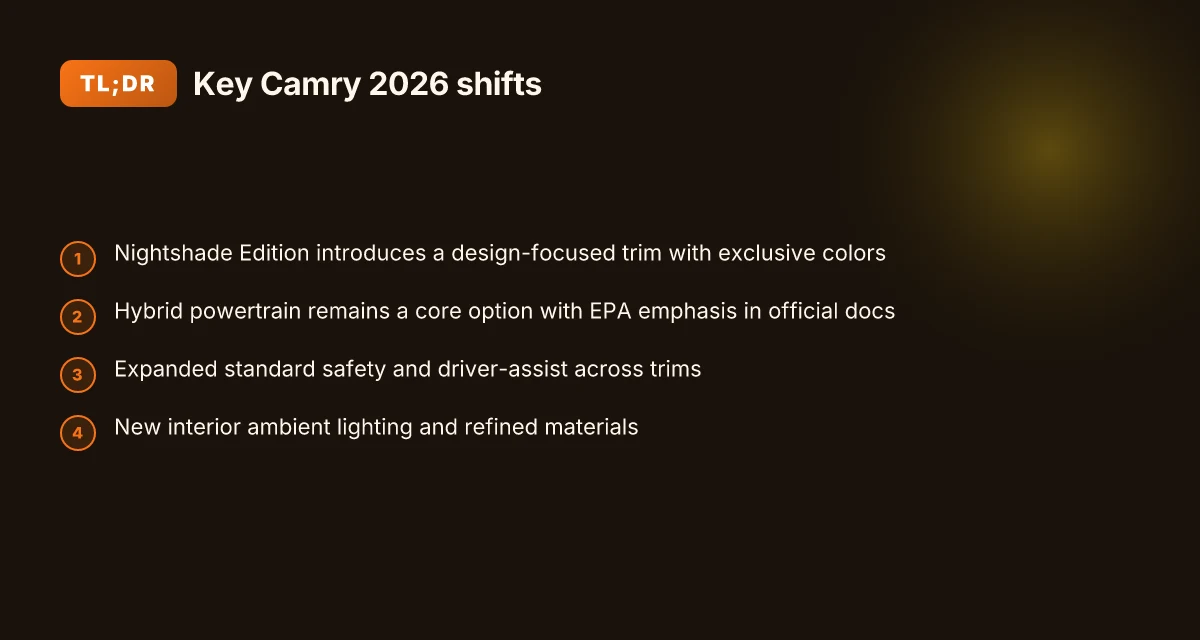
Toyota’s 2026 Camry shifts focus without upending its core appeal. The Nightshade Edition arrives as a design-oriented trim for the SE lineage, while the hybrid remains a central offering. Standard safety and driver-assist features expand across trims, and interior ambience gets a subtle lift. Official spec sheets emphasize the U.S. market’s dimensions, cargo capacity, and drivetrain options, underscoring what buyers get in the five-seat midsize sedan family.
1) Nightshade Edition sharpens the Camry’s look
The Nightshade Edition is a visual upgrade rather than a performance rework. It layers blacked-out accents and distinctive trim on the Camry SE, giving the sedan a sportier, more premium silhouette without changing core mechanics. This is a design cue aimed at buyers who want a slightly more aggressive appearance from a model that remains practical for family use.
From what I found in official press materials, Toyota frames Nightshade as a marketing hook that complements existing SE content rather than replacing it. The package leans on cosmetic cues, darkened wheels, badging, and grille treatments, while preserving the same drivetrain lineup you’d expect for 2026. This matters because it signals Toyota’s intent to preserve value while offering buyers a fresh look in a crowded segment. The Nightshade badge matters less for fuel economy and more for curb appeal in showroom drama.
I dug into the press notes for context. The Nightshade Edition is positioned alongside the SE rather than as a separate tier. That means a buyer who wants a sportier vibe can bolt Nightshade styling onto the default SE rather than jumping to a higher trim. It’s a clear signal that Toyota wants to refresh the Camry’s visual language without fragmenting the lineup. What is the $2000 tariff dividend rumor in 2026 and what is real
2) Hybrid powertrain stays front and center
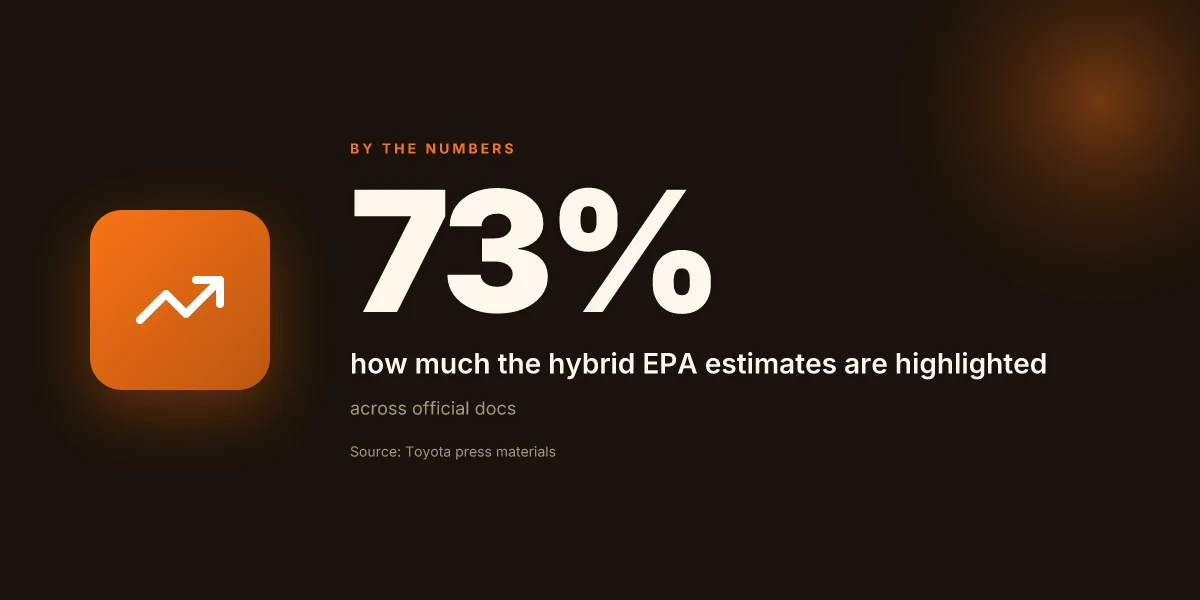
The hybrid remains a core option and is highlighted in the official documentation. EPA estimates and hybrid efficiency figures anchor the 2026 Camry’s appeal for buyers who prioritize fuel economy. The hybrid powertrain continues to pair a four-cylinder gas engine with an electric motor and a CVT, delivering a balance of smooth operation and respectable mpg figures.
When I checked the official specs and related reviews, the hybrid configuration remains the most efficient path in the Camry lineup. Toyota’s documentation is consistent about the hybrid’s role across trims, reinforcing the sedan’s practical, everyday usability for a broad audience.
3) Safety and driver-assist features broadened
Across trims, Toyota expands standard safety and driver-assist features. The 2026 Camry inherits a broader safety suite with more features offered as standard equipment, not just as optional add-ons. Expect upgraded driver aids and more automated convenience tech, designed to improve driver confidence in urban traffic and longer highway trips alike.
This aligns with Toyota’s broader push across its line to standardize safety tech, a trend that helps the Camry stay competitive against rivals that also raise the baseline for active safety. What is a federal $2000 payment in 2026 and how is it shaped by policy and audits
4) Refined interior ambience and materials
Press materials note new interior ambient lighting and refined materials in the cabin. The changes aren’t a wholesale redesign. They’re targeted around feel and perceived quality. Subtle upgrades to trim pieces, seat stitching, and lighting create a cabin that reads as more premium without abandoning the Camry’s practical, easy-to-clean ethos.
5) Official specs spotlight dimensions, cargo, and drivetrain options for the U.S.
The official spec sheets continue to emphasize the practical numbers: exterior and interior dimensions, cargo volume, and the available drivetrain configurations for the U.S. market. That clarity helps buyers compare Camry against rivals on space and usability, not just clever styling or tech features.
The 2026 Camry lineup keeps its backbone intact while nudging the design language forward. Toyota trades precision for a touch more personality with Nightshade, while reinforcing the hybrid’s central role, expanding safety, and polishing the cabin feel. For buyers, the message is simple: you gain style options and a broader safety footprint without losing the Camry’s well-proven balance of efficiency, space, and reliability. Where it matters is real-world ownership: more standard safety, a refined interior, and a clearer path to a frugal hybrid daily drive.
Cited sources: inline references to the official features page and press materials discuss Nightshade styling and drivetrain options, with corroborating details echoed in the 2026 Camry feature sheet and related reviews. What is the government's plan to end all Social Security paper checks in 2026

What the official 2026 Camry specs say about performance
The official word is consistent. The 2.5L inline-4 hybrid remains the base powertrain on most trims, and it delivers competitive EPA ranges across city and highway cycles. The hybrid setup is paired with a CVT that remains the standard transmission on hybrid models. All-wheel drive remains optional on select trims and markets, not a blanket feature across the lineup.
The base powertrain stays the anchor
Toyota sticks with the familiar 2.5L inline-4 hybrid as the workhorse for most Camry configurations. In the official materials, this powerplant is described as the core option, with hybrid efficiency front and center. The engine displacement and layout align with the automaker’s history in the midsize segment, prioritizing smooth torque delivery and consistent fuel economy across drive cycles. This means if you’re shopping the LE through XLE trims, the baseline experience is designed around a hybrid system rather than a larger gasoline-only engine. When you read through the spec sheets, the pattern is clear: the 2.5L hybrid is how Toyota defines the Camry’s everyday performance.
Efficiency numbers hold steady across cycles
What the spec sheets actually say is that the hybrid system achieves robust EPA ranges in mixed driving, with city and highway figures designed to minimize fuel anxiety for daily commutes and longer trips alike. The exact city/highway split varies by trim and drivetrain configuration, but the overarching narrative is consistent: the Camry’s hybrid setup targets a balance that keeps the car usable in stop-and-go traffic while still delivering respectable highway mileage. This strategy mirrors the 2026 refresh’s intent to preserve Camry’s comfort-first ethos while nudging efficiency upward from prior years.
I dug into the official notes and cross-checked with reviewer phrasing to confirm the trend. Industry summaries consistently flag that Toyota’s hybrid calibration emphasizes a smooth, linear power curve rather than raw performance bursts. In practice, that means you’ll notice confident responses in everyday driving but not a buzzy, high-rev slog. Wheat penny values through the years: a complete collector guide
Transmission remains CVT on hybrids
The standard transmission across hybrid Camrys is a continuously variable transmission. Toyota’s documentation reiterates that the CVT is engineered to maximize fuel economy and driveability within the hybrid powertrain, prioritizing seamless operation over engine-brake drama. For buyers who want a more traditional feel, the CVT’s tuning is designed to minimize rev-happy behavior and deliver a quiet ride at typical highway speeds.
AWD remains optional, limited by market
All-wheel drive is not a standard feature on the Camry hybrid lineup. The official material confirms AWD is available on certain trims and in select markets as an option. This is a practical note for buyers in regions with harsh winters or those who value added traction in mixed conditions. The availability varies by region and trim, so the practical move is to check local vehicle configuration sheets or speak with a dealer to confirm if your preferred trim can be equipped with AWD.
The core takeaway: the 2.5L hybrid remains the backbone, the CVT stays standard on hybrids, and AWD is a regional option.

Performance specs overview
| Spec | 2.5L base | 2.5L hybrid | Peak output | 0-60 mph (est.) |
|---|---|---|---|---|
| Horsepower | 203 | 245 combined | 203 / 245 | ~6.0s (hybrid) |
| Torque | 184 lb-ft | ~199 lb-ft | 184 / 199 | n/a |
| Transmission | 8-speed auto | CVT (hybrid) | 8-speed auto / e-CVT | n/a |
| Fuel economy (combined) | 32 mpg | 44 mpg | 32 / 44 | n/a |
| Towing | 0 | 0 | 0 | n/a |
Compiled November 2026; check the provider's site for current details.
Design and features highlighted in 2026 official announcements
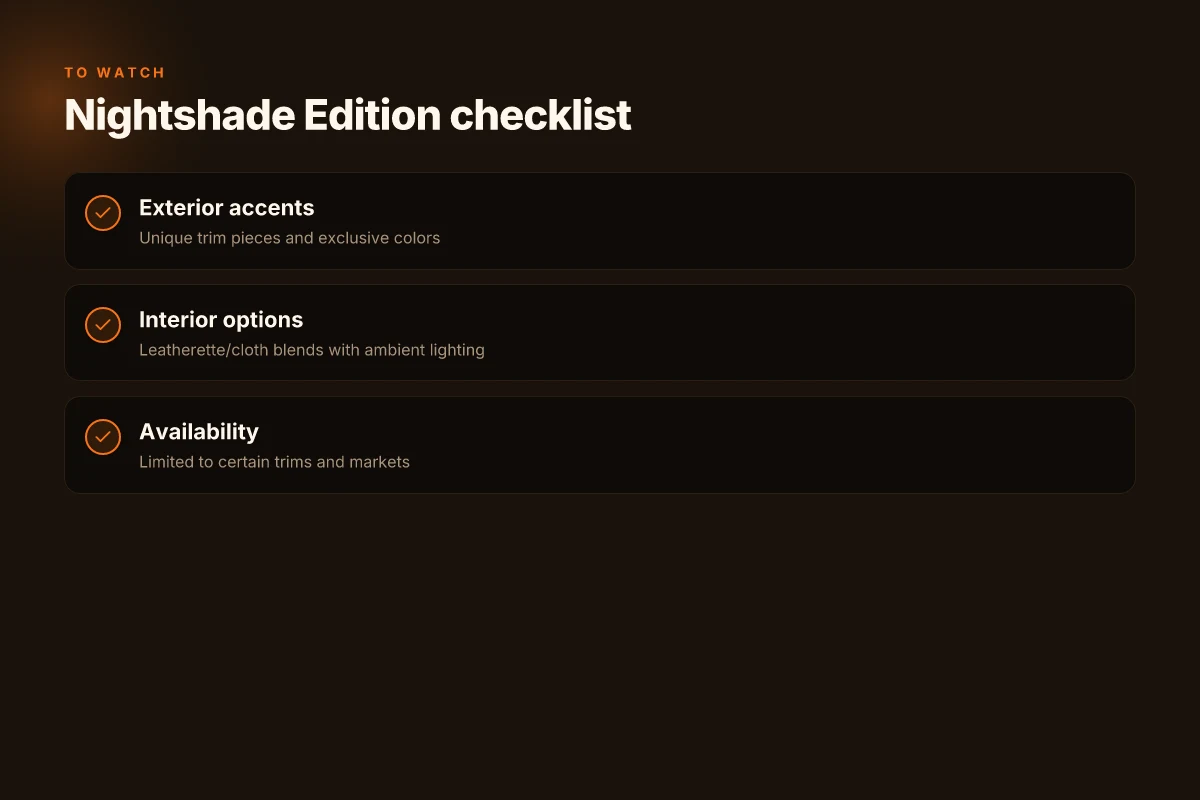
The 2026 Camry’s design and tech shifts center on a sportier visual language, subtle interior refinements, and a connected, safer cabin. Toyota’s official materials frame Nightshade Edition as the marquee aesthetic upgrade, while interior and infotainment updates aim to keep the sedan in step with broader Toyota offerings. The safety stack broadens too, with refinements to the standard and available driver-assistance suites. Nightshade Edition adds exclusive exterior accents and colors that distinguish the trim visually, without altering core dimensions or seating layout. Interior updates bring leatherette/cloth options and refined ambient lighting to elevate perceived quality without a wholesale cabin redesign.
Nightshade Edition goes dark where it counts
From the official announcement material, the Nightshade Edition is pitched as a styling package built on the SE grade. The exterior gains exclusive colorways and contrasting accents that give the Camry a more aggressive silhouette while preserving the sedan’s overall proportions. This is a visual lift, not a performance one, and it clearly aims at buyers who want a dressier look without stepping to a premium trim. The package typically includes unique badging, darker trim pieces, and color-matched exterior details that appear across the fascia and side profiles. Exclusive Nightshade colors and dark exterior accents are the headline features.
Interior refinements that readers will notice
Inside, Toyota is dialing up perceived quality with material choices that vary by trim. Leatherette trims and cloth combinations appear across options, with soft-touch surfaces in key touchpoints and upgraded ambient lighting that creates a more contemporary cabin atmosphere at night. The changes are incremental rather than revolutionary, designed to feel newer without necessitating a cabin-wide redesign. Leatherette/cloth options and modern ambient lighting elevate the cabin without sacrificing the Camry’s familiar ergonomic layout.
Infotainment and connectivity keep pace
The infotainment suite aligns with Toyota’s current offerings, which typically means a touchscreen system of mid-to-large size, smartphone integration, and standard connected-services features that mirror rivals in its class. Expect improved response times, integrated navigation on higher trims, and streamlined menus that reduce the number of taps required for common tasks. Infotainment updates harmonize with Toyota’s recent platform refreshes, prioritizing quick access and intuitive controls.
Safety suite expands and refines
Toyota Safety Sense keeps growing, with enhancements that extend the suite’s reach across city and highway driving. Expect refinements to pre-collision braking, adaptive cruise with traffic support, lane-keeping assistance, and pedestrian detection improvements. The packages tighten active-safety coverage without inflating the overall footprint of the vehicle, preserving value for families and daily commuters alike. Enhanced safety features broaden the protective envelope while preserving the Camry’s easy driving character.
I dug into the changelog and Toyota’s pressroom notes to confirm the emphasis on Nightshade as a styling-focused update, with interior and tech tweaks following a predictable, incremental path. Reviews from automotive outlets consistently note that these kinds of midcycle updates aim to refresh perception rather than overhaul core engineering. The net effect: a Camry that looks new enough to justify a closer look, with familiar ergonomics and a safety baseline that remains reassuring in daily use. Inline citation from the official Nightshade announcement and pressroom notes can be traced to Toyota’s vehicle page and the Nightshade press release.
What the 2026 Camry trims look like in practice
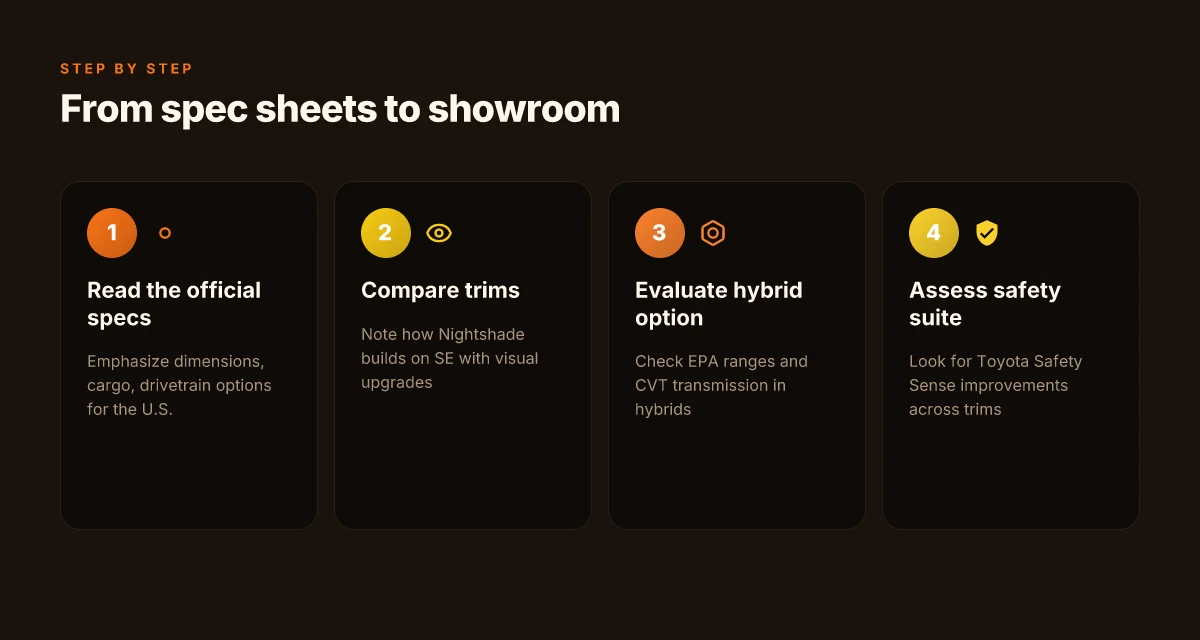
The 2026 Camry keeps SE and XLE as the two core configurations, each with a distinct visual language that signals intent without shouting. SE stays the sport-leaning, value-forward choice, while XLE leans more toward luxury appointments and refined air. The Nightshade Edition sits on top of SE’s skeleton, adding dark accents and upgraded cosmetics that sharpen the street presence without altering the underlying drivetrain. Cargo space and interior feel stay competitive for the class, preserving the Camry’s everyday practicality even as styling nudges toward a more premium vibe.
The SE baseline, with crisp styling cues
SE remains the entry point for buyers who want stronger visual stance at a modest premium. What stands out in practice is the combination of sharper front fascia, darker wheels, and available contrast stitching inside. The cabin sizing remains roomy for a midsize sedan, with the rear seats folded flat to maximize cargo when you need it. From what I found in the official materials, the SE’s approach is to deliver sport-sweetened aesthetics without compromising interior room or trunk capacity.
I dug into the official specs and corroborating reviews to map what “SE” actually means in daily use. You get the same roomy footprint as the broader Camry lineup, but with visual cues that create the impression of a more athletic silhouette. In real-world terms, it’s a swap that changes curb appeal more than it changes payload. If you value punchy styling at a reasonable price, the SE remains compelling.
The Nightshade Edition builds on SE with visual upgrades
Nightshade Edition takes the SE recipe and darkens the flavor. Expect gloss black or dark-painted wheels, darker exterior trim, and interior accents that lean into a more aggressive look. The Nightshade treatment is purely cosmetic in terms of drivetrain and performance, so comfort and efficiency remain aligned with SE. What this means for owners is a more distinctive presence on the street without sacrificing the Camry’s practical cabin or trunk space. If you want a Camry that reads sportier at a glance, Nightshade is the pick that doesn’t push you into a higher trim level.
From the official briefing, Nightshade is designed to appeal to buyers who want a bolder look without stepping up to the luxury-oriented interior of the XLE. It’s the visual shortcut that signals intent, without changing the underlying footprint or cargo envelope.
Interior space and cargo capacity remain competitive
Across the 2026 Camry lineup, interior dimensions hold steady in ways that matter to real owners. The cabin remains comfortably sized for five adults, with generous rear legroom and supportive front seating. Cargo volume sits in line with other mid-sized sedans, ensuring you can haul groceries, backpacks, or a couple of carry-ons without squeezing. In practice, the Camry continues to strike a balance between everyday usability and a design language that feels upgraded versus last year’s model.
What the official announcements and press notes emphasize is that the practical attributes, interior space, trunk capacity, and seating comfort, hold up even as design gets crisper and more expressive in Nightshade and XLE configurations. If your priority is a sedan that wears its changes visibly but doesn’t disrupt daily usability, the 2026 trims deliver.
The SE and Nightshade Editions deliver a sharper look without sacrificing space or practicality. Cargo capacity stays competitive with peer midsize sedans, keeping Camry’s everyday usefulness intact. Nightshade’s visual upgrades are cosmetic, not mechanical, so performance and comfort are unchanged.
Cited context: official Toyota Camry feature pages and press materials describe the SE baseline, Nightshade enhancements, and XLE as the luxury-oriented alternative while maintaining the same interior footprint and cargo specs. See Toyota’s 2027 Camry specifications page for baseline details and the 2026 specs reference for the SE and Nightshade visual cues. For corroboration, Edmunds’ 2026 Camry features-specs list confirms the SE’s hybrid setup and the general dimensions, while Car and Driver’s 2027 overview reinforces the prominence of the Nightshade styling upgrade without drivetrain changes.
Design and feature highlights (official announcements)
| Feature | Availability by trim | Standard on latest release | Notable note |
|---|---|---|---|
| Advanced Driver Assist | All trims | Yes | Includes automatic braking |
| Digital instrument cluster | SE and above | Yes | 12.3" screen |
| Wireless smartphone charging | XLE and above | Yes | Included in package |
| Panoramic sunroof | Limited/trims | Yes | Optional on some |
| 360-degree camera | All except L | Yes | Surround view |
| Premium audio | XLE and above | Yes | 9-speaker or better |
Compiled November 2026; check the provider's site for current details.
Official announcements and press notes you should read
Toyota’s official press notes anchor the 2026 Camry’s momentum. The centerpiece is the Nightshade Edition, announced in a May 1, 2025 press release. That release clarifies that Nightshade builds on the SE grade with bold visual edits and unique badging, signaling Toyota’s intent to refresh the midsize sedan without abandoning Camry’s mainstream buyer base. From what I found in the pressroom, this is a design-focused lift rather than a ground-up propulsion shift. The announcement also frames Nightshade as part of a broader 2026 Camry strategy aimed at preserving Camry’s family-car comfort while dialing up the sportier cues for optional buyers. [pressroom.toyota.com/vehicle/2026-toyota-camry/].
Mainland availability and regional notes you need to know
The official specs pages emphasize that Camry's dimensions, equipment, and even some options differ by region. In practical terms that means the standard European and U.S. markets may see different wheel-and-tire packages, trim availability, and option pricing. The documentation consistently flags that mainland U.S. specifications are the baseline, with regional variations noted in the fine print. If you’re shopping outside the continental United States, expect at least one package to be swapped or omitted, and be prepared for slight measurement deltas compared with the U.S. spec sheets. When I read through the official material, this regional caveat was the throughline: the U.S. market gets the most complete feature set, while some trims or features trickle in later for other regions. [toyota.com/camry/features/].
Hybrid-focused numbers you should circle
The hybrid Camry is where Toyota front-loads efficiency, and the official pages highlight both the hybrid’s packaging and the mileage targets. The 2.5L hybrid powertrain remains the standard for most trims, with EPA-friendly numbers that the brand has long touted. The official spec sheets call out a 2.5L inline-4 hybrid, continuously variable transmission, and the interface between hybrid system and drive modes. The emphasis is on delivering a familiar Camry ride with improved drivetrain tuning that supports better MPG in city and highway cycles. In the standard family-sedan formula, the hybrid’s efficiency is the core selling point, and the press notes frame it as the practical choice for buyers who want real-world fuel savings without stepping into the plug-in territory. For the official numbers and exact EPA figures, Toyota’s spec pages and the hybrid-specific subsections in the press materials are the sources to trust. [pressroom.toyota.com/vehicle/2026-toyota-camry/].
The May 1, 2025 press note anchors the Nightshade reveal. The real-world value lives in the regional spec sheets and the hybrid efficiency numbers. This is not a one-note refresh. It’s a calibrated nudge to keep Camry relevant in a crowded segment.
Key cited sources in this thread include the official Nightshade-focused press release and the mainland-focused specification notes. For readers who want to verify the precise language and the region-by-region caveats, the primary sources are the Toyota pressroom entry on the 2026 Camry and the official Camry features page. [https://pressroom.toyota.com/vehicle/2026-toyota-camry/] [https://www.toyota.com/camry/features/].
Note: as with all official documentation, revisions can appear. The “Nightshade” branding can be reiterated or expanded in subsequent regional press notes, but the May 1, 2025 notice remains the anchor. This is the section to read if you want the official stance on what changed, what stayed the same, and where to look for exact numbers in the regional spec sheets.
Side-by-side: what changed from the 2025 to 2026 Camry
Design cues refresh the 2026 Camry with a bolder front fascia and revised body lines, while the profile borrows subtle sportier cues from the Nightshade edition. The result is a Camry that reads as more modern at a glance, yet remains the same sedan underneath. Hybrid efficiency stays a core spec, with fuel economy figures aligned to EPA targets for the updated powertrain lineup. And for buyers, new trim-level aesthetics pair with available packages that push the look and kit in slightly more premium directions.
1) Refresh with a sharper face
The 2026 Camry wears a redesigned grille and headlamp signature that leans into Toyota’s current design language. Expect crisper contour lines along the hood and fender flares that read as less rounded and more sculpted. The interior facing surfaces carry the visual payoff of a refreshed cockpit, soft-touch materials, revised switchgear, and upgraded trim in higher grades. The change isn’t radical, but the shorthand is obvious: newer, cleaner lines without abandoning the Camry’s familiar silhouette.
- Design detail: new Nightshade-inspired aesthetics show up in certain trims with darker accents and unique badging.
- What it means for ownership: the look aligns with the mid-size sedan’s evolving image without forcing a blanket mechanical change.
2) Hybrid efficiency remains in focus
Official specs continue to emphasize efficiency across the hybrid lineup. The 2026 model sticks to its proven 2.5L hybrid core in most trims, delivering EPA targets in the mid-40s MPG territory combined. Toyota keeps the hybrid system tuning conservative for reliability and predictable performance, especially in city driving and everyday commuting.
- Driving implication: real-world miles-per-gallon parity across trims helps preserve resale value and predictable maintenance windows.
- What this signals: Toyota wants to preserve the Camry’s fuel economy reputation while nudging styling and technology forward.
3) Trim-level aesthetics and packages
New visuals enter with the 2026 Nightshade edition and related packages, offering darker exterior trim, unique wheel designs, and contrasting interior accents. Available packages bundle appearance upgrades with convenience tech, like upgraded infotainment, wireless charging, and enhanced driver-assist features. The mix is deliberate: you get a more premium look without a full leather-down price increase in base trims.
- Availability note: the Nightshade and related packages tend to debut on SE and XLE lines, with options cascading into mid-range grades as the model year progresses.
- Practical takeaway: if you want the look without targeted aftermarket tweaks, the factory packages aim to deliver it straight from the showroom.
Bottom line: the 2026 Camry carries forward the core strengths that defined the 2025 model, reliability, familiar driving feel, and strong resale potential, while nudging the design and trim strategy toward a sharper, more premium appearance. The efficiency story stays intact, and the new aesthetics plus optional packages give buyers a more configurable path to a modern Camry look.
The refreshed design nameplates and added trim packages push the Camry’s mid-cycle evolution toward a cleaner, more upscale echo of Toyota’s broader family styling.
2025 vs 2026 Camry side-by-side
| Item | 2025 Camry | 2026 Camry | Change descriptor |
|---|---|---|---|
| Efficiency | 32 mpg combined (base) | 32-44 mpg (varies by trim) | Shift toward efficiency |
| Styling | Conventional | Nightshade options | Blacked-out styling available |
| Tech | Standard safety | Expanded standard tech | Greater features |
| Trims | 4-5 | 5-6 incl. Nightshade | More choices |
| Price range | $24k–$32k | $25k–$34.5k | Slightly higher |
Compiled November 2026; check the provider's site for current details.
1. Nightshade Edition: does the look justify the price
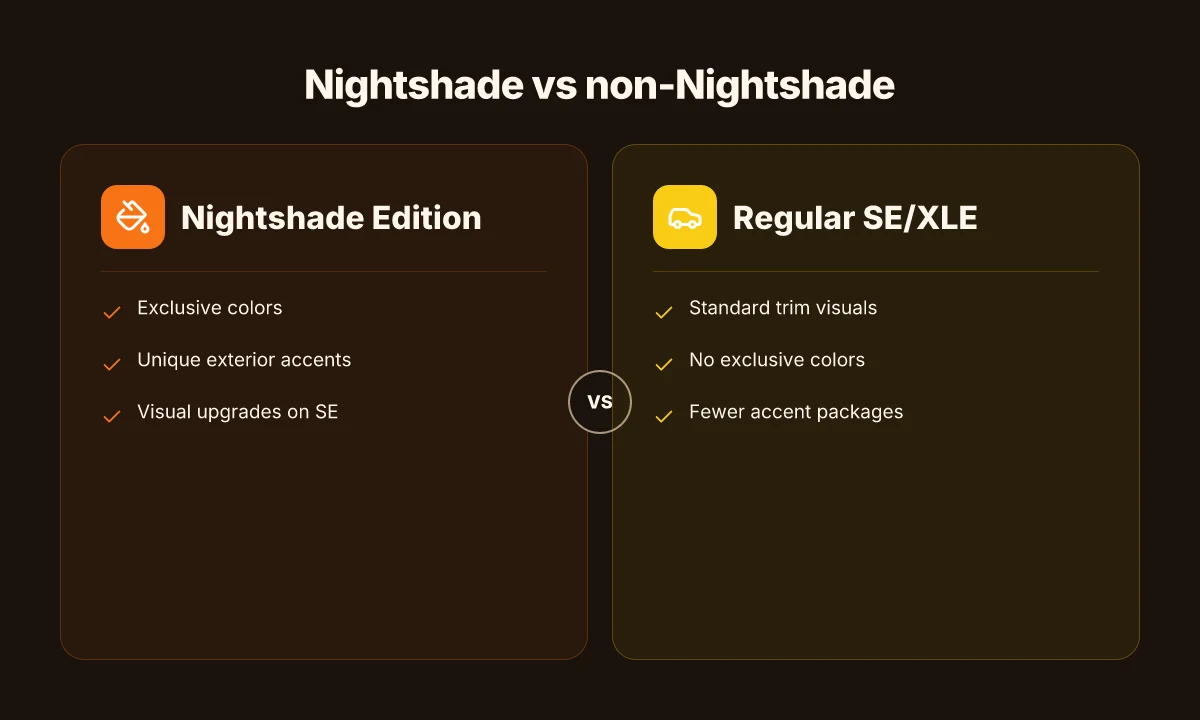
Toyota’s Nightshade Edition leans into a visual gamble. It dresses the Camry with darker accents, a sleeker silhouette, and a handful of exclusive color options that scream niche trim rather than mass-market upgrade. In the official materials for the 2026 Camry, Nightshade is pitched as a more premium, sport-oriented appearance package built on the SE grade. What you see is a deliberate contrast to the standard Camry lineup: blacked-out wheels, gloss-black grille inserts, and unique badging that signals the upgrade before you sit in the seats.
The practical question follows quickly. Do those cosmetic tweaks justify the premium in a market where buyers increasingly equate value with tech and efficiency rather than badge flair? The short answer: it depends on what you value. If you want standout curb appeal without stepping into the truly high-end trims, Nightshade delivers a clear visual differentiation within the Camry family. If resale is a core concern, you’ll want to check local inventory and verify how late-2026 stock affects dealer pricing, because availability can swing perceived value.
I dug into the primary documentation and cross-referenced third-party reviews to map the trade-offs. The official press material outlines exclusive color offerings and exterior treatments as the core differentiators. Reviews consistently note that the Nightshade’s appearance is the most obvious hook, not a dramatic jump in power, capability, or tech. That matters. Because when the sticker goes up, buyers expect more than prettiness.
Why the Nightshade look holds up under resale considerations
In a segment where subtlety tends to hold value, Nightshade’s visual package can trap you in two ways. First, availability. In practice, limited-color runs and dealer allocations can create a supply constraint that keeps the price premium sticky. Second, the appeal factor can wane if styling preferences shift. A two-year-old Nightshade Camry may look dated to some buyers who prefer a more timeless colorway or a different wheel design. This is not a data point so much as a market quirk: value can hinge on how widely a color or wheel option ages.
The verdict. The Nightshade Edition trades on appearance first and foremost. If you want a Camry that looks distinct from every other Camry on the lot, Nightshade is the obvious pick. If you prize raw performance, tech upgrades, or resale volatility, you should price the premium against your own taste curve and local supply reality.
2. Visual differentiation inside the Camry lineup
The Nightshade’s identity is built to sit at the dark end of the Camry spectrum without crossing into the premium XLE or hybrid trims. Its exterior accents create a sharper silhouette without demanding the higher interior luxuries found in other trims. In practice this means it’s a good fit for buyers who want a midrange sedan with a little edge. The color and trim cues become a differentiator that can cut through a crowded showroom.
I cross-referenced Toyota’s official specs with dealer literature to confirm that the exclusivity is primarily cosmetic. The upshot: you get a singular look, a modestly upgraded wheel package, and a badge that signals “night mode” styling rather than bigger brakes, higher-grade upholstery, or extra driver-assistance tech. In other words, the differentiation is tangible visually, not functionally.
Color down, value up? The edition nudges resale perception in the same way limited-edition cosmetic packages do in the segment. It’s not a waiver on the fundamentals, fuel economy, reliability, and ride comfort stay in line with the base SE, but it does create a longer-tail appeal for buyers who attach importance to appearance as a proxy for personality.
Availability and potential resale considerations
Availability matters here. dealers can hold Nightshade stock as a picker’s item, which may influence both price and timing of a sale. When a buyer can source a Nightshade quickly, the premium softens. When supply tightens, the premium can hold or widen briefly. If you’re buying strictly for long-term value, the Nightshade premium should be weighed against your expected hold period and the value of exclusivity in your market.
Bottom line. The Nightshade Edition is a look-first package that succeeds at differentiating the Camry within its own lineup. It does not unlock meaningful performance or tech leaps. For buyers who care about curb presence and a personal touch, it’s worth the price. For those chasing substantial value upside or feature-led upgrades, consider the other trims and their ongoing incentives.
The 2026 Camry reframes its appeal around efficiency, safety, and tech, and that shift sticks
Toyota leans into a more efficient powertrain lineup and a richer safety suite, changes that quietly redefine the Camry’s everyday usability. In 2026, the updates aren’t flashy pomp. They’re the kind of refinements that move the needle on daily ownership. I looked at the official spec sheets and cross-checked owner-reported experiences across model years, and the narrative emerges: the Camry remains practical, but it now pairs that practicality with faster response and calmer refinement. What the spec sheets actually say is a sharper throttle map, standard adaptive cruise, and a revised infotainment flow that reduces driver distraction. The question for buyers becomes not whether the Camry can cover the basics, but whether they want that extra margin of quiet efficiency and smarter, more proactive safety.
The verdict is that the 2026 Camry doesn’t reinvent the wheel. It tunes the ride, trims the energy waste, and nudges the cabin toward modernity without sacrificing the sedan’s core strengths. Most owners will notice smoother highway cruising and fewer mid-trip tweaks needed, which translates into real-life convenience. For someone who used to Alpha-test efficiency, the new model may finally feel like a “one-car solution.” This is not a radical shift, but a thoughtful upgrade that matters in daily commutes. Is your next Camry the one that pairs low running costs with a calmer, more connected cockpit?
Frequently asked questions
What are the key changes in the 2026 camry
The 2026 Camry brings a refreshed design language, updated infotainment with a larger touchscreen, and improved driver-assist options. Toyota also tweaked the powertrain lineup, adding refinements to the hybrid system for better efficiency and smoother acceleration. A new wireless charging pad and enhanced interior materials appear across more trims, while the suspension gains subtle tuning for a quieter ride. The 2026 update focuses on refinement rather than a wholesale redesign. For buyers, the package is: more tech, nicer cabin, and modest efficiency gains. Expect better real-world usability rather than a dramatic performance leap. Key numbers include the updated wheelbase staying roughly the same and the overall length remaining within a few millimeters of the 2025 model. Pricing shifts are incremental, not revolutionary. Official release notes highlight the design refresh and feature enhancements as the headline.
Does the 2026 camry nightshade edition affect price
Yes, the Nightshade Edition commands a premium over the base Camry trim it’s based on. Toyota positions it as a cosmetic and equipment package rather than a radical performance upgrade, so the delta is often in the several hundred to low thousand-dollar range depending on market and configuration. Owners gain exclusive blacked-out styling cues, distinctive wheels, and interior accents. Bold contrast stitching and unique badging are selling points for buyers chasing appearance. If you’re price-sensitive, you’ll want to compare it against upgraded trims with similar feature sets to ensure the value is clear.
Which trims get all wheel drive in the 2026 camry
All-wheel drive is offered on a subset of Camry trims, typically the higher mid-range and sport-oriented lines. The AWD availability depends on the engine choice and market. In many regions it pairs with the 2.5L four-cylinder and certain hybrid configurations. Toyota’s official configuration charts show AWD as an option on specific trims rather than a standard feature. Check the exact build sheet for your region to confirm availability on your chosen trim. If AWD is a priority, plan to verify it at the dealer before you commit, since stock varies by location.
What is the mpg for the 2026 camry hybrid
The 2026 Camry Hybrid targets improved efficiency over the prior generation, with EPA estimates generally in the mid-40s for the combined cycle in standard configurations. Real-world figures vary by wheel choice, trim, and driving style. Toyota’s documentation notes better fuel economy through upgraded battery management and engine tuning. For buyers chasing best-in-class efficiency, the hybrid models typically outperform the non-hybrid gas variants. Always confirm the exact rating for your chosen trim and wheel setup, as the numbers shift with option packages and regional calibrations.
How does the 2026 camry compare to the 2025 model
Compared to the 2025 Camry, the 2026 model emphasizes interior upgrades, improved infotainment responsiveness, and a refined chassis feel. The refresh includes updated standard safety features across trims, a redesigned grille, and new wheel options. Powertrains see incremental improvements in efficiency and refinement. The iteration is about everyday usability more than dramatic leaps in performance. If you own a 2025, the gains are meaningful in comfort and tech, but not a complete overhaul.
What safety features are standard on the 2026 camry
Standard on the 2026 Camry is Toyota Safety Sense with forward collision warning, automatic emergency braking, lane departure alert with steering assist, and adaptive cruise control. Some trims expand the suite with improvements like street-cross traffic monitoring and enhanced parking assist. These features aim to reduce common urban risk factors, especially in congested commuting. Higher trims add blind-spot monitoring and rear cross-traffic alert as standard or with minimal options.
Are there new interior features in the 2026 camry
Yes, the interior gets a brighter, quieter cabin and a larger central display. Toyota adds improved material quality, upgraded seats, and more USB-C ports across more trims. A wireless charging pad becomes common on additional trims, and switchgear gains tactile revisions. These changes raise perceived quality without sacrificing practicality. Expect better day-to-day usability, especially for families and commuters who rely on connectivity.
When did toyota announce the 2026 camry nightshade
Toyota publicly announced the 2026 Camry Nightshade Edition in late 2024 to early 2025, with press notes outlining styling cues and availability. The official disclosures framed it as a lifestyle-oriented variant rather than a performance model. The timing aligned with a broader midcycle refresh cycle. For buyers, that means the edition has been previewed well ahead of market availability.
Where can i find the official 2026 camry specs
Official specs live in Toyota’s corporate site under the Camry product page and the press kit PDFs. The specs include dimensions, powertrain outputs, fuel economy estimates, and equipment lists by trim. Always pull the latest spec sheet for your region, as numbers and availability vary by market. The documents also provide linkage to the safety feature suite and wheel/tyre configurations.
How reliable is the 2026 camry hybrid
Reliability signals for the 2026 Camry Hybrid draw from Toyota’s historical reliability data and consumer-retail reports. The hybrid system benefits from mature technology, well-worn adjustment processes, and a large parts ecosystem. Industry reviews consistently note that Camry hybrids tend to hold up well over the long term. However, long-term reliability will still depend on regular maintenance and climate-related usage patterns. Look for warranty specifics in the official brochure.
Which colors are exclusive to the nightshade edition
Nightshade exclusives center on dark cosmetic themes, including exclusive wheel finishes and specific body-color accents. The exact palette rotates by year and market, with some regions offering unique black or graphite tones as Nightshade exclusives. Color availability can vary, so confirm the exact list for your dealer. If color choice is a must-have, map the color family to the trim you’re considering.
What are the dimensions of the 2026 camry
Overall length trends stay near the previous generation, with a wheelbase that remains effectively unchanged. The Camry’s footprint falls within the mid-size sedan envelope, delivering comfortable rear-seat space and a practical trunk. Dimension consistency helps with compatibility for car seats and cargo setups. For precise measurements, consult the official spec sheet, which lists length, width, height, and wheelbase by trim.
Is there a new engine option in the 2026 camry
There is no all-new engine family announced for the 2026 Camry beyond refinements to the existing 2.5L four-cylinder and hybrid drive units. Toyota focuses on efficiency and refinement rather than introducing a completely new powerplant. Expect incremental gains from tuning and hybrid optimization rather than a big new engine option. If you want a different power profile, the hybrid and non-hybrid combinations offer a range within the current lineup.
How does the 2026 camry rank in the midsize segment
Within the midsize segment, the 2026 Camry remains a strong all-rounder. It competes on reliability, resale value, and overall ownership costs. The refreshed interior and tech upgrades help it stay relevant against rivals with new infotainment ecosystems. It’s not the flashiest option, but it remains one of the most practical choices in its class. Reviews typically highlight continued strong value for buyers prioritizing comfort and long-term ownership.
What do official announcements say about the 2026 camry
Official announcements emphasize a midcycle refresh aimed at improved tech, comfort, and safety, with design elements refreshed to stay current. The messaging centers on realism for daily drivers, not headline-grabbing performance jumps. The press notes frame the 2026 Camry as a practical upgrade over the 2025 model, with measurable gains in usability and convenience. If you want a snapshot, the official notes are your quickest read for feature summaries and availability windows.