FortiClient VPN Windows 11: Install, Set Up, and Troubleshoot

Learn how to install FortiClient VPN on Windows 11, configure a connection, and fix common setup or connection problems.
FortiClient VPN on Windows 11 lets you connect securely to a workplace or other private network, provided you have the correct VPN details and account access. Install the appropriate FortiClient VPN version, enter the settings supplied by your organization, and connect. If setup fails, first confirm the software version is supported and restart the relevant FortiClient service before trying more involved fixes.

Editor's pick: NordVPN — fast, secure VPN — Strong encryption, a no-logs policy and apps for every device. 30-day money-back guarantee. Get NordVPN →
Compare the setup options before installing FortiClient VPN
| Option | Best for | What you need | Main consideration |
|---|---|---|---|
| FortiClient VPN for Windows | Connecting to an organization’s VPN | Windows 11 PC and VPN details | VPN access must be provided by your organization |
| Full FortiClient app | Users who need broader endpoint features | Windows 11 PC and the appropriate license or setup | Includes more than VPN functionality |
| Organization-provided installer | Following your employer’s approved setup | Installer and any organization instructions | Use the version recommended by your IT team |
| Fortinet download | Getting the VPN client from its vendor | Internet access and a compatible Windows PC | Confirm you select the VPN-only option |
| IT-assisted installation | Users with managed or restricted PCs | Access to the organization’s support team | IT can provide approved settings and help |
| Personal VPN service | Personal internet privacy needs | A separate personal VPN subscription | Not a substitute for organization VPN access |
Compiled November 2026; check the provider's site for current details.
| VPN | Obfuscation | From / month | Plan | Free plan | Refund | Alipay | UnionPay | Crypto | Website opens in China | Trustpilot | |
|---|---|---|---|---|---|---|---|---|---|---|---|
 ZoogVPN | Turn on manually Shadow | $2.49/mo | 27 months: $59.99 | Yes | 7 days | ✓ | ✓ | ✓ | ✓ | Official site blocked; our special link opens (4.4 s) | 4.2/5 (195 reviews) |
 NordVPN | Turn on manually Obfuscated Servers / NordWhisper | $3.49/mo | 27 months: $94.23 | No | 30 days | ? | ✗ | ✓ | ✓ | ✗ Blocked | 4.2/5 (51,628 reviews) |
 ExpressVPN | ✓ On by default all servers | $3.00/mo | 28 months: $84 | No | 30 days | ✗ | ✗ | ✓ | ✗ | ✗ Blocked | 4.4/5 (29,706 reviews) |
 Surfshark | ✓ On by default Camouflage, with OpenVPN | See site | See site | No | 30 days | ✗ | ✗ | ✗ | ✓ | ✗ Blocked | 4.3/5 (31,823 reviews) |
 Proton VPN | Turn on manually Stealth, free plan too | $2.99/mo | 12 months: $35.88 | Yes | 30 days | ✗ | ✗ | ✗ | ✓ | ✗ Blocked | 2.1/5 (1,040 reviews) |
 Astrill VPN | Turn on manually StealthVPN / OpenWeb | $12.50/mo | 24 months: $300 | No | See site | ✗ | ✗ | ✗ | ✓ | ✗ Blocked | 1.3/5 (110 reviews) |
 Private Internet Access | Turn on manually Shadowsocks, OpenVPN only | $2.03/mo | 40 months: $81.2 | No | 30 days | ✗ | ✗ | ✗ | ✗ | ✗ Blocked | 4.2/5 (11,033 reviews) |
 CyberGhost | Turn on manually selected servers | $2.19/mo | 28 months: $61.32 | No | 45 days | ✗ | ✗ | ✗ | ✓ | ✗ Blocked | 4.0/5 (24,178 reviews) |
 PureVPN | Turn on manually switch to OpenVPN | $1.69/mo | 60 months: $101.55 | No | 31 days | ? | ? | ✗ | ✓ | ✗ Blocked | 4.4/5 (17,994 reviews) |
 AdGuard VPN | ✓ On by default TrustTunnel | $2.99/mo | 24 months: $71.76 | Yes | 30 days | ✓ | ✗ | ✓ | ✓ | Official site blocked; our special link opens (3.7 s) | 4.3/5 (290 reviews) |
 Mullvad | Turn on manually QUIC / Shadowsocks / LWO | $5.61/mo | €5/mo | No | 14 days | ✗ | ✗ | ✗ | ✓ | ✗ Blocked | 3.2/5 (192 reviews) |
 Windscribe | Turn on manually Stealth / WStunnel | $5.75/mo | 12 months: $69 | Yes | See site | ✗ | ✗ | ✗ | ✓ | ✗ Blocked | 4.7/5 (13,355 reviews) |
 StrongVPN | Turn on manually Scramble, OpenVPN TCP | See site | See site | No | 30 days | ✓ | ✗ | ✗ | ✗ | ✗ Blocked | 4.4/5 (2,695 reviews) |
 LightXtreme 闪连 | Not listed | $7.08/mo | 12 months: $84.99 | Yes | 30 days | ✓ | ✓ | ✓ | ✓ | ✓ Yes (3.5 s) | No page |
Prices checked 2026-11-10 on each vendor's pricing page (cheapest long plan, USD). Check the vendor's checkout for the final price.
Obfuscation checked 2026-11-14 on each vendor's site and help center: "on by default" = nothing to set; "turn on manually" = switch protocol or mode in settings; "not listed" = the vendor describes no obfuscation.
Payment methods checked 2026-11-10 on each vendor's payment pages: all 14 take cards and PayPal; ✗ = not listed, ? = the vendor's own pages disagree.
China access: whether the official website opens from mainland China networks (tests the website only, not the VPN connection). Last checked 2026-11-18 01:02 Beijing time.
Trustpilot score and review count checked 2026-11-10.
What you need before installing
FortiClient is a VPN client, not a VPN service that automatically gives you access to a network. Your employer, school, or network administrator must provide the connection details and authorize your account.
Before installation, check that you have:
- A Windows 11 device with permission to install software.
- An installer from Fortinet or your organization’s approved software portal.
- The VPN type, such as SSL VPN or IPsec VPN.
- The VPN server address and any required port or authentication settings.
- Your username, password, and any required multifactor authentication method.
Use the version recommended by your organization. A managed network may require a specific FortiClient release or a full endpoint-management client rather than the standalone VPN app. Avoid third-party download sites, which may offer outdated or modified installers.
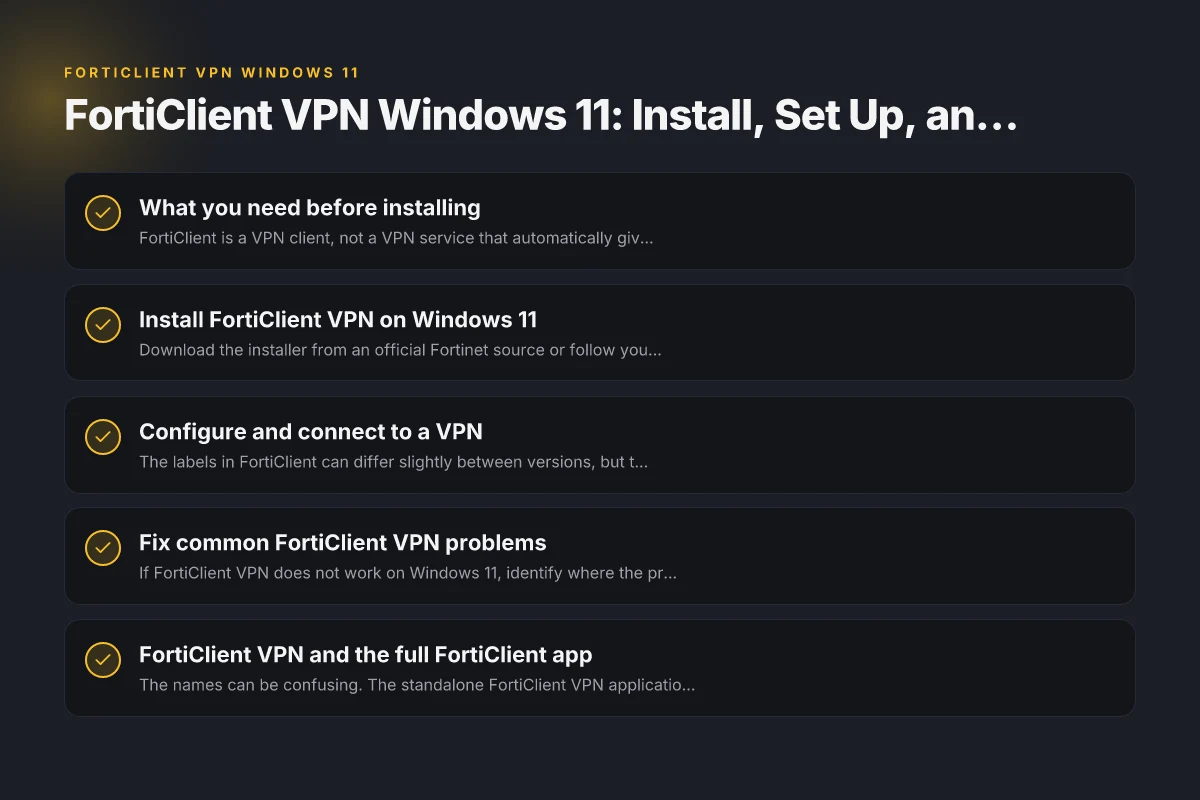
Install FortiClient VPN on Windows 11
- Download the installer from an official Fortinet source or follow your IT department’s instructions.
- Open the downloaded file and approve the Windows permission prompt if it appears.
- Follow the installer prompts. If asked to select components, choose the option your organization specifies.
- Restart Windows if the installer requests it.
- Open FortiClient and select the VPN area to add or edit a connection.
Installation can vary by FortiClient release and by organization policy. If the setup program will not run, confirm that you have an installer intended for your Windows device and that you have administrator rights. On managed computers, contact IT before changing security settings or removing an existing client. VPN for Edge: How to Choose and Use One
Choose the right connection setup for your FortiClient VPN
| Setup choice | Information needed | Who provides it | When to choose |
|---|---|---|---|
| SSL VPN | Server address and organization-specific settings | Organization or IT team | When the organization specifies SSL VPN |
| IPsec VPN | Gateway address and required authentication details | Organization or IT team | When the organization specifies IPsec VPN |
| Username and password | Account credentials | Organization | When password sign-in is enabled |
| Multi-factor authentication | Additional verification method | Organization | When the account requires a second factor |
| Saved connection profile | Approved connection settings | User or IT team | When reconnecting with the same settings |
| Manual connection setup | Complete VPN details | Organization or IT team | When no profile is supplied |
Compiled November 2026; check the provider's site for current details.
Configure and connect to a VPN
The labels in FortiClient can differ slightly between versions, but the general process is similar:
- Open FortiClient and choose Configure VPN or the option to add a connection.
- Select the connection type provided by your administrator.
- Enter the VPN name and server address.
- Add any required port, certificate, or authentication details.
- Save the profile, select it, and choose Connect.
- Sign in with your authorized credentials and complete any multifactor prompt.
Do not guess at server names or settings. Ask your administrator for a working configuration if you are missing information. A connection may appear to start successfully but still fail if the server address, VPN type, certificate, or authentication method is wrong. Edge Secure Network VPN Review: What It Protects, and What It Doesn’t
SSL VPN and IPsec VPN
FortiClient can support different VPN connection types, including SSL VPN and IPsec VPN. They use different settings and authentication flows, so choose the type your organization specifies. A profile for one type cannot necessarily be used as a substitute for the other.
| Connection option | What to confirm before connecting |
|---|---|
| SSL VPN | Server address, any required port, and the organization’s sign-in method |
| IPsec VPN | Server address, the required IPsec settings, and any certificate or authentication requirements |
Fix common FortiClient VPN problems
If FortiClient VPN does not work on Windows 11, identify where the process fails: installation, opening the app, authentication, or establishing the tunnel. This helps you avoid changing unrelated Windows settings.
FortiClient will not install or open
- Restart Windows and run the installer again.
- Make sure the installer came from Fortinet or your organization.
- Check whether your account has permission to install applications.
- Ask IT whether your Windows 11 build and FortiClient release are supported.
- On newer or specialized devices, confirm that the installer supports the device’s processor and Windows edition.
Users have reported installation difficulties on Windows 11 releases and devices, including Windows 11 24H2 and Surface hardware. These reports do not establish that every device or release has the same problem. If installation remains blocked, give IT the exact Windows version, device model, and installer version.
The app opens, but the VPN will not connect
Try these checks in order: Free VPN for Microsoft Edge: What Works and What to Know
- Verify the server address and VPN type against the details from your administrator.
- Confirm that your internet connection works without the VPN.
- Check that your username, password, and multifactor approval are correct.
- Restart Windows, then try again.
- Ask IT whether the VPN service is available and whether your account is enabled.
A Windows network adapter or a stopped FortiClient service may also contribute to connection errors. One troubleshooting report specifically notes that restarting the FortiClient Scheduler service through the Windows Services panel helped. If you try this, open Services, locate FortiClient Scheduler, and restart it if available. Service names and availability may vary by version. Do not disable or remove services without guidance.
SAML sign-in or browser authentication fails
Some IPsec VPN setups use SAML authentication, which may involve a browser-based sign-in. If authentication opens incorrectly or does not return to FortiClient, check with IT whether your profile should use an external browser for SAML authentication. A user report for a specific FortiClient and Windows combination describes enabling Use external browser as user-agent for SAML user authentication in FortiClient’s VPN settings. This is not a universal fix. Use it only if it matches your organization’s setup.
FortiClient VPN and the full FortiClient app
The names can be confusing. The standalone FortiClient VPN application focuses on connecting to VPNs, while the full FortiClient product may include additional security and endpoint-management features. Organizations may deploy the full client to enforce security policies or manage devices.
FortiClient VPN is commonly offered as a free VPN client, but that does not mean it provides free VPN access to a private network. You still need a VPN server, permission to use it, and valid connection details. Whether you can use the standalone client depends on your organization’s requirements. Windows VPN: How to Set One Up and Choose a Provider
Troubleshoot FortiClient VPN problems by symptom
| Symptom | Check first | Likely next step | Who can help |
|---|---|---|---|
| Installer will not run | Windows version and installer source | Use the organization-approved installer | IT team |
| FortiClient will not open | Installation completion and pending restart | Restart Windows and try again | IT team |
| VPN profile is missing | Whether a connection was configured | Add the organization’s VPN settings | IT team |
| Connection fails | Server address and connection type | Verify settings with the organization | IT team |
| Sign-in is rejected | Username, password, and multi-factor prompt | Confirm account access or reset credentials | Organization’s account support |
| Connection drops | Network stability and VPN availability | Try a stable network and reconnect | IT team |
| VPN works but access is denied | Required organization permissions | Ask whether access is granted for the resource | Resource owner or IT team |
Compiled November 2026; check the provider's site for current details.
Recommendation
For FortiClient VPN on Windows 11, use the installer and profile approved by your organization, then verify the VPN type, server address, and sign-in method before connecting. If installation or connection still fails, note the FortiClient and Windows versions, the exact error, and the step where it occurs. Contact your IT administrator before changing adapters, security settings, or managed VPN configuration.