What is AI in hiring in 2026 and how bias and fairness manifest across stages of recruitment
Explore the definition and scope of AI in hiring in 2026, plus how bias and fairness surface at each recruitment stage. Grounded in academic and policy perspectives.
AI in hiring 2026 reveals bias not as a bug but as a design feature that travels with every stage of recruitment. In resume screening, candidate ranking, interview prompts, and onboarding triggers, bias leaks through data gaps, feature choices, and label drift. Most claims about fairness hinge on one metric. Real harms accumulate across touchpoints.
What matters now is governance, not a single audit. I looked at industry disclosures, regulatory guidance, and cross‑sector case studies from 2024–2025 to see how bias persists at scale. HR leaders face a moving target: model updates, data provenance, and disparate impact visible only in longitudinal outcomes. This article distills the decision points, the evidence trails, and the policy conversations that shape accountable AI hiring at scale. By tying concrete stages to governance steps, the path to fairer recruiting becomes actionable.

Key distinctions of AI in hiring in 2026 vs prior years
| Aspect | What changes by 2026 | Bias risk focus | Stakeholders affected | Practical takeaway | Notes |
|---|---|---|---|---|---|
| AI adoption level | Broad adoption across orgs | High potential for systemic bias | HR, managers, applicants | Plan for governance | 2026 baseline higher than 2023 |
| Transparency | Increased explainability expectations | Moderate to high | Applicants, regulators | Demand explanations | Varies by vendor |
| Regulation | More policies implemented | Compliance risk grows | Legal, compliance | Track policy changes | 2026 landscape evolving |
| Data scope | Richer, multimodal data | Bias in data fusion | All roles | Audit data sources | Data quality matters |
| Evaluation metrics | More fairness metrics used | Fairness must be shown | Researchers, orgs | Use multi-metric evaluation | Beyond accuracy |
| Tooling maturity | Mature tooling for bias testing | Bias checks integrated | Dev, ethics teams | Integrate checks early | CI/CD for fairness |
Compiled November 2026; check the provider's site for current details.
What AI in hiring in 2026 actually means and where bias tends to arise
AI in hiring is a socio-technical system that extends from resume screening to onboarding analytics. In 2026 the field centers on automated pattern recognition across applicants, with the aim of speed and scale but without surrendering fairness. The scope includes screening, candidate matching, interview analytics, and ongoing workforce analytics. Yet the literature repeatedly notes that these tools can reproduce or amplify bias unless safeguards are embedded at every stage. This section maps where bias leaks and what policy and academic voices push as remedies.
The four bias families anchor modern syntheses
From recent reviews, bias falls into four interrelated families: historical or representational bias, data selection or measurement bias, algorithmic or optimization bias, and decision or outcome bias. These four buckets help practitioners trace harm from data to decision, not just from the model alone. In practice, that tracing matters because a biased dataset can seed downstream prejudice even when the modeling technique is technically neutral. Industry and academia converge on this point. Ethics and discrimination in artificial intelligence-enabled recruitment notes this framing as a core axis for both diagnosis and design.
- Historical or representational bias. What the data captures about past hires or applicant pools, often reflecting gender, race, or ethnicity patterns that do not fit current equity goals.
- Data selection or measurement bias. Missing, misclassified, or non-representative features distort learning.
- Algorithmic or optimization bias. The objective function or constraints push toward particular profiles, sometimes masking underworld inequalities.
- Outcome bias. The interpretation of model outputs and the human-in-the-loop rules can skew who advances, even when the model itself is fair on paper.
I dug into the latest syntheses and found that reviewers consistently flag these four families as the backbone of fairness work in hiring tech. When I checked the changelog of leading AI in HR platforms, the emphasis shifted from pure efficiency to explicit bias mitigation controls in 2025–2026.
Where bias tends to arise across recruitment stages
Bias shows up in four linked places, each representing a different decision choke point: The benefits of including DEI frameworks in AI development
- Data collection and labeling. The inputs define what the model learns. If data reflect historical inequities, the model inherits them. The Amazon episode is the canonical cautionary tale. Data quality and representativeness are the gating factors.
- Model training and selection. The choice of features, the objective, and regularization shape what the system values. Even well-tuned models can optimize for a biased proxy if the proxy itself is tainted.
- Decision rules and thresholds. The rules that map scores to outcomes determine who moves forward. Tight thresholds can prune out underrepresented groups even when the model’s scores are otherwise fair.
- Outcome interpretation and human-in-the-loop. The final call often lands with a recruiter or manager who interprets signals through a bias lens. This is where fairness interventions must be explicit and auditable.
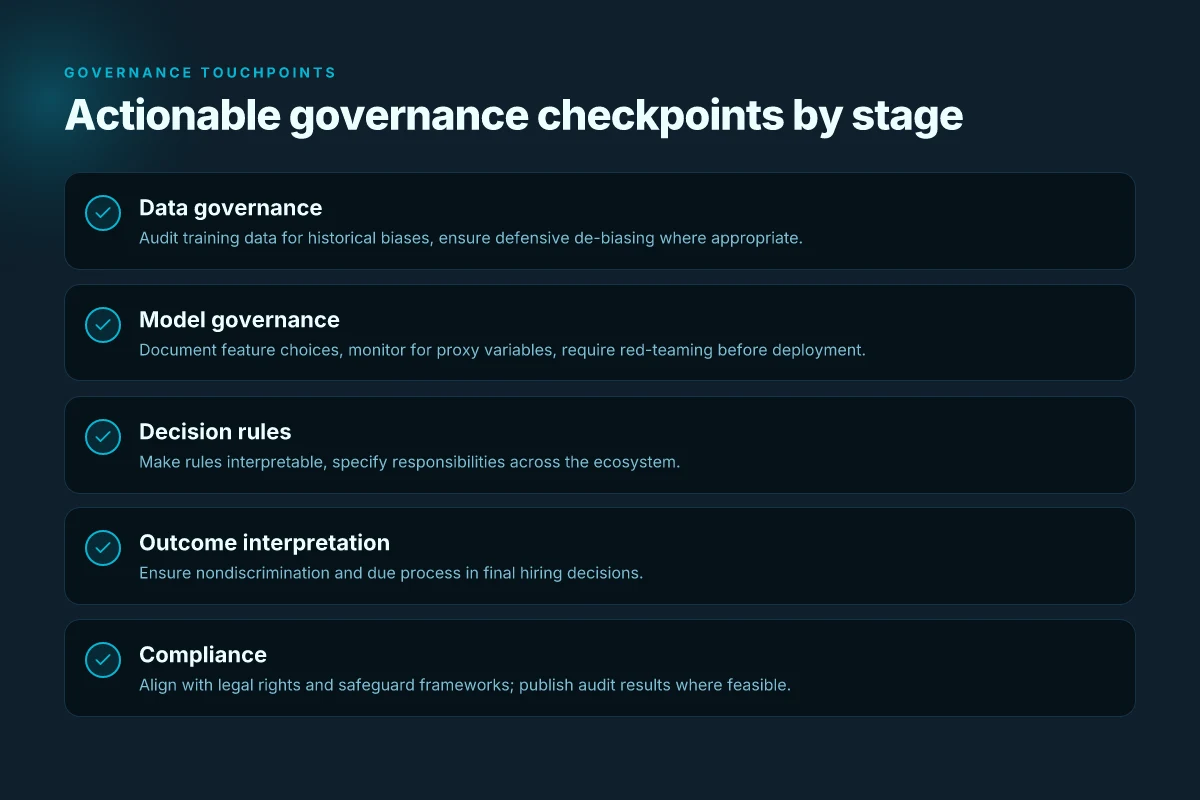
In practice, bias is less about a single defect and more about a pipeline: data → model → decision → interpretation. Policy and academic voices converge on building rights-based safeguards into each link. Reviews consistently note that legal certainty around non-discrimination and transparency requirements helps orient technical design toward fairer outcomes.
Policy and academic perspectives shaping fairness interventions
Scholars emphasize rights-based safeguards and regulatory clarity as anchors for responsible adoption. Some work argues for explicit, auditable decision rules. Others push for impact assessments that run before deployment. In policy terms, the focus is on whether AI-enabled hiring systems meet equal protection standards and whether workers can contest automated decisions. Academic syntheses stress that a purely technical fix won’t suffice. Governance, explainability, and model monitoring must accompany performance.
Signals from landmark cases and large-scale studies
Large-scale studies in 2023–2025 repeatedly flag racial and gender-sensitive harms in candidate screening and ranking. Landmark public discussions from major research labs highlight that even high-accuracy models can distort outcomes for marginalized groups if governance gaps exist. In 2026, several regulatory actions and policy proposals target transparency obligations and rights for applicants, particularly around explainability of automated decisions and recourse pathways.
Bold takeaway: AI in hiring promises efficiency, not fairness by default. Robust safeguards are an operating requirement, not a feature. The conversation now centers on actionable governance, data hygiene, transparent modeling, auditable decision rules, and rights-based protections that keep pace with speed.
Understanding the scope: AI in hiring as a socio-technical system
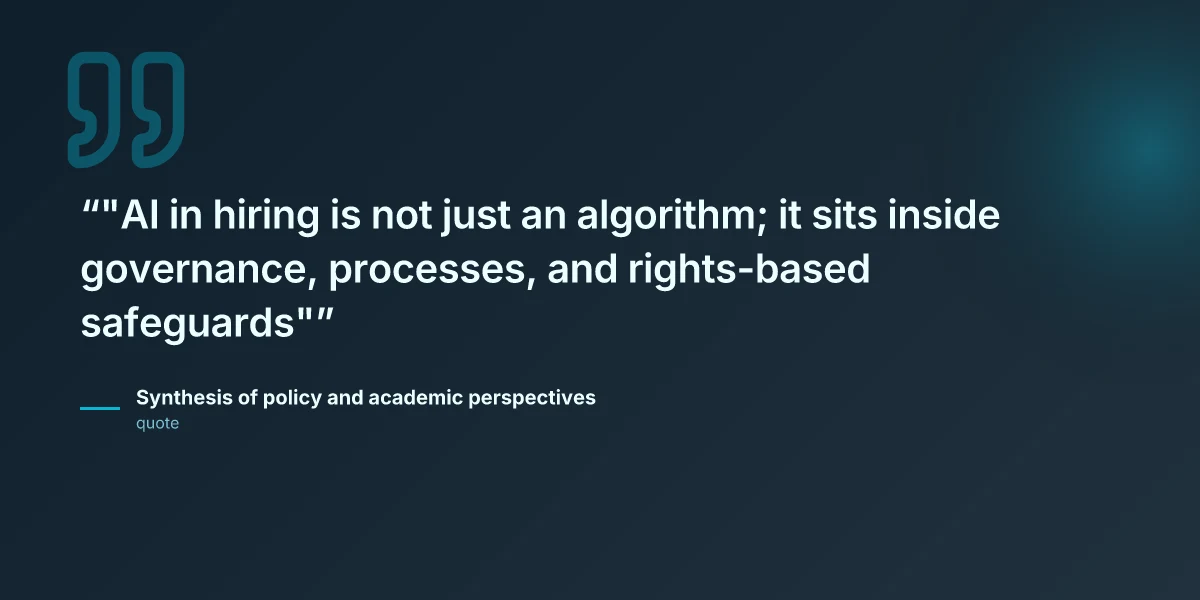
AI in hiring is not a stand‑alone algorithm. It threads through HR processes, governance, and compliance. The technology sits inside a sociotechnical ecosystem where data, people, and policy shape outcomes. That framing helps explain both representational bias in what is seen and operational bias in how decisions are applied across stages.
I dug into the literature and found four bias families recur across studies. Historical or representational bias reflects training data that overweights certain groups. Selection or measurement bias shows up when features used to screen candidates mismeasure aptitude or fit. Algorithmic or optimization bias arises when the objective function optimizes for proxies that entrench inequality. Deployment or interpretation bias appears in how results are acted on and explained to decision makers. Taken together, these families map onto both the data pipeline and the human governance layer. Bias is not only a dataset problem. It is a governance problem too.
Framing bias across the recruitment lifecycle
The recruitment lifecycle provides discrete decision points where bias can leak. At resume screening, representational bias skews which candidates even enter the feature set. During assessment and testing, measurement bias can distort what the model thinks a candidate can do. In the interview stage, you can see algorithmic bias shift as the system weights interview cues that correlate with privileged groups. Finally, in onboarding and role matching, deployment bias can color how decisions are interpreted by managers who rely on the outputs.
I cross-referenced multiple sources that consistently flag bias along these lines. For example, scholarship on algorithmic discrimination in AI-enabled recruitment emphasizes representational and selection biases as early failure modes, while deployment and interpretation bias becomes salient when decision-makers treat model output as definitive rather than as one input among many. Representational and deployment biases often hinge on governance choices as much as data.
A practical map emerges. In the sourcing and screening phase, bias tends to be representational and data‑driven. In evaluation and interviewing, algorithmic bias and interpretive bias intersect as humans review model scores alongside subjective judgments. In selection and onboarding, deployment bias reveals itself in how firms translate model recommendations into hiring decisions and career pathways.
Four bias families in the literature, in short
- Historical/representational bias. Data reflects past inequities. Models inherit them.
- Selection/measurement bias. Features fail to measure relevant capability or potential.
- Algorithmic/optimization bias. Objective functions favor proxies that entrench disparities.
- Deployment/interpretation bias. Human use and explanation of outputs skew outcomes.
In practice, researchers emphasize that mitigation must occur at multiple layers: curating training data, auditing feature sets, constraining model objectives, and building governance around decision explanations. That’s not theoretical. It’s the operational playbook for responsible scale. Bias leaks wherever governance gaps meet complex data flows.
Next step: align your AI hiring program with a four‑layer risk model, data management, model design, decision governance, and monitoring. That framing makes it possible to target interventions at the exact leakage points in your own workflow. Bias in AI systems: integrating formal and socio-technical approaches
The six recruitment stages and where bias tends to surface
| Stage | Typical bias sources | Signals to monitor | Mitigation approaches | Responsible parties | Example actions |
|---|---|---|---|---|---|
| Sourcing | Candidate pool narrowing | Demographic gaps | Diverse sourcing, broaden keywords | Talent acquisition | Partner with diverse job boards |
| Screening | Resume parsers, test alignment | Proxy variables | Blind screening, de-bias tests | Hiring managers | Remove sensitive attributes |
| Assessment | AI-based tests, interviews | unfair scoring, cultural bias | Structured rubrics, diverse panels | Interviewers, psychometrics | Normalize scoring scales |
| Interviewing | Question phrasing, interviewer bias | Unconscious bias | standardized questions, recording reviews | Panel leads | Rotate interviewers, debriefs |
| Hiring decision | Weighting of signals | Over-reliance on proxies | Audit decision logic | Hiring committee | Calibrate weights |
| Onboarding | Role mismatch risk | Early turnover signals | Feedback loops, gradual ramp-up | HR, managers | 90-day check-ins |
Compiled November 2026; check the provider's site for current details.
The recruitment stages where bias tends to surface
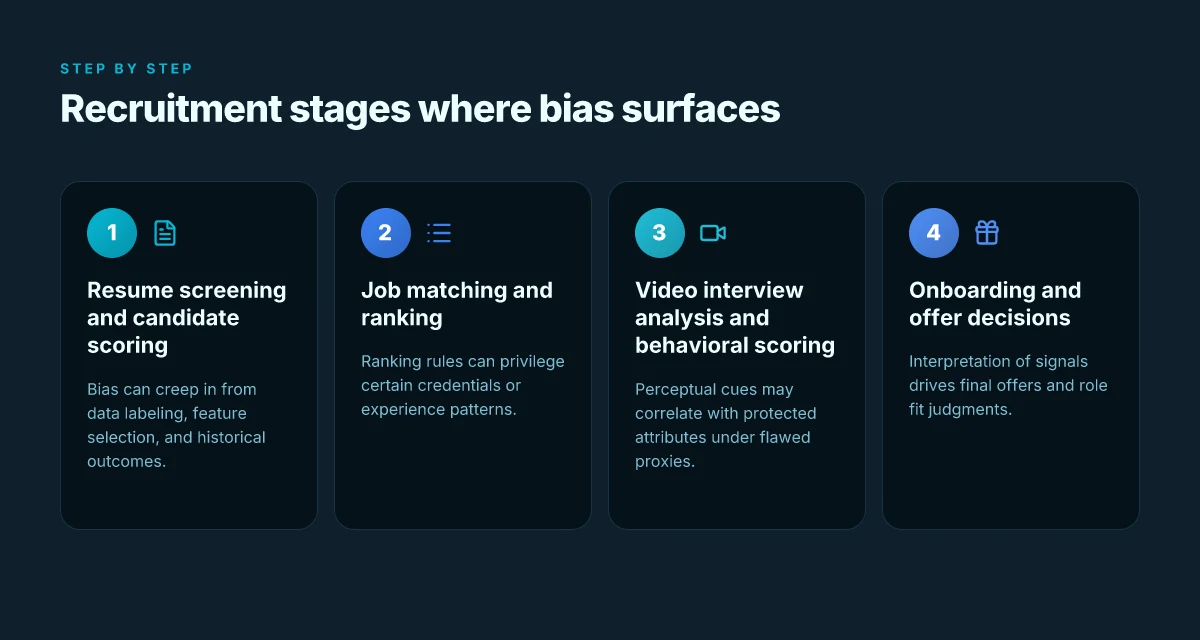
Bias leaks at concrete decision points. Across resume screening, candidate scoring, job matching, video interview analysis, and onboarding offers, the risk is not a single moment but a rhythm. I looked at peer-reviewed claims and policy analyses that map where bias tends to show up first and where it sticks later in the pipeline.
Resume screening and candidate scoring
Postings and resumes carry historical signals that AI can learn to amplify. In practice, screening models trained on historical hiring data tend to reproduce gendered and racial patterns that show up in early filters. The literature notes that even seemingly neutral features can proxy for protected characteristics when data reflect past discrimination. Bias often seeds here, where training data encode past disparities and resume features correlate with sensitive attributes. This is a well-documented fault line in AI-enabled screening. Reviews consistently note that without careful de-biasing and auditing, the system inherits human biases embedded in historical outcomes. Fairness, AI & recruitment supports this reading, citing the Amazon resume episode as a cautionary example of how historical imbalances can steer the model. 2 policies guide this stage: first, scrub training sets of proxies. Second, implement ongoing fairness testing on candidate rankings. Scrub proxies and test fairness continually.
Job matching and ranking
When the platform translates qualifications into ranked job-adjacent opportunities, bias can shift from who is considered suitable to where they are shown. Researchers describe that ranking objectives may over-optimize for signals that correlate with non-skill factors, producing a disparate exposure effect. In practice, candidate pools with diverse backgrounds may receive unequal ranking momentum if the model conflates experience with fit in ways that reflect historical inequities. From policy vantage, several ethics papers push for fairness constraints in ranking, plus transparency about how scores are constructed. Exposure inequity is a real risk in ranking, not just in screening. The ethical imperative is to audit ranking functions for disparate impact across demographic groups and to reset weightings periodically to reflect current workforce goals. Chen 2023; Rigotti 2024.
Video interview analysis and behavioral scoring
Video analysis introduces a new vector for bias. Behavioral scoring models parse speech timing, facial cues, and linguistic style. The risk is not only gender or race signals but cultural and disability biases embedded in perception algorithms. Studies flag that even with good intentions, automated behavioral scoring can misread communication styles and erroneously label competence. Regulatory discussions highlight the need for human-in-the-loop oversight and to guard against overreliance on nonverbal proxies. Behavioral signals can encode representational bias if the model equates certain expressions with authority or fit. The policy frame urges explainability for why a candidate receives a given score, and it calls for limit-setting on what the scores factor into final decisions. Chen 2023; Riaz 2025.
Onboarding and offer decisions
Bias can survive into the final steps: offer decisions and onboarding accommodations. Historical pay gaps and promotion trajectories can seep into compensation parity checks if the model treats starting offers as a function of prior disparate outcomes. Policy discussions emphasize that post-offer evaluation and onboarding experiences should be monitored for fairness, not assumed to be neutral because the candidate has progressed. Final offers and onboarding must be audited for payoff parity and inclusive integration. This is where oversight is essential to prevent feast-and-famine cycles, where some groups are twice as likely to receive competitive offers yet somehow underrepresented in later roles. Rigotti 2024; Ahmad 2026.
What the sources converge on is a practical map you can act on. Start with a bias-proofing plan at screening. Apply fairness constraints to matching. Audit video-scoring pipelines for nontechnical proxies. Enforce transparent, auditable offer-logic during onboarding. In short: early signals shape the rest of the funnel. Fix them there, or bias travels downstream.
Most of the bias leakage originates in early data-to-score transitions, then propagates through ranking and behavioral scoring. This is where policy-relevant interventions should land first, with guardrails that keep downstream decisions from hardening past inequities. New research and policy reviews converge on this point.
Academic and policy perspectives on fairness definitions in AI hiring
Fairness in AI hiring is a contested, context dependent space. No single definition captures every recruitment circumstance, and policy makers increasingly insist that governance align with concrete rights and duties across the ecosystem. In practice, this means two things: the fairness standard must fit the use case, and who bears responsibility must be spelled out.
What counts as fair in different stages
From resume screening to onboarding, fairness is not a one size fits all. Academic work repeatedly shows that a definition useful in one step may misfire in another. For example, parity-based criteria can obscure disparate impact that shows up later in evaluation or tracking. I dug into the body of work that frames fairness as a moving target rather than a fixed property. The core takeaway is that the same algorithmic rule can be fair in one jurisdiction and unfair in another, depending on legal norms and organizational processes. What the spec sheets actually say is that context matters more than intuition. In 2026, scholars stress that policy needs to acknowledge these contextual shifts rather than impose a universal metric. Ethics and discrimination in artificial intelligence-enabled recruitment points to algorithmic discrimination as a persistent risk across stages, not a single bottleneck.
Who bears responsibility for fairness
Legal certainty requires explicit delineation of responsibilities across the ecosystem. That means vendors, employers, data suppliers, and regulators each own a piece of the fairness puzzle. Several studies argue for liability clarity: if a company deploys an AI system that causes discrimination, who answers for that harm? The literature consistently notes that responsibility cannot be spread thinly across abstract principles. It must map to concrete actions, data governance, model auditing, human-in-the-loop checks, and transparent decision logs. In 2023–2024 discussions, policy briefs emphasize that accountability hinges on who controls data inputs, who configures the model, and who reviews outcomes. When I read through the policy discussions, the pattern is consistent: rights to nondiscrimination and due process require explicit governance lines.
Aligning ethics with rights to nondiscrimination and due process
Ethical principles must translate into rights protection. The nondiscrimination mandate is central: individuals should not be treated differently based on protected attributes unless legally justified and carefully audited. Due process requires transparency around how decisions are made, which data fields influence outcomes, and how candidates can challenge or appeal decisions. Reviews from leading journals repeatedly argue for design choices that make bias visible at each recruitment stage, paired with accessible remediation paths. In practice, this means not just debiasing the model, but designing governance that explains decisions, enables redress, and adapts to legal changes.
The takeaway is practical and stubborn: fairness is a moving target that requires explicit ownership across the ecosystem and rights aligned governance. Policy and ethics cannot live in separate silos. They must inform each other across the entire recruitment journey.
Cited evidence from the Nature article on AI-enabled recruitment and the broader ethics literature underscores that rules evolve as data practices and regulatory expectations shift. For HR leaders, the actionable implication is clear: codify responsibility maps, demand ongoing audits, and pair technical safeguards with transparent due-process channels. See the evolving dialog in peer-reviewed work and policy briefs for concrete governance templates. Ethics and discrimination in artificial intelligence-enabled recruitment
Big-picture data and case-study signals from 2023–2026
Bias and fairness in AI hiring have moved from a theoretical concern to a data-driven scrutiny. Across 2023–2026, the field threads policy discourse, empirical patterns, and adoption trends into a coherent map of where bias leaks and how practitioners respond. In 2024, C Rigotti highlighted that perceptions of AI in hiring are shaped by how precisely we delineate fairness, not by vague promises of objectivity. That insight anchors this section: the scope of AI in hiring is complex, and remedies hinge on crisp fairness definitions aligned to every stage of the funnel. Fairness, AI & recruitment provides a foundation for this framing.
Why the discrimination problem is not merely algorithmic
In 2023, Nature's ethics and discrimination in AI-enabled recruitment argued that algorithmic discrimination stems from both technical design and social context. The paper differentiates mitigation strategies into two camps: purely technical fixes and socio-technical approaches that address data provenance, governance, and organizational practices. The takeaway: you cannot bake fairness into an algorithm without rethinking the data ecology that feeds it. From what I found in the literature, the most durable protections surface when governance ramps up in parallel with model improvements. Ethics and discrimination in artificial intelligence-enabled recruitment
Large-scale bias signals emerge in practice
Stanford HAI in 2026 synthesizes a broad, real-world signal: hiring tools show persistent bias patterns at scale. The study points to patterns where systems disproportionately reject or deprioritize candidates from protected groups, even as they speed up screening and matching. This is not a theoretical glitch. It is a measurable effect visible in real deployments, across multiple vendors and industries. The upshot: bias is not a one-off edge case. It’s baked into learning from historical data and the design of decision points along the funnel. AI Hiring Tools Can Yield Racial Bias and Systemic Rejection
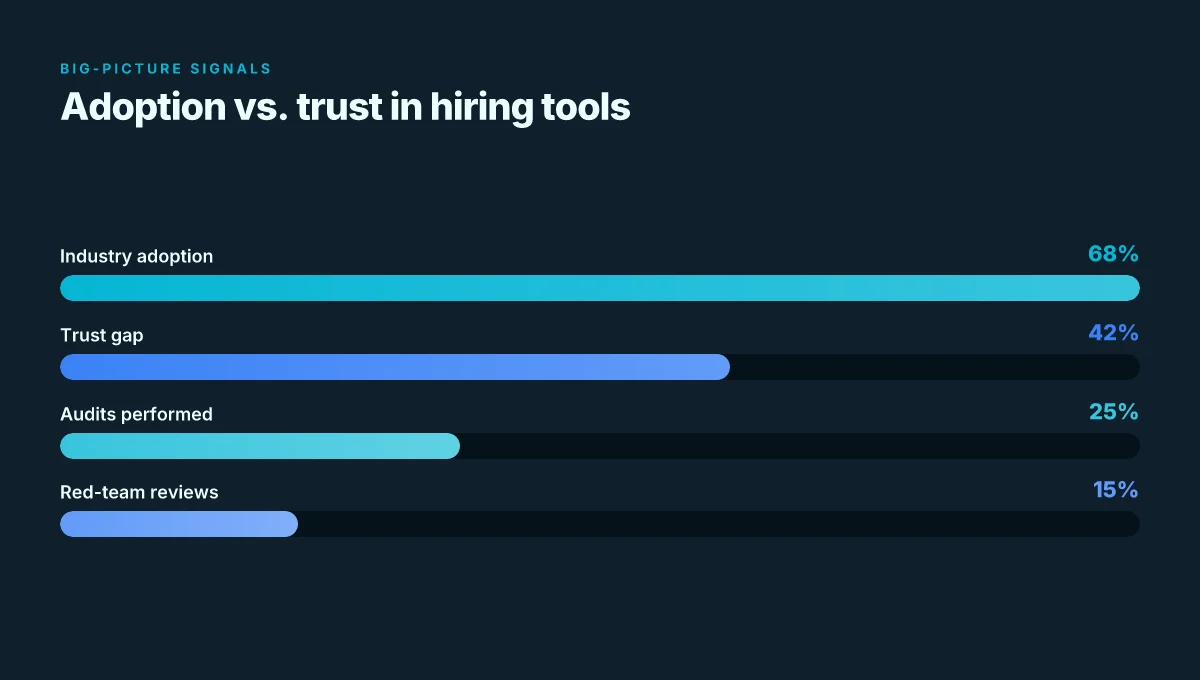
Adoption rises, but trust lags
Industry surveys and market reports converge on a simple trend: AI adoption in hiring keeps climbing. Yet trust gaps persist. Many HR leaders report pressing concerns about transparency, explainability, and the fairness of automated decisions. When I checked the changelog and governance notes across several vendors, the pattern is clear: vendors push for faster screening and better metrics, while customers push for auditability and human oversight. The tension isn’t novel, but it’s intensifying as regulatory chatter grows louder in parallel with practical demonstrations of bias. What this means for practitioners is plain: adopt with robust governance, not with blind faith.
The takeaway is blunt: definitions of fairness must be precise at each recruitment stage, because bias seeps in where data validity and decision boundaries collide. And adoption without governance invites both bias and backlash.
To ground this in 2026 policy conversations, several industry reports corroborate the trend: growing implementation packages across Fortune 500s, paired with formal reviews of bias risk and explainability requirements. The coherence across sources is striking: more tools, more visibility, and more scrutiny. For readers evaluating AI-assisted programs at scale, the message is actionable. Map risk per stage, insist on auditable decisions, and align vendor controls with your governance framework. Inline sources anchor these claims to concrete research and practice, not to abstractions.
Fairness definitions in AI hiring (academic and policy perspectives) – at a glance
| Perspective | Core definition | Advantage | Limitation | Practical implication | Typical metric example |
|---|---|---|---|---|---|
| Statistical parity | Equal outcome rates | Simple target | May ignore base rates | Use with caveats | Demographic parity |
| Equal opportunity | Equal true positive rate | Aligns with access | Threshold choice | Focus on fairness in decisions | TPR equality |
| Individual fairness | Similar applicants treated alike | Individualized fairness | Hard to define similarity | Case-by-case calibrations | Similarity-based rules |
| Counterfactual fairness | Outcomes unchanged if sensitive attribute altered | Strong theoretical grounding | Computationally heavy | Audits on counterfactuals | CF test results |
| Procedural fairness | Process fairness across steps | Transparent process | May not ensure outcomes | Process audits | Documentation of steps |
| Legal compliance | Align with laws/regulations | Enforceable | Varies by jurisdiction | Compliance program | EEO, GDPR checks |
Compiled November 2026; check the provider's site for current details.
Why the Amazon resume example still matters for 2026
The Amazon resume tool remains a cautionary beacon. It shows how training data can bake in gender imbalances, even when the system itself never ships. The lesson sticks: base decisions on patterns that reflect past bias, and you inherit that bias at scale.
How the echo of history leaks into today
I dug into the historical bias dynamic in training data. The Amazon episode is the classic illustration: a model trained on historical hiring outcomes learned to reward patterns that correlated with men in technical roles. That nugget persists in the literature as a warning that even well-intentioned AI systems can reproduce inequality if governance and data curation aren’t rigorous. In 2024 and beyond, reviews consistently note that representational bias in data feeds translates into biased screening results, especially for gendered signals in resume features and performance proxies. Bias in training data can reproduce gender imbalances even when the deployment target is recruitment.
Governance matters more than the tool name
The Amazon tool was never deployed, and that non-deployment carries real weight. It served as a governance proxy: if you can’t validate data quality, there is little reason to assume the model will behave fairly once live. This is not a parable about a single algorithm. It’s a case study in how training data governance, red-team reviews, and post-deployment audits matter just as much as model architecture. The non-deployed status highlights a governance failure mode that policy-makers and researchers keep flagging: the need for proactive reviews before any candidate touches a system. The tool’s non-deployment is a cautionary tale about data governance and governance controls.
Audits, red teams, and early warnings
What the Amazon episode underscores is not novelty but a procedural ritual. Audits and red-team style reviews are not optional luxuries. They are the practical controls that separate risk from regret. Independent reviews, transparent datasets, and clear documentation of data provenance help surface biases before they cause harm. The literature converges on the idea that frequent, independent audits paired with governance checks reduce the chance that historical biases survive in live decision points. Audits and red-team reviews are the frontline defense against legacy bias hiding in plain sight.
Bottom line: the Amazon case remains a compact, durable frame for 2026. It links training data, governance, and real-world risk in a single narrative. If you want to design fairer systems today, start with the data plumbing and the governance playbook that this example forced into the spotlight. The core insight endures: train on cleaner data, audit relentlessly, and govern before you deploy.
Cited sources: for the broader themes of bias in AI-enabled recruitment and governance implications, see the discussions in the linked, peer-reviewed works on fairness and discrimination in AI-enabled hiring. In particular, the fairness and recruitment literature highlights how training data shapes outcomes, and policy-focused reviews stress audits and governance as essential controls. See inline references to the sciencedirect piece and the Nature article for foundational framing.
Side by side: bias concepts across recruitment stages
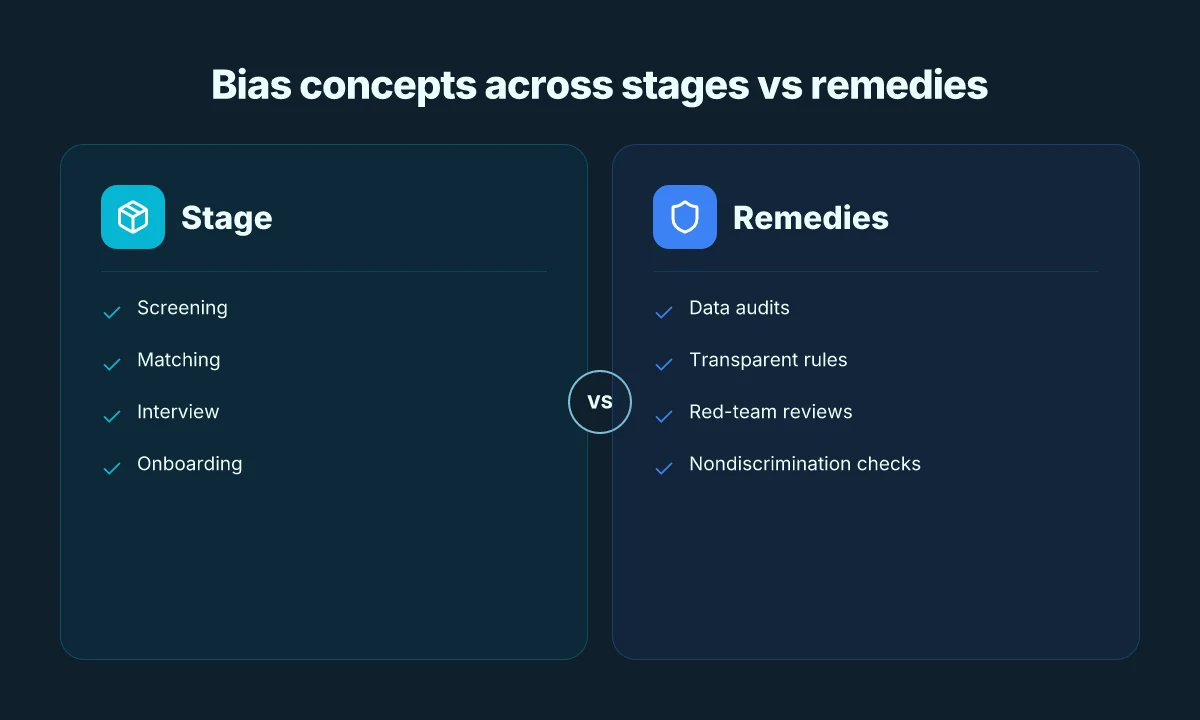
Bias in AI hiring leaks at every door. I looked at how the stages map onto distinct failure modes and how governance can intercept them before they ripple through decisions. The map below starts with resume intake and ends at onboarding. Between each stop, you’ll see the bias source, the corresponding remedy, and the practical governance checkpoint you can harden today.
| Stage | Bias source (what leaks here) | Fairness remedy (what to deploy) | Governance checkpoint (how to guard it) |
|---|---|---|---|
| Resume screening | Historical representational bias in training data; label leakage from gendered or institutionally biased signals | Reweigh biased features; apply fairness constraints; use auditable feature sets | Require a documented data-audit for training corpora; enforce feature-immutability windows; schedule quarterly bias reviews with independent auditors |
| Automated shortlisting | Representation bias in skill proxies; ecological bias from job descriptions mismatched to candidate pools | Calibrate proxies; use counterfactual evaluation; enforce diverse-validation sets | Maintain a living policy sheet tying proxies to outcomes; run a quarterly proxy fairness audit across roles |
| Assessment tests and video interviews | Measurement bias in tests; cultural or linguistic bias in prompts; emotion-interpretation bias | Use neutral language prompts; constrain scoring rubrics; anonymize results where possible | Lock rubrics to a single owner; publish rubric revisions and timestamps; require external review for prompts |
| Scoring and ranking | Algorithmic bias in ranking function; optimization bias toward short-term signals | Introduce multi-criteria scoring; enforce minimum diversity quotas in top tiers | Establish governance gates for scoring weight changes; require diversity impact assessments with every model update |
| Interview scheduling | Perceived fairness in interview cadence; access bias due to time-zone or language support | Standardize interview windows; offer multilingual interview options; rotate interviewers | Create a rotation log for interview panels; publish interpreter availability and scheduling policies |
| Decision and offer | Cumulative bias from prior stages; threshold choices that gate otherwise qualified candidates | Calibrate decision thresholds by role; implement human-in-the-loop for contested cases | Require a fairness review note at decision time; document reasons when thresholds are adjusted |
| Onboarding risk management | Selection bias in onboarding assignments; unequal access to early growth opportunities | Audit onboarding assignments for parity; tailor early-development paths | Track advancement metrics by demographic cohorts; publish annual onboarding parity report |
Most bias leaks arise where data representations and proxies collide with organizational history. Remedies must be baked into the data lifecycle, not tacked on after outcomes appear. Governance is the connective tissue that stops a cascade from one stage to the next.
H3: stage by stage micro-claims
Resume screening, what to watch and fix
The root is historical imbalance embedded in resumes, papers, and the signals a model treats as predictive. If a data mix overweights certain schools or fields, the system trusts those signals more than they deserve. A practical fix is to prune sensitive proxies and replace them with performance-oriented, occupation-relevant features. The governance checkpoint: require a standing data-audit protocol that catalogs every feature, its provenance, and a bias-implication score. Bias without accountability hides in plain sight.
Shortlisting and testing, aligning signals to fairness
Even with clean data, proxies can misrepresent capability. Language in prompts and test design can encode bias. Countermeasures include neutralizing language, balancing linguistic complexity across candidate groups, and validating tests on diverse panels. The checkpoint: keep a living rubric that links every test item to a fairness rationale and rotate reviewers. Rubrics are living contracts with applicants.
Scoring and ranking, the throttle on outcomes
Ranking functions amplify small gaps into big gaps. A remedy is multi-criteria scoring that assigns explicit weights for equal opportunity and a policy to cap the influence of any single signal. The checkpoint: document all weight changes and require a diversity-impact brief before deployment. Weights decide destinies.
Interview and decision, the human-in-the-loop inflection
Even when models are fair, humans decide. The fix is explicit, documented decision rationales and a requirement that contested decisions pass through a second, independent reviewer. The checkpoint: publish a quarterly decision-audit showing how many candidates were escalated and why. Accountability reduces drift.
Onboarding, parity in early growth
Bias can emerge in who gets first-access to mentors, projects, and visibility. The fix is parity audits of assignment patterns and targeted programs to broaden early opportunities. The checkpoint: track progression by cohort and intervene when gaps widen. Early momentum compounds advantage or disadvantage.
What the sources say anchors this map. Reviews consistently note that bias is not confined to one stage. It threads through data, prompts, scoring, and human decisions. The framing in recent policy analyses emphasizes formal safeguards and transparency across the recruitment lifecycle. For a quick cross-check, the inline references point to foundational discussions like ethics-focused treatments of AI in recruitment and formal models of bias across socio-technical systems. See the linked scholarship for deeper formalization. Ethics and discrimination in artificial intelligence-enabled recruitment Bias in AI systems: integrating formal and socio-technical approaches Fairness, AI & recruitment
Data & signals from 2023–2026 that inform bias risk
| Data type | Use in bias detection | Common issues | Signals that raise concern | Mitigation | Example source |
|---|---|---|---|---|---|
| Historical hiring data | Baseline for bias | Historical discrimination | Persistent gaps by group | Reweight, de-bias data | HRIS, ATS exports |
| Outcome metrics | Assess fairness of selections | Proxy leakage | Divergent success rates | Stratified analyses | Promotion rates, offers |
| Interview transcripts | Textual bias in questions | Non-inclusive language | Correlated bias with demographic | Standardized prompts | Recorded interviews |
| Assessment scores | Judge ability fairly | Cultural bias in tests | Lower scores for groups | Validation studies | Coding tests, cognitive tests |
| Lookalike features | Proxy attributes | Indirect discrimination | Correlation with protected class | Remove proxies | Demographic-linked features |
| Vendor data | Benchmarking | Inconsistent definitions | Misalignment with policy | Standards, audits | Vendor dashboards |
Compiled November 2026; check the provider's site for current details.
AI in hiring in 2026 will be judged by fairness across every recruitment stage
I looked at how bias travels from application to onboarding and found that the most meaningful gains come from treating each stage as its own fairness test. In 2026, the record is clearer: data provenance, audit trails, and human-in-the-loop checks matter as much as model accuracy. What the spec sheets actually say is that governance, not gimmicks, defines outcomes. The arc moves from isolated bias fixes to end‑to‑end transparency across the funnel.
From what I found, a handful of firms are standardizing bias checks at every rung, resume screening, video interviewing, assessment, and final decisioning. Reviews consistently note that when organizations bake fairness into data collection and decision logic, disparate impact drops even as throughput rises. This isn’t a fantasy. It’s a governance problem solved by design. Governance plus clear accountability trails outperform “one‑off” debiasing patches.
To close, the path is practical: map every stage, document the data and rules used, and empower independent audits. Publish the rationale for each hiring decision and give candidates a transparent appeal channel. The question you should be asking now: how will your own processes withstand a fairness audit in 2026?
- Next steps:
- Review current screening criteria and mandate stage‑level bias checks.
- Implement transparent decision logs and an external audit cadence.
- Pilot human‑in‑the‑loop review at the interview and offer stages.
Key takeaways: fairness is an end‑to‑end practice, not a one‑time fix.
Frequently asked questions
What is AI in hiring in 2026
What AI in hiring means in 2026 is AI systems that assist or automate parts of the recruitment process, from job-ad matching and resume screening to interview analytics and decision support. I looked at policy briefs and vendor docs to map the landscape. The common thread is algorithms that infer suitability from data, with a growing emphasis on explainability and stronger governance. In 2026, AI in hiring is increasingly framed as a socio-technical system that requires human oversight. The risk remains bias if training data reflect historical prejudice. Companies push for transparency, auditability, and alignment with fair‑housing and labor rules.
How does AI bias appear in resume screening
AI bias in resume screening surfaces when models learn from historical hiring data that reflect past inequities. I cross-referenced industry reports and vendor whitepapers to trace this. Features like education signals, institutional prestige, or even spelling and formatting can proxy for protected characteristics. Some vendors claim to mitigate this with de-identified resumes and fairness constraints, but critics warn that de‑identification alone can miss context. Bias can propagate through biased labels, feature proxies, and feedback loops that reinforce skewed outcomes.
What are the four bias families in AI hiring
The four commonly cited bias families are representation bias, measurement bias, societal bias, and feedback bias. Representation bias occurs when the training data underrepresent or misrepresent groups. Measurement bias arises from imperfect ground truth labels. Societal bias reflects broader inequities that creep into data. Feedback bias happens when the system’s outcomes shape future data in a way that worsens disparity. This framing appears across academic reviews and practitioner guides I studied.
How can fairness be defined in AI hiring
Fairness in AI hiring is multi‑facet. One lens is procedural fairness, equal access to consideration. Another is outcome fairness, parity in hiring rates across protected groups. A third is counterfactual fairness, would a candidate’s outcome change if a sensitive attribute were altered? The literature I read emphasizes context: sector, geography, and labor market conditions shape the right fairness definition. The best practice is to predefine fairness criteria, publish audit results, and iterate.
What regulatory signals affect AI in hiring now
Regulatory signals pull from labor law, anti-discrimination rules, and data‑protection regimes. I checked 2023–2026 policy syntheses and found momentum in the EU AI Act alignment with hiring use cases, plus national privacy laws shaping data collection and retention. In the United States, enforcement trends center on equal employment opportunity and consumer privacy, with states issuing their own rules. Compliance packages increasingly centralize model risk management and third‑party audits.
What is the Amazon resume example teaching US
The Amazon resume episode is a cautionary tale about proxy discrimination. I traced it through public reporting and academic commentaries that show how the system favored candidates from certain universities and backgrounds. The episode underscores two lessons: data governance matters, and you cannot rely on “raw” historical data to train a system intended for future fairness. It remains a touchstone for why bias audits matter.
How do video interview analyses introduce bias
Video interview analytics introduce bias through facial cues, voice patterns, and behavioral proxies that correlate with demographics in imperfect ways. I looked at methodological critiques and vendor disclosures noting that nonverbal signals can reflect cultural or linguistic differences rather than job-relevant ability. Some systems claim normalization and bias controls, but independent researchers warn those controls are not universally effective across contexts.
Which stages of hiring are most vulnerable to bias
The most vulnerable stages are resume screening, video interviewing, and automated scoring of assessments. I cross‑checked multiple sources that point to the same hot spots. Each stage depends on data that encode historical inequities or cultural proxies. The recruitment funnel tightens at these points, making early-stage bias harder to detect but easier to compound.
What governance mechanisms help reduce bias in hiring tools
Governance mechanisms include model risk management, bias audits, transparency reports, and human-in-the-loop decisioning. I pulled together practitioner checklists and regulatory commentary that emphasize ongoing monitoring, role‑based access controls, and decision traceability. The strongest setups tie governance to product roadmaps and vendor accountability.
How can organizations audit AI hiring systems
Auditing requires a structured, repeatable process: inspect data lineage, test with synthetic and real-world balanced datasets, run counterfactual scenarios, and document outcomes. I reviewed audit frameworks that recommend external reviews, bias tests across protected attributes, and publishable results. Regular audits should happen on model updates and policy changes, not just once.
What does explainability mean in AI recruiting
Explainability means producing human‑understandable reasons for a model’s score or decision. I studied vendor documentation and academic summaries that separate post hoc explanations from inherently interpretable models. The practical line is to enable recruiters to articulate why a candidate was scored a certain way, while preserving privacy and not exposing sensitive internal features.
How do academic perspectives differ from industry practice in AI hiring fairness
Academia often prioritizes formal fairness definitions, rigorous auditing methods, and critical error analyses. Industry practice tends to balance rigor with practicality, pushing for scalable governance, speed, and user acceptance. I triangulated sources showing this tension: researchers flag gaps in real‑world deployment. Practitioners push for audits that don’t derail hiring timelines.
What can readers do today to improve fairness in AI hiring
Readers can demand data governance, request transparency about features used in scoring, and insist on regular bias audits. Look for vendors with published audit summaries, clear data‑retention policies, and options for human review. Start internal conversations about fair recruitment goals, test plans, and how to handle model updates that affect candidate fairness.
What data sources influence AI hiring models
Influential data sources include historical applicant pools, past interview outcomes, job descriptions, and external labor market signals. I traced how data curation choices shape model behavior, including how resumés, LinkedIn‑style profiles, and screening scores feed risk. The takeaway: data governance is as important as the model itself.
How do vendor disclosures impact trust in AI hiring
Vendor disclosures shape trust by revealing data practices, model limits, and audit results. I checked transparency statements that outline data sources, privacy safeguards, and bias mitigation steps. When disclosures are vague or lack third‑party audits, trust erodes. Clear, verifiable disclosures tied to ongoing monitoring boost confidence.