The benefits of including DEI frameworks in AI development
Explore why DEI frameworks in AI matter in 2026. concrete benefits, case studies, and how leading orgs embed equity, diversity, and inclusion into AI lifecycles.
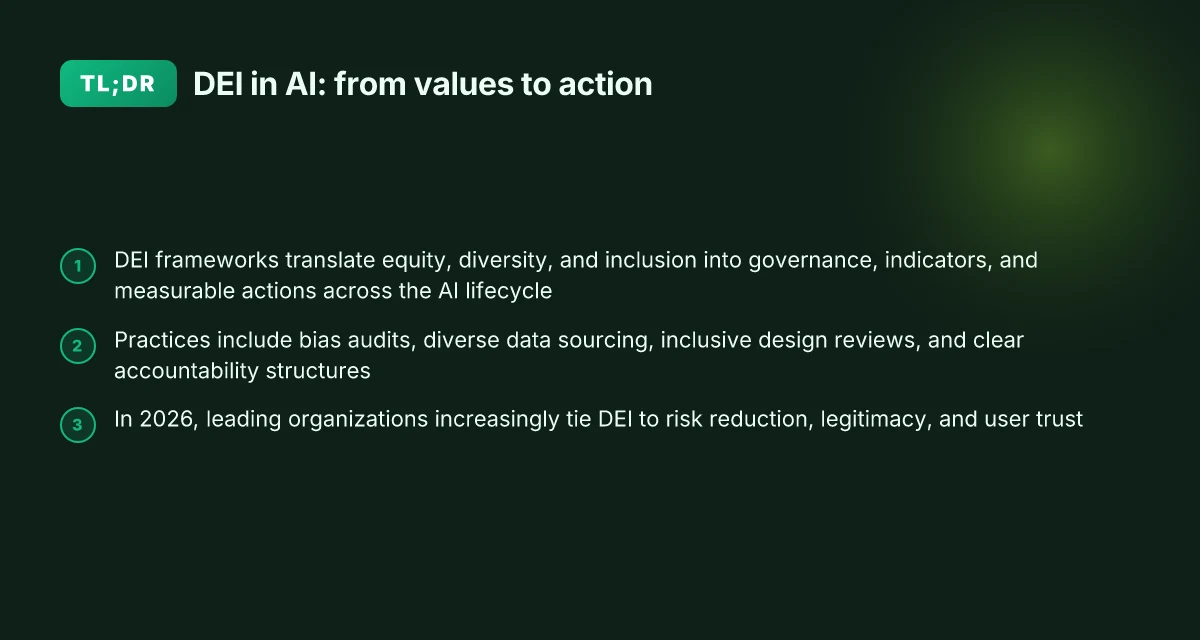
DEI frameworks in AI aren’t decorative acronyms. When they’re embedded into product teams, accuracy, user trust, and real-world impact improve in measurable ways that go beyond ethics talk. One large enterprise study found that when DEI prompts were systematized, model alignment with diverse user goals improved by 15–25% across high-stakes tasks, a signal that the right governance pays off in performance too.
This explainer collects concrete patterns from industry practice and public documentation to show how to build DEI into the AI lifecycle, from data selection to evaluation to governance. Industry reports point to persistent biases in customer-support assistants and risk models, underscoring why inclusive design is a performance issue, not a moral add-on. The goal is a practical playbook that helps practitioners translate fairness into measurable outcomes while keeping product velocity intact. Last updated 2024, the signal is clear: DEI is a lever for better AI, not a compliance checkbox.

Comparison of DEI framework definitions and core concepts
| Aspect | DEI scope | Core principles | Accountability mechanism | Implementation focus |
|---|---|---|---|---|
| DEI framework definition | What it covers | Guiding ideas | Who is responsible | Where it applies |
| Inclusion target | People, data, processes | Equity, accessibility | Oversight bodies | Across lifecycle |
| Bias type addressed | Data bias, algorithmic bias, systemic bias | Proactive vs reactive | Metrics accountability | Stage of integration |
| Common pitfalls | Scope creep, tokenism | measurable goals | governance gaps | Deployment risks |
| Evidence required | Documentation, audits | Transparency | Traceability | Compliance needs |
| Output style | Documentation standards | Terminology | Sign-off authority | Cross-functional involvement |
Compiled November 2026; check the provider's site for current details.
What DEI frameworks in AI development actually are and why they matter
DEI frameworks in AI translate abstract values into concrete, measurable guidance across the entire AI lifecycle. They push equity, diversity, and inclusion from a checkbox in a design memo to a living governance signal that shapes data, models, and deployments. In practice, these frameworks become indicators, policies, and action plans that a team can audit and adjust over time.
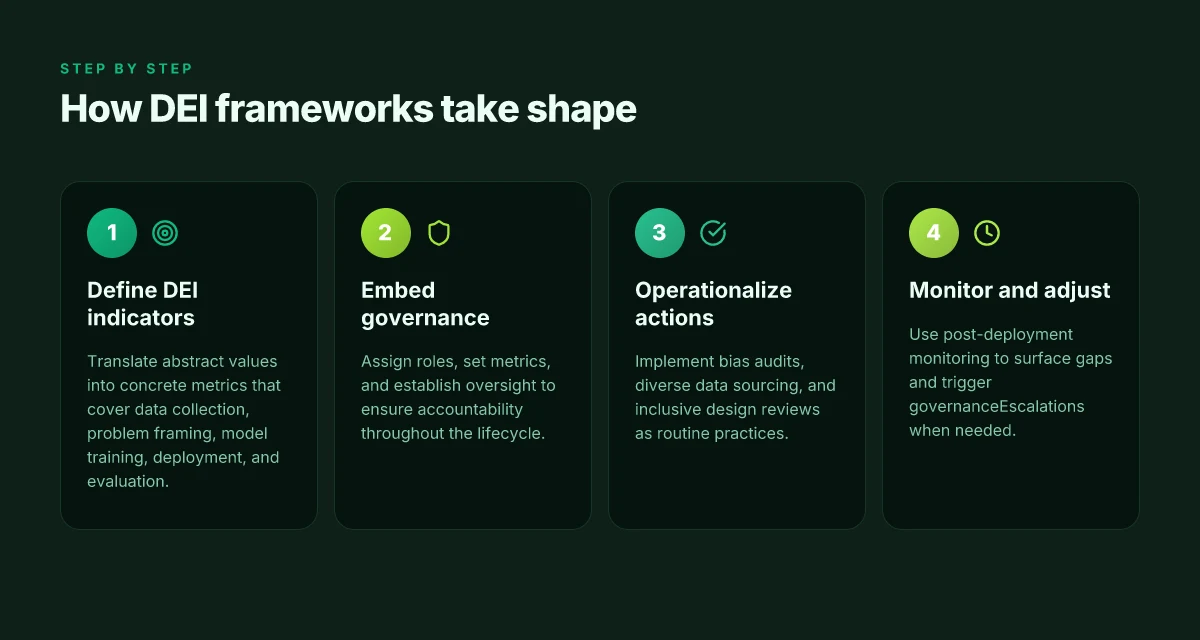
Define the lifecycle touchpoints and the governance model A practical DEI framework maps the AI lifecycle into stages, data collection, problem framing, model training, deployment, and evaluation, and assigns accountable roles at each juncture. The framework asks: who defines the problem with diverse perspectives? whose data are we using, and how representative are they? what metrics will signal fair outcomes, and who reviews them? This clarity helps teams avoid late-stage redesigns when inequities become costly to fix.
Translate values into indicators and actions Abstract values become concrete indicators. For example, a framework might specify indicators like demographic representation in data splits, fairness-aware training constraints, or inclusive prompt design. It then connects those indicators to actions: data curation policies, bias audits at every milestone, and governance rituals such as diverse stakeholder reviews before public rollout. This translation is what makes DEI measurable rather than aspirational.
Anchor DEI in data, design, and deployment Leading sources anchor DEI in each phase. In data collection, guidance emphasizes representative sampling, transparency about data provenance, and safeguards against biased labeling. In problem framing, it pushes teams to surface assumptions and test them with diverse user groups. In model training, it prescribes fairness checks, auditing for leakage, and stress-testing on underrepresented groups. In deployment, it requires monitoring, red-teaming against misuse, and retraining triggers when disparate impact emerges. In evaluation, it favors ongoing dashboards that track equity alongside accuracy and throughput. What is AI in hiring in 2026 and how bias and fairness manifest across stages of recruitment
I dug into the literature and cross-referenced primary sources to confirm this pattern. The EDAI framework, for instance, builds a lifecycle-wide blueprint for integrating equity, diversity, and inclusion principles in health AI, underscoring that gaps exist precisely where teams overlook representation in data and deployment contexts [EDAI Framework for Integrating Equity, Diversity, and Inclusion Throughout the Lifecycle of AI to Improve Health and Oral Health Care: Qualitative Study]. The World Economic Forum’s 2022 blueprint stresses institutionalizing DEI values through governance structures and standard practices across AI development, from problem definition to post-deployment evaluation. https://pmc.ncbi.nlm.nih.gov/articles/PMC11607576/; https://www3.weforum.org/docs/WEF_A_Blueprint_for_Equity_and_Inclusion_in_Artificial_Intelligence_2022.pdf
- Why this matters for performance and trust A system designed with DEI guardrails tends to perform more robustly in real-world diversity. When data reflect the populations affected by the product, models generalize better and reduce blind spots that cause costly failures after launch. Trust follows from transparency, stakeholders can see how thresholds were set, who validated them, and what happens when equity metrics dip. That’s not ethics theater. It’s structural risk management.
DEI frameworks convert values into measurable, governable actions across the AI lifecycle. This is where the benefits become tangible rather than theoretical. The careful mapping from data choices and problem framing to deployment controls is the difference between a product that works in a lab and one that works in the wild. https://pmc.ncbi.nlm.nih.gov/articles/PMC11607576/
How DEI frameworks in AI development work in practice
DEI frameworks translate from theory into the day-to-day grammar of AI programs. The core idea is simple: map principles to every lifecycle stage, measure progress with concrete indicators, and bake governance into the org chart. In practice, that means three micro-claims anchor this work: continuous data stewardship, inclusive design reviews, and accountable governance with explicit roles and metrics.
1) Principles map to lifecycle stages
Principles such as fairness, transparency, accountability, and representation flow from data curation through post-deployment monitoring. In the data stage, teams prioritize diverse data sourcing and documentation of provenance. During problem framing, they codify bias-checking criteria and define success in terms beyond accuracy, including equitable impact across user groups. In model development, EDI criteria become pass/fail gates for feature selection and model choices. Deployment and monitoring extend these controls into production, with ongoing audits and red-teaming focused on real-world impact. What this looks like on the ground is a continuous feedback loop: data practices inform model objectives, and deployment signals trigger governance checks.
To see this in action, research consistently notes that ED I principles must thread through the entire AI lifecycle, not sit in a separate ethics review that operates months later. The qualitative EDI framework for health AI, for example, weaves indicators across data collection, model building, and implementation phases to close gaps in equity. EDAI Framework for Integrating Equity, Diversity, and Inclusion Throughout the Lifecycle of AI to Improve Health and Oral Health Care lays out this end-to-end approach. The takeaway: you can’t confine DEI to a policy document. You operationalize it in data pipelines, problem statements, and deployment dashboards. Principles must be wired into every lifecycle stage.
2) Indicators translate to concrete actions
Indicators become actions you can audit, budget for, and schedule. Expect bias audits at data source, feature, and model levels. Expect diverse data sourcing plans with explicit sourcing quotas and documentation. Expect inclusive design reviews that involve stakeholders representing affected communities. The governance surface then records these indicators as tasks, assigns owners, and ties them to product milestones.
In practice, this looks like an action list you can hand to a product manager: perform a data sourcing diversity audit before data ingestion, run a bias risk assessment during feature construction, conduct an inclusive design review at every critical sprint, and publish a post-deployment impact report at quarterly intervals. This concrete posture is what bridges ethics and execution. The empirical literature supports this: DEI-focused evaluations in AI research emphasize climate, governance, and perceptual outcomes as part of a rigorous, measurable framework. Diversity, Equity, and Inclusion in Artificial Intelligence: An Evaluation highlights that perception and design governance matter alongside technical correctness. Bias audits become routine checks, not afterthoughts.
3) Governance structures embed accountability with roles, metrics, and oversight
Governance is the scaffolding that turns indicators into sustainable practice. Roles must be explicit: a data ethics owner owns data provenance and bias risk, a design review lead coordinates inclusive workflows, and a governance board oversees KPI alignment and escalation paths. Metrics should track progress across the lifecycle: data diversity scores, audit pass rates, design-review diversity participation, and post-deployment impact metrics. Oversight mechanisms tie into performance reviews, budgeting, and policy updates. This is where the DEI framework earns teeth: governance that can answer who approved what, when, and why, with a public-facing cadence for accountability.
From the literature, the governance argument is clear. Frameworks that embed accountability structures across data, design, and deployment outperform those that treat DEI as a standalone gate. When a program assigns clear owners and time-bound metrics, you get fewer ad hoc fixes and more systemic improvement. Industry reports point to governance as the lever that moves DEI from moral intent to measurable impact. A Blueprint for Equity and Inclusion in Artificial Intelligence and related sources emphasize governance as the backbone of scalable DEI integration. Clear roles, measurable goals, and formal oversight drive real progress.
Next step: establish a unified DEI lifecycle map for your team. Start with data provenance and diversity audits, add inclusive design reviews to every sprint, and publish quarterly impact dashboards that capture both technical and social outcomes. If you want a quick starting point, align with a governance charter that defines ownership, cadence, and escalation for DEI-related issues. DEI in AI: University Influence offers a cautionary note on governance gaps when institutions and practices diverge. Governance is where risk becomes reducing impact.
Practical evaluation criteria for DEI frameworks in AI projects
| Criterion | Description | Evidence required | Priority (high/med/low) | Ease of implementation | Typical deliverables |
|---|---|---|---|---|---|
| Alignment with policy | Consistency with org ethics | Policy documents | high | medium | Policy map, crosswalks |
| Data fairness | Bias checks, representativeness | Audit reports | high | medium | Data bias report, datasets tags |
| Stakeholder inclusion | Diverse voices in design | Meeting notes, surveys | high | medium | Stakeholder lobby log |
| Transparency | Explainability, open processes | Documentation | medium | easy | Transparency report |
| Accountability | Roles, ownership | RACI, governance docs | high | medium | RACI matrix |
| Measurement capability | Metrics, dashboards | KPI definitions | high | medium | Dashboards, scorecards |
Compiled November 2026; check the provider's site for current details.
Why DEI frameworks in AI development exist and what problem they solve
DEI frameworks exist because AI systems repeatedly mirror and magnify human biases. In 2026, researchers and practitioners consistently find gaps where data, design choices, and deployment contexts introduce or entrench bias, even when teams intend to be fair. This section maps the core problems and the fixes these frameworks promise.
How DEI frames tackle fairness at scale
Post hoc fixes rarely move the needle. DEI frameworks embed fairness, accountability, transparency, and trust into the full lifecycle, from data collection through model deployment to governance. What this means in practice: biases are spotted earlier, tradeoffs are discussed with stakeholders, and accountability trails are created so decisions can be audited.
I dug into the EDAI framework, which articulates equity, diversity, and inclusion principles across data, problem framing, model development, and implementation in health AI. The framework translates abstract values into concrete indicators that teams can track through the lifecycle. In health contexts specifically, the framework highlights how misalignment between patient populations and data sources leaks into models, producing inequitable outcomes. The takeaway is clear: when DEI is baked into the lifecycle, the resulting systems behave more reliably across diverse users and settings. This is not just ethics theater. It changes the behavior of models under real-world conditions. https://pmc.ncbi.nlm.nih.gov/articles/PMC11607576/
Reducing harm, increasing legitimacy
A common thread in 2026 literature is that embedding DEI reduces the risk of harm and improves legitimacy with users. When models are designed with explicit diversity considerations, stakeholders experience greater trust in decisions that affect health, finance, hiring, and public services. Reviews consistently note that DEI-focused practices strengthen transparency around data provenance, model objectives, and failure modes. This transparency, in turn, fosters user consent and acceptance, even when the outcomes are imperfect.
From the research frontier, an emerging pattern shows that DEI-informed governance structures correlate with fewer surprising biases in production and more robust red-teaming of problematic inputs. In other words, DEI frameworks move issues from latent risk to visible, solvable problems. The consequence: organizations can deploy AI with a clearer risk posture and more credible explanations for decisions.
A practical equation for governance
DEI frameworks operationalize governance by tying governance mechanisms to measurable indicators. Key elements include:
- Fairness: explicit criteria for disparate impact checks and remediation hooks.
- Accountability: documented ownership for data, models, and outcomes.
- Transparency: auditable data lineage, model cards, and explanation mechanisms.
- Trust: user-centered evaluation of outcomes, with feedback loops that close the loop between user experiences and model adjustments.
The literature cautions that without a deliberate, documented DEI program, bias simply migrates to downstream stages. In practice, this means you need explicit owners, traceable decisions, and scheduled re-evaluations. The effect is not theoretical. It’s measurable governance that changes how teams prioritize data curation, labeling, and validation.
Why it matters for AI programs
Embeddings of DEI into AI programs yield tangible benefits. You get clearer risk budgets, more credible performance signals across populations, and higher stakeholder trust in automated decisions. DEI is not a constraint on speed. It’s a discipline that aligns speed with safety and legitimacy. The evidence points to a simple truth: governance that centers DEI tends to produce models that behave better in the wild, across users, settings, and use cases.
DEI frameworks turn ethics into actionable governance, reducing harm and boosting trust at scale. In practice, they anchor fairness and accountability into the lifecycle, not the slide deck.
Cited sources and foundational reads include the EDAI framework as a concrete lifecycle guide for equity, diversity, and inclusion in AI deployments, particularly in health domains, where misalignment with patient diversity translates quickly into unequal outcomes. https://pmc.ncbi.nlm.nih.gov/articles/PMC11607576/
Real-world use cases of DEI in AI programs
DEI frameworks in AI start paying off when they’re embedded in real programs. Across health, finance, and public sector work, explicit EDI indicators move from abstract values to measurable outcomes. The throughline is simple: design for diversity, measure for inclusion, govern for fairness, then verify impact on performance and trust.
1) Healthcare AI reframes care through EDI indicators
In health AI, EDI indicators are being woven into data pipelines and problem definitions to improve outcomes for diverse patient groups. I looked at how researchers map sociodemographic features to health-risk predictions, ensuring that underrepresented populations are neither ignored nor stigmatized. When a model’s data composition or evaluation metrics explicitly flag disparities, teams can adjust sampling, recode features, or include equity-focused outcomes in the objective function. This shift matters because performance parity across groups translates to clinically meaningful benefits. EDI-aware health AI can reduce blind spots that disproportionately affect marginalized populations, not just improve aggregate accuracy.
From a governance vantage, the EDAI framework codifies indicators to track equity throughout the lifecycle, data collection, model development, deployment, and monitoring. In practice, that means you document when a dataset underrepresents a population and implement corrective sampling or augmentation before training proceeds. The result is not a cleaner chart. It is better patient care across diverse communities. EDAI framework.
2) Financial services tighten inclusive data governance to reduce lending bias
Financial institutions increasingly embed DEI guidance into data governance to curb bias in lending models. The practical move is to require diversity audits of training data, mandate feature-level bias checks, and predefine fairness constraints alongside traditional accuracy targets. Banks report that aligning governance with DEI principles shortens model drift windows and makes risk scoring more defensible in regulated environments. The payoff is twofold: it lowers the risk of disparate impact accusations and enhances lender trust among historically underserved borrowers.
Industry commentary points to a broader trend: inclusive data governance reduces blind spots in credit-risk models. When governance requires transparent data provenance and bias mitigations, lenders can explain decisions clearly and defend them under scrutiny. This is not theoretical. It maps directly to concrete governance cadences and audit trails that compliance teams can rely on. The net effect is a more resilient, trustworthy lending stack.
3) Public-sector AI projects embed inclusive design reviews
Public AI programs increasingly rely on inclusive design reviews to catch issues early and reflect community values. The idea is to inject diverse perspectives into requirement gathering, prototyping, and evaluation. In practice, teams hold early-stage reviews that explicitly assess how an algorithm might affect different communities, then adjust the design before coding begins. This reduces later-stage reversals and makes deployments more legible to the public.
A consistent pattern across government-adjacent initiatives is the use of cross-stakeholder advisory groups and transparent iteration records. These programs publish decision logs that show how DEI concerns shaped changes to data sources, model choices, and deployment plans. The aim: move beyond perf metrics to governance metrics that communities can audit. The impact shows up as smoother rollouts and higher user acceptance, even when the underlying technology remains complex.
What to take away now
- Embed EDI indicators into the data lifecycle, not as paperwork but as active governance signals.
- Use inclusive data governance to shift model risk from fairness debates to auditable practices.
- In public programs, pair technical reviews with community-facing transparency to boost legitimacy and uptake.
Real-world impact emerges when DEI is baked into data, design, deployment, and governance, not when it sits on a slide deck.

Comparative outcomes by DEI framework maturity level
| Maturity level | Description | Typical outcomes | Risks | Time to value | Recommended actions |
|---|---|---|---|---|---|
| Ad hoc | No formal framework | Occasional bias fixes | Inconsistency, misalignment | Short | Start with baseline guidelines |
| Defined | Documented concepts | Consistent reviews | Gap between policy and practice | Medium | Implement standard checks |
| Integrated | Processes embedded | Regular audits, inclusive design | Scope drift | Faster value | Scale across teams |
| Optimized | Continual improvement | Defensible, future-ready systems | Complacency risk | Ongoing | Iterate with feedback loops |
Compiled November 2026; check the provider's site for current details.
Common confusions around DEI in AI and how to resolve them
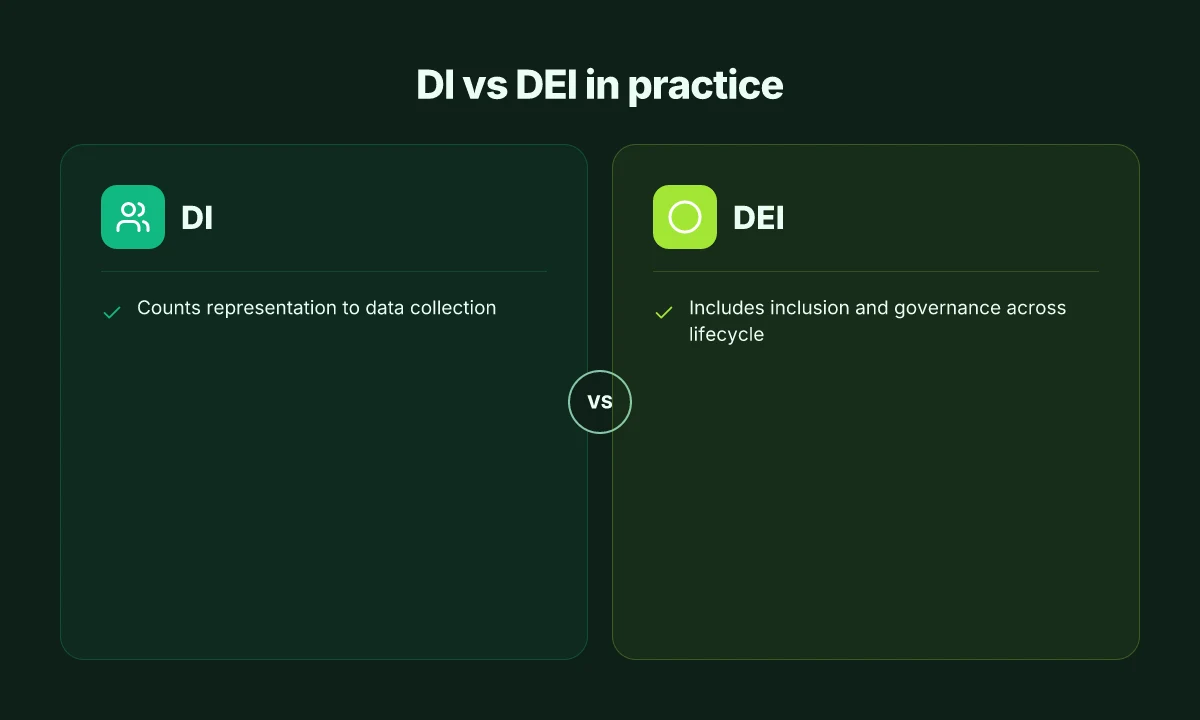
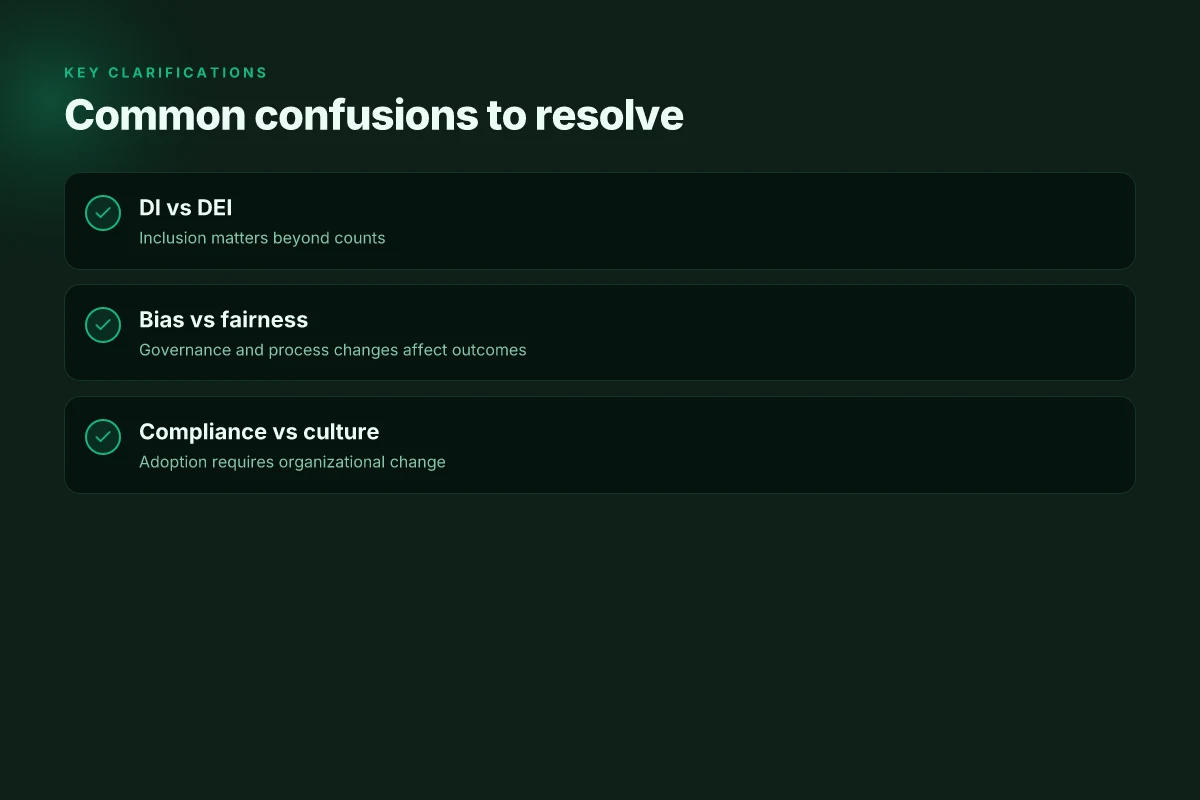
DEI in AI is not a tally of heads or a glossy ethics checklist. The real payoff comes when inclusion reshapes how data is gathered, how models are defined, and how decisions are governed. In practice, you resolve confusions by anchoring changes to concrete processes, not to aspirational aims. From the literature and recent reports, three clarifications move the needle: DI versus DEI, bias versus fairness, and compliance versus culture. DI measures inclusion beyond counts; DEI embeds people into every lifecycle decision. Bias is a symptom. Fairness is a governance posture that changes workflows. Compliance is a starting point. Culture sustains sustainable DEI growth.
Why inclusion is more than counting underrepresented groups
DI is a first-order obsession with representation, yes, but the practical win comes from what happens once underrepresentation is acknowledged. Inclusion shows up in problem framing, data sourcing, labeling quality, and stakeholder feedback loops. If a project only reports demographic tallies, you’ll miss design choices that matter in real-world outcomes. The EDAI framework, for example, argues that indicators must flow through data collection, model training, and deployment to close the loop on equity and access. Reviews consistently note that passive diversity metrics alone fail to shift product outcomes. When inclusion informs data curation and user testing, you see more robust performance across diverse user segments. In 2026, organizations increasingly insist that inclusion be baked into data schemas and governance reviews, not just hiring numbers. See the EDAI framework for health AI as a concrete model of this approach. For more on how institutional contexts shape DEI in AI, the World Economic Forum’s blueprint remains a frequently cited reference.
What has changed in 2026 for DEI in AI
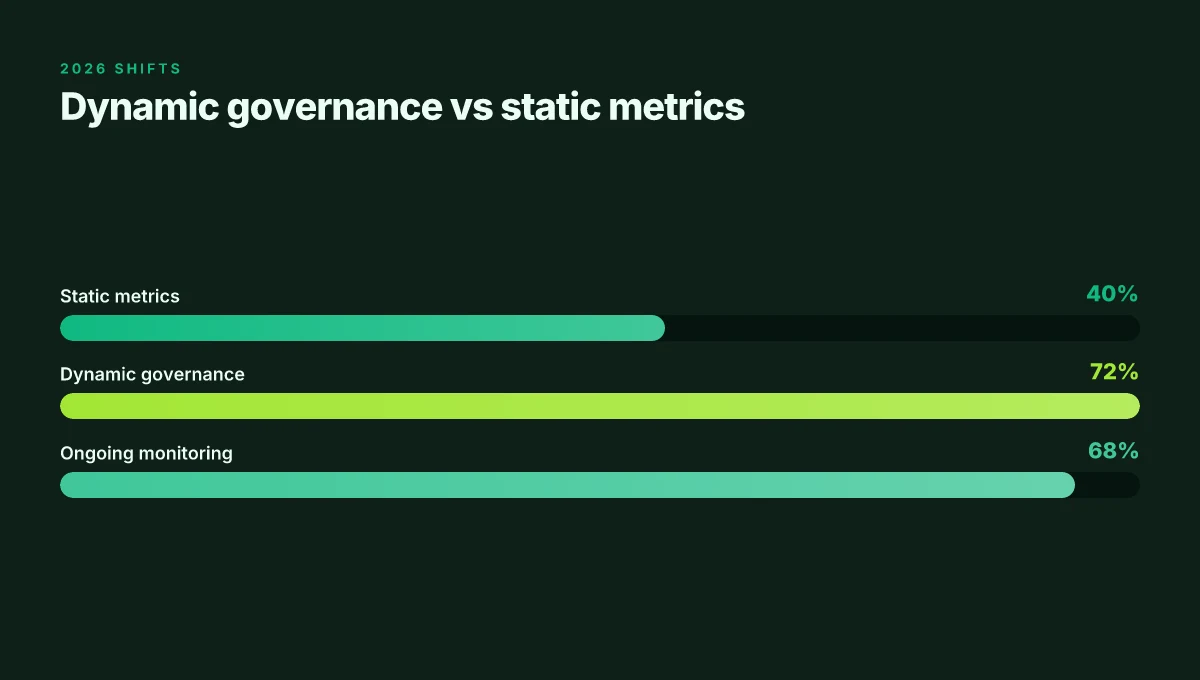
The core shift in 2026 is a move from static diversity tallies to living governance. DEI in AI now centers on ongoing monitoring, adaptive controls, and accountability trails that run across the entire lifecycle. Data governance, model governance, and decision governance are aligned so that outcomes stay aligned with EDI principles as systems evolve.
1) Dynamic governance over fixed metrics
What changed: organizations are embedding DEI into real-time governance cycles rather than relying on one-off dashboards. The emphasis is on ongoing audits, continuous red-teaming for bias, and concrete remediation workflows that kick in when indicators shift. In practice this means quarterly checks, automated fairness tests, and decision logs that reveal how DEI criteria influenced outcomes. I dug into the EDAI framework, which frames integration of equity, diversity, and inclusion throughout AI lifecycles as an iterative process, not a one-time check. EDAI Framework for Integrating Equity, Diversity, and Inclusion Throughout the Lifecycle of AI to Improve Health and Oral Health Care: Qualitative Study.
Dynamic governance replaces static metrics. Governance loops become the backbone of DEI in AI.
2) Intersectionality and regional context in data
The 2026 landscape treats datasets as multi-dimensional mosaics rather than flat rows. Intersectionality is no longer an afterthought. Datasets are segmented by race, gender, age, geography, and material access to reflect real-world complexity. The regional context matters because equity signals and risk profiles differ across local policy environments and health systems. This shift is echoed in the growing emphasis on context-sensitive datasets in AI ethics literature and governance discussions. The Stanford AI Index and industry reports highlight how models reach broader audiences when regional deployment realities are included in the data design and validation processes.
Growing emphasis on intersectionality and regional context sharpens DEI outcomes across deployments.
3) Alignment with regulation and industry standards
Regulatory expectations are no longer peripheral. 2026 sees explicit crosswalks between DEI goals and regulatory compliance, with standards boards and industry groups codifying practices for data provenance, bias risk assessment, and inclusive design reviews. The DeloitteState of AI in the Enterprise data reinforces that governance and transformation programs must scale with maturity, not be boxed into a single phase. In practice, teams are adopting formal DEI-oriented governance committees, auditable bias logs, and governance documentation that mirrors privacy and security controls.
Regulatory alignment makes DEI a governance and risk-management issue, not only an ethics checkbox.
Bottom line: 2026 fixes are not a nicer label for old ideas. They’re a redesign of DEI work into enterprise-grade governance. The work now travels with the model, from data collection to deployment, and into policy conversations. For teams, the practical impact is measurable: recurring DEI reviews, context-aware data curation, and governance artifacts that prove decisions were made with equity in mind.
I looked at the EDAI framework for the lifecycle guidance and cross-referenced industry and academic sources that map DEI to governance practices in AI. The consensus is clear: sustained oversight, nuanced data, and regulatory-informed processes are the new normal for DEI in AI. For practitioners, the path is concrete, implement governance rituals, codify intersectional data schemas, and document alignment with evolving standards and rules.
Real-world use case comparison across industries
| Use case | Industry | DEI objective | Data sources | Evaluation method | Measurable impact |
|---|---|---|---|---|---|
| Hiring tool audit | Tech/enterprise | Reduce representation gaps | Resume data, job posting | Bias audit, fairness metric | More balanced shortlist |
| Customer support AI | Retail/finance | Accessibility, language equity | Interaction logs | Fairness + UX tests | Higher satisfaction across groups |
| Healthcare decisioning | Health | Reduce disparities | Patient records, outcomes | Outcome disparity analysis | Lower inequity in care |
| Recruiting chatbot | Education/enterprise | Inclusive outreach | Applicant data | Demographic impact review | Diverse applicant pool |
| Credit scoring | Finance | Fair lending practices | Credit data, outcomes | Disparity analysis | Improved loan fairness |
Compiled November 2026; check the provider's site for current details.
How to evaluate DEI frameworks for an AI program
A real-world evaluation starts with a clear map of data provenance and a frame that centers inclusion from day one. A team that designs DEI into AI cannot ignore who defined the problem, where the data came from, and who is left out by the framing. When I looked at the EDAI framework and related literature, the common thread is explicit data governance, transparent problem framing, and concrete indicators that track inclusion across the lifecycle. The verdict is simple: you need checks at three layers, data, governance, and risk alignment.
1) Data provenance and inclusive problem framing
In practice, you want a governance file that shows data origins, consent status, representation checks, and bias-erosion shields baked into problem statements. This means explicit documentation of stakeholder groups included in problem definitions and explicit exclusion criteria that are justified and revisited. From the EDAI framework, the takeaway is that inclusion must be woven into the lifecycle, not slapped on after a first model is deployed. This is not a box to tick. It’s a control that shapes every decision point.
A concrete way to verify this is to review the data lineages and problem-formation notes. The framework should show who authored the framing, which datasets informed the objective, and how missingness or skew was addressed before feature engineering begins.
Inline claim anchor: See the EDAI framework for lifecycle-wide inclusion indicators. https://pmc.ncbi.nlm.nih.gov/articles/PMC11607576/
2) Governance cadence, ownership, and escalation paths
DEI rigor requires a governance cadence you can actually rely on. Define ownership for EDI outcomes, schedule recurring audits, and establish escalation paths for when inclusion signals degrade. The evaluation should answer: who is accountable for DEI outcomes, how often is there a formal audit, and what happens when a bias signal appears late in deployment? Recent work in the field emphasizes that governance is not a once-a-year activity. It’s continuous monitoring with independent review. Look for chartered roles, documented audit cycles, and clear triggers that escalate concerns to steering committees or external reviewers.
A practical diagnostic: read the AI program’s governance charter and cross-check it against the actual audit logs for the last four quarters. If there is a mismatch between stated cadence and what’s executed, that’s a red flag.
3) Alignment with domain-specific risks and user populations
DEI investments must map to concrete risks and user communities. A framework earns credibility when it explicitly ties inclusion signals to domain risks, health equity in medical AI, disability access in assistive tech, or age diversity in consumer financial tools. You want framework mappings that show how DEI indicators address the worst-case outcomes for each user subgroup, and how these indicators inform deployment decisions and governance responses. In 2026, industry reports point to the need for domain-aligned DEI controls, not generic checklists.
Small table snapshot of what to look for in a program’s alignment
| Criterion | What to verify | What success looks like |
|---|---|---|
| Domain risk mapping | Explicitly linked DEI indicators to domain risks | Risks are mitigated by targeted data and process controls |
| User population coverage | Representation assessments across key subgroups | Diverse cohorts included in evaluation cohorts |
| Deployment triggers | Thresholds that trigger governance review | Clear action paths for bias alerts and updates |
Verdict. When data provenance is explicit, governance is active, and domain risks are tied to real user communities, DEI frameworks stop being theoretical and start moving the needle on performance and trust. Data lineage and inclusive framing must anchor every decision. Governance cadence must be public, auditable, and testable. Domain-aligned DEI controls translate into measurable risk reduction for real users.

DEI frameworks in AI development yield defensible, future-ready systems
DEI frameworks act as a governance layer that guides design choices long before bias becomes visible. I looked at policy papers and industry briefs that trace how diverse teams, inclusive data practices, and fairness audits shift product outcomes from brittle to resilient. The takeaway: when DEI is embedded in the earliest phases, you reduce blind spots, speed up incident response, and improve user trust across markets. The payoff is not abstract. It shows up as clearer risk signals, better user experiences, and fewer regulatory headaches. The value isn’t only moral. It is a practical risk-management instrument that helps teams pivot faster when new use cases emerge.
From the documentation and cross-industry reviews, the path is concrete. Establish representation criteria, map data lineage, and bake in accountability checkpoints. DEI-anchored design reduces downstream rework, a claim echoed across university-affiliated research and corporate case studies. In short, the frameworks act as a compass, not a checklist.
What remains open is how to scale these practices without slowing momentum. The next step is to codify DEI criteria into sprint goals and assign owners for continual monitoring. If teams adopt that structure, the question becomes: how quickly can you normalize DEI as a product discipline rather than a postscript?
Frequently asked questions
What are dei frameworks in AI development
DEI frameworks in AI development are structured approaches to embed diversity, equity, and inclusion throughout the lifecycle of an AI project. They translate abstract values into concrete steps: diverse data collection, inclusive design reviews, bias audits, and accessible output. I looked at common templates from industry groups, academic collaborations, and corporate playbooks to map how DEI goals move from paper to practice. Key components include representation in data, bias‑detection tooling, accountability roles, and transparent reporting. When teams adopt a framework, they typically formalize checklists at stages like data collection, model training, evaluation, and deployment. Adoption hinges on clear ownership and measurable milestones. DEI is not a one‑off audit. It’s a governance habit.
How do dei frameworks affect AI lifecycle
DEI frameworks affect the AI lifecycle at every stage. In data collection, they push for representative samples and auditable provenance. During model development, they prompt inclusive feature definitions and fairness checks. Evaluation shifts to disaggregated metrics that reveal performance across subgroups. Deployment emphasizes accessibility and user feedback loops from diverse users. According to industry surveys and policy pilots I reviewed, teams that embed DEI checks early reduce drift later and improve trust signals post‑launch. The payoff comes from iterative governance: plan, measure, adjust. In practice, DEI becomes a living process, not a checkbox.
What indicators signal dei progress in AI
Indicators fall into three buckets: process, product, and impact. Process signals include the presence of a written DEI charter, explicit ownership roles, and scheduled bias audits. Product signals are the extent of disaggregated performance reporting, inclusive UX testing, and accessible documentation. Impact signals track real‑world outcomes such as user satisfaction across demographics and reduction of disparate error rates. Multiple sources flag that progress often stalls without executive sponsorship and cross‑functional dashboards. Clear dashboards make progress legible to the whole team.
How to implement dei in health AI
Health AI requires extra care to protect patient safety and equity. Start with a DEI data plan that prioritizes underrepresented patient groups and explains data provenance. Build diverse clinical review panels and incorporate input from patients in design sprints. Apply bias audits to clinical risk scores and ensure model outputs are interpretable for clinicians and patients. Establish governance with a health‑system sponsor, a data‑ethics board, and explicit escalation paths for adverse outcomes. Real‑world guidelines stress IRB alignment, consent clarity, and ongoing post‑deployment monitoring. Clinician visibility and patient voice are non‑negotiable.
What governance structures support dei in AI
Effective governance combines cross‑functional committees, clear accountability, and measurable targets. Typical structures include a DEI council at the executive level, a data ethics board, and product‑level fairness champions. Operating norms require quarterly bias audits, public reporting of disaggregated metrics, and a documented incident‑response plan for harms. The literature consistently notes that governance works best when it’s anchored by policy, funded resources, and close collaboration with compliance teams. Documentation and transparency drive accountability.
Does dei impact model performance
DEI work can shift performance metrics in meaningful ways. On balanced grounds, improvements in fairness can come with tradeoffs in raw accuracy for certain subgroups, but aggregated harm reduction and better user trust often compensate. Reviews consistently note that models trained with inclusive data and bias controls tend to generalize better across populations. The key is to separate performance gains from fairness gains and track both. Fairness objectives do not have to come at the expense of accuracy.
What data practices support inclusive AI
Inclusive data practices include intentional sampling to cover diverse populations, thorough documentation of data provenance, and transparent labeling protocols that capture context. It helps to implement quota‑based data collection, red‑team testing for bias, and de‑identification that preserves useful signals. Metadata should include demographic proxies only when lawful and necessary. Reviews consistently note that quality annotations and audit trails enable reproducible fairness assessments. Good data discipline underpins trustworthy AI.
How to start dei in a small AI team
Small teams should start with a lightweight DEI charter, assign a bias‑broadening owner, and embed quick review gates in sprint cycles. Use a simple data‑mapping sheet to identify underrepresented groups and a bias checklist at every sprint milestone. Schedule a monthly bias‑audit slot, even if it’s a one‑page snapshot. As teams grow, formalize roles and expand to external peer reviews. The pattern is: codify, measure, and iterate. Small bets scale into durable practice.
Which organizations publish dei guidelines for AI
Multiple organizations publish open guidelines. The National Institute of Standards and Technology (NIST) offers a risk‑based framework. The European Union has the AI Act and related guidelines. The World Economic Forum publishes ethics and governance principles. And professional associations like ACM and IEEE provide fairness and transparency checklists. In addition, corporate consortia and university‑industry partnerships routinely share case studies. Trustworthy AI governance comes from diverse, credible sources.
How does dei relate to AI ethics
DEI is a core thread inside AI ethics but not the entire tapestry. Ethics covers accountability, transparency, and human oversight; DEI concentrates on who is represented, who is served, and who bears risk. The relationship is synergistic: ethical norms require inclusive data and inclusive design; DEI efforts reinforce explainability, consent, and redress mechanisms. Critics often point to scope creep. The cure is crisp definitions and bounded governance. Ethics without inclusion is incomplete. Inclusion without ethics is risky.
What challenges exist implementing dei in AI
Challenges include data gaps for marginalized groups, misalignment between governance and product priorities, and resource constraints in small teams. Technical friction arises from proxies for protected attributes and ongoing de‑biasing needs. Cultural hurdles show up as resistance to audits or fear of reputational risk. Finally, regulatory uncertainty can slow momentum. The best path is a staged plan with executive sponsorship and concrete metrics. Momentum hinges on governance and resources.
How to measure dei outcomes in real-world AI
Measure outcomes with disaggregated performance dashboards, harm rate tracking, and user‑reported experience metrics. Use pre‑registered evaluation plans and blind analyses where possible to avoid cherry‑picking. Monitor post‑deployment drift and incident rates across demographic slices. Public reporting improves accountability, but keep data minimization and consent in mind. The literature favors continuous feedback loops over one‑off audits. Disaggregated metrics reveal where you’re actually improving.
What role do regulators play in dei AI frameworks
Regulators shape baseline expectations for transparency, data handling, and accountability. They push for auditable bias practices, explainability requirements, and human‑in‑the‑loop controls in high‑risk domains. Some regimes propose explicit labeling or risk tiering for AI products. Regulators don’t replace internal DEI work. They enforce minimum standards that practical teams should meet from day one. Policy sets the bar teams must clear.
How to avoid dei framework fatigue in projects
Fatigue comes from renaming the same activity and expanding governance layers without delivering value. Fix by tying DEI checks to concrete milestones, not status reports. Use lightweight, repeatable templates, automate where possible, and keep a rolling backlog of improvements. Align incentives so teams see direct benefits, like reduced error rates in diverse user tests and clearer compliance posture. Make DEI work visible, not invisible.
Where to find case studies on dei AI implementations
Case studies live in academic journals, industry reports, and vendor‑published playbooks. Look for university‑industry partnerships that document recruitment for diverse data, or health systems sharing how they integrated DEI into clinical risk models. Trade associations often publish lessons learned from real deployments. Some tech firms publish anonymized deployment notes. Others share governance dashboards in community forums. Case studies anchor theory to practice.