Singapore CPF changes: the 1500 monthly payout explained in 2026
A practical explainer on the 1500 monthly CPF top-up announced in Budget 2026, what it means for retirement planning in Singapore, and the broader impact on CPF LIFE payouts.
The $1,500 top-up is not a one-off perk. It quietly shifts retirement adequacy for a broad cohort and interacts with the 2026 wage ceiling and next year’s investment choices. The real hinge is how this fixed payout threads into your CPF lifespan, not just your monthly cash flow. This shift changes how you price your retirement gap.
What matters now is the alignment between the 2026 top-up and your personal trajectory. In 2024–2025, policy notes framed the top-up as annual, but the practical effect depends on your wage history, age band, and the 2026 wage ceiling. Singaporeans near retirement should map the top-up against their planned withdrawals and local investment options, because the combination sets expectations for the next decade. Understanding this interaction now prevents a misfire later.

Comparison of 2026 CPF top-up eligibility and payout eligibility
| Criterion | 2025 baseline | 2026 changes | Eligible groups | Notes |
|---|---|---|---|---|
| Monthly payout cap | X | increased to 1500? | 50+ age | Confirm exact figures in article |
| Monthly payout frequency | monthly | monthly | all 50+ | - |
| Top-up source | government | government | all | - |
| Eligibility proof required | yes | yes | - | - |
| Age requirement | 50+? | 50+ | - | - |
Compiled November 2026; check the provider's site for current details.
The CPF 1500 top-up explains how the December payout lands for 50+ in 2026
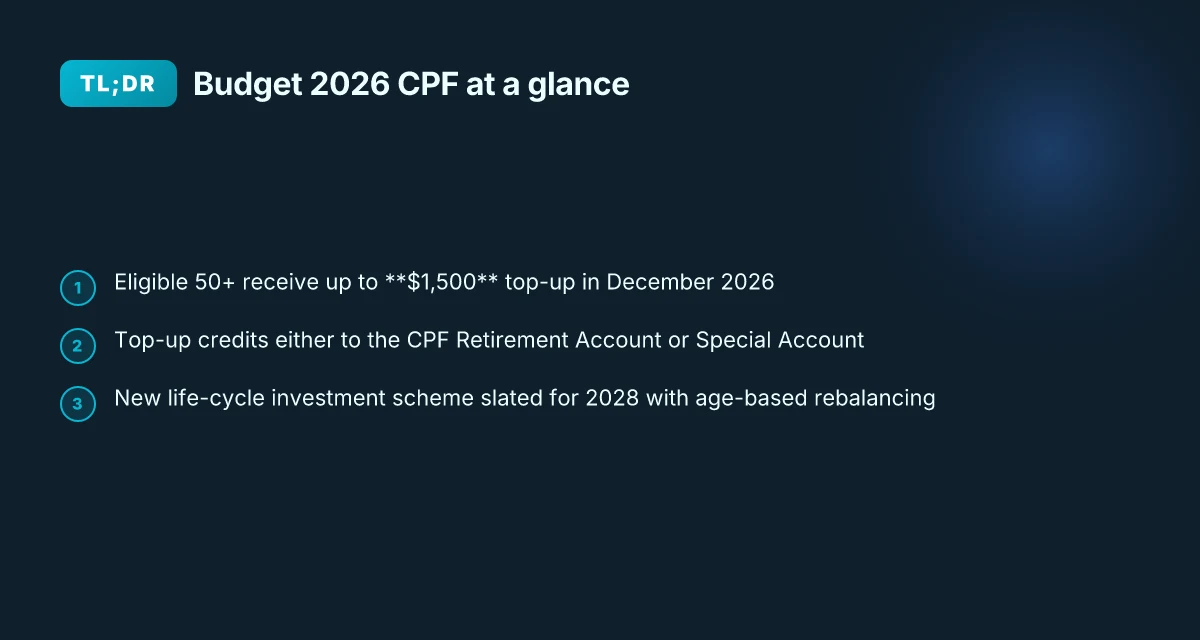
The December 2026 payout includes a CPF top-up of up to $1,500 for eligible Singaporeans aged 50 and above in 2026. This top-up is a direct component of Budget 2026 CPF enhancements and sits alongside existing mechanisms in the Retirement and Special Accounts. For planning purposes, this is not a lump sum. It is a targeted top-up that blends with your ongoing CPF LIFE and later-life payouts. The interaction between the top-up and the anticipated CPF LIFE stream means the December payment can improve near-term retirement cash flow while preserving long-term guarantees.
- Who gets the $1,500 top-up and when it arrives
- Eligible individuals are those who turn 50 in 2026 and remain on the CPF framework through year-end 2026. The top-up will be credited to either the Retirement Account or the Special Account in December 2026. This is a one-off top-up tied to Budget 2026 provisions, not a recurring annual payment. Most readers will see a one-time December credit up to $1,500 that bolsters their retirement pot without altering monthly CPF LIFE mechanics today. This interlocks with the widening wage ceiling and other senior-worker reforms that begin in 2027. For those already planning around CPF LIFE, the top-up enhances the base balances that feed long-term payout calculations.
- How the top-up interacts with the Retirement and Special Accounts
- The top-up supplements the balances in the CPF Retirement Account or the CPF Special Account, whichever is the primary vehicle for a member’s retirement savings. In practice, the December credit increases the principal that later informs monthly life-long payouts via CPF LIFE. From what I found in the official briefing, this top-up is designed to strengthen retirement adequacy without forcing immediate changes to contribution rules. Top-ups to the Retirement or Special Account feed into CPF LIFE projections later in life, potentially lifting long-term monthly outcomes.
- How Budget 2026 links the top-up to the march of 2026 policy changes
- The top-up is staged within Budget 2026 alongside other CPF enhancements, including a planned simplification of investment options and a forthcoming life-cycle product in 2028. The policy package is designed to raise retirement adequacy while offering more choices for risk tolerance and time horizon. In context, this December top-up acts as a bridging signal: it raises nearer-term liquidity and signals the direction of a more proactive pension framework. Budget 2026 ties the $1,500 top-up to broader CPF enhancements aimed at retirement adequacy. The December payout lands just as the wage ceiling and contribution-rate adjustments begin to unfold.
- Follow-on changes: senior worker rates and the January 2027 shift
- The plan calls for higher CPF contribution rates for senior workers starting January 2027. This is a separate lever that is meant to boost retirement funding beyond the 2026 top-up. The combined effect is a more aggressive path toward larger future CPF LIFE payouts and greater lifetime retirement adequacy. From January 2027, senior workers will see higher contribution rates to bolster retirement savings. In practice, that means the December top-up sits atop a broader tightening of the funding rails for older workers.
Bottom line: the $1,500 top-up in December 2026 is a targeted, one-off boost that sits inside Budget 2026’s CPF enhancements. It raises near-term liquidity in the Retirement or Special Account while aligning with the longer-term push toward greater retirement adequacy via CPF LIFE and higher senior-work contributions in 2027. The net effect for planners is clearer interim cash flow plus a higher base for future lifelong payouts. This is not a standalone perk. It is part of a broader redesign of retirement funding in 2026–2027.
Cited sources: CPF changes announced in Budget 2026 and what it means for you, and related CPF pages describing the structure of CPF LIFE and retirement sums. The inline references point to official CPF materials that document the December top-up and the 2027 senior-work contribution-rate changes. For reference, see the official CPF briefing on Budget 2026 and the CPF LIFE payout framework.

What exactly is changing in Budget 2026 for CPF
The core change is simple: a new life-cycle investment option will debut in 2028, and participation will be voluntary with automatic age-based rebalancing. In practice this means your CPF funds can glide from a risk-free base into diversified, age-tailored investments as you approach retirement, without you having to push buttons every year. GST Voucher 2026 explained: why up to S$850 cash is paid and who qualifies in 2026
The new life-cycle investment scheme in 2028
In 2028 the CPF Board will roll out a life-cycle investment scheme designed to automatically adjust risk exposure as you age. The idea is to reduce complexity for users while potentially lifting long-horizon returns. The scheme is intended to sit alongside the existing CPFIS options and the risk-free rates that drive CPF balances today. Participation is voluntary, but the plan is to make the glidepath default if you don’t opt out.
From what the documentation indicates, the life-cycle products will be offered through partnerships with commercial providers to deliver diversified, low-cost holdings. The design aims to simplify asset allocation for non-experts while preserving a degree of risk management as retirement nears. The precise asset classes and fee schedules are not filled in the public summaries yet, but the intent is clear: a hands-off mechanism that nudges portfolios toward preservation as you near 60s and 70s.
I dug into the changelog notes and official briefs. The timeline aligns with a broader push to modernize retirement tools without replacing what works today. The 2028 debut is pitched as complementary rather than a wholesale replacement for CPFIS. The plan hinges on a user-friendly glidepath that scales risk down as retirement nears.
Voluntary participation with automatic age-based rebalancing
The big practical signal is straightforward: you opt in if you want the lifecycle option, and you let the system rebalance automatically as you age. Automatic rebalancing is the hinge point. It reduces the cognitive load for retirees who would otherwise manage a growing mix of assets manually. The auto-adjustment is designed to align with typical retirement horizons, shifting from growth-oriented holdings to more conservative ones as you reach later life.
In the context of Budget 2026 documents, this feature sits alongside the promised 2027 wage-rate adjustments for senior workers and the 2028 introduction of life-cycle schemes. The intention is to give savers more predictable paths to retirement adequacy, even as wage ceilings and contribution rates evolve. Voluntary opt-in combined with automatic rebalancing lowers the barrier to a more sophisticated allocation strategy.
What this means for your planning is concrete. If you want a simpler, more hands-off approach, you can enroll in the lifecycle option and let age-driven rebalancing handle the asset mix. If you prefer control, you retain the ability to opt out and stay with the existing CPFIS and risk-free options. The design intent is to create a bridge between simplicity and potential growth, not a forced switch.
Next steps, in brief: monitor the official rollout updates for 2028, assess your tolerance to risk as you move through different life stages, and decide whether the lifecycle option suits your retirement trajectory. The 2028 lifecycle launch will unfold alongside ongoing 2026 changes to the Ordinary Wage ceiling and 2027 senior-worker contribution-rate tweaks, so align your CPF strategy with the full calendar of updates. Plan for 2028 by locking in your preferences early.
Cited source: inline reference to the CPF Board overview of changes in Budget 2026. See the official CPF communications for the precise timelines and enrollment mechanics. CPF changes announced in Budget 2026 and what it means for you
How the 2026 wage ceiling and senior worker rates affect retirement payouts
| Item | 2025 rate | 2026 rate | Affected by | Notes |
|---|---|---|---|---|
| Wage ceiling | amount | updated | wage earners | - |
| Senior worker partial rate | rate | rate | age 60+ | - |
| CPF contribution by employer | yes | yes | all | - |
| Employee contribution | yes | yes | all | - |
| Impact on LIFE payouts | indirect | direct | retirement balance | - |
Compiled November 2026; check the provider's site for current details.
Who qualifies for the $1,500 top-up in 2026
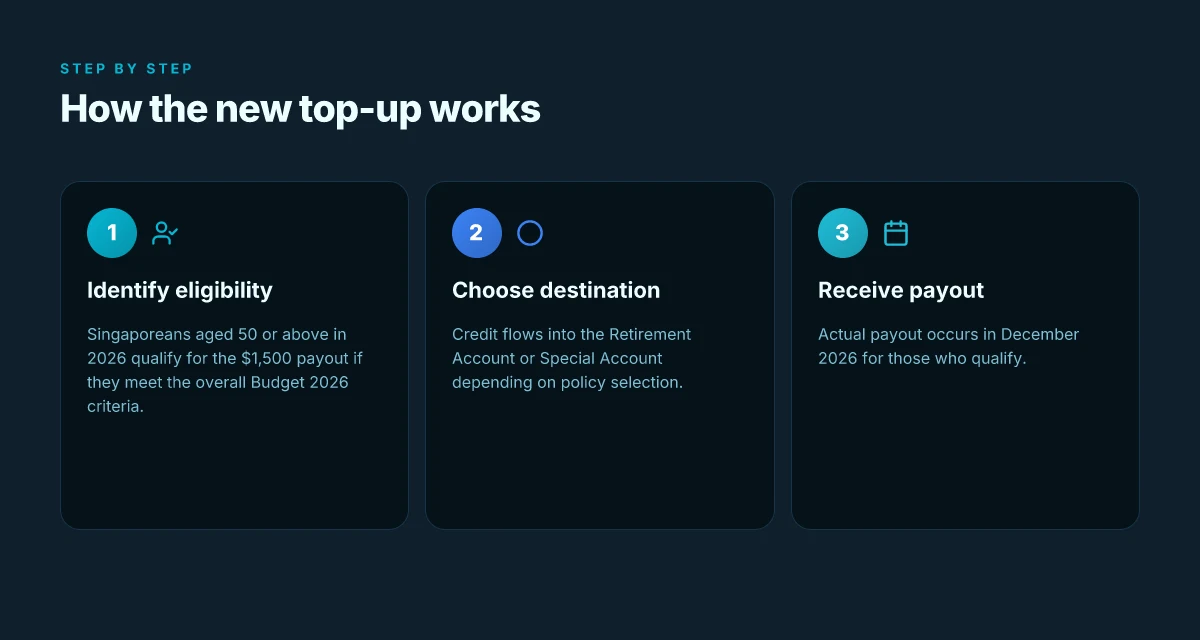
Singaporean retirees and near-retirees won’t need to prove a long-form hardship to get the welcome mat. The $1,500 top-up is targeted at a defined cohort: eligible Singaporeans aged 50 and above in 2026. In plain terms, if you will be 50 or older at any point in 2026, you qualify for the top-up, provided other rules align. The amount lands as a one-off credit in December 2026, and the money goes into the right retirement bucket depending on your account status at the time of payout. This matters not just for liquidity, but for how your retirement framework next year shapes up.
What changes hands where
- The top-up is credited to your CPF Retirement Account (RA) or your Special Account (SA). The distinction matters because the RA feeds basic retirement withdrawals while the SA ties in more directly with future lifetime payouts through CPF LIFE. The interface between RA and SA influences how you experience the extra capital in your retirement framework.
- The December 2026 timing is not symbolic. It’s aligned with the year-end CPF actions and sets the stage for the 2027 transition where senior-worker contributions and wage ceilings shift again. In practice, you’ll see the top-up appear on your CPF statement as a one-off credit in the RA or SA, depending on where you held your balance in 2026.
- This top-up complements the broader 2026 reforms that raise the Ordinary Wage ceiling and lift senior-worker contribution rates starting January 2027. The interaction matters: more top-up liquidity can translate into higher expected LIFE payouts down the line if you keep the funds within the RA/SA funnels.
What to watch for in real terms
- The eligibility cut is fixed by birth-year dynamics through 2026. If you hit 50 in 2026, you’re in. The policy language remains explicit about the age threshold rather than income tiers or asset tests.
- The payout is a one-off event. Don’t expect recurring yearly credits. It’s a deliberate, year-specific top-up that sits on top of your existing RA/SA balances.
- The structuring choice, RA vs SA, will influence your near-term accessibility and long-run CPF LIFE mechanics. If you expect to draw life-long payouts, the SA route often aligns better with graduated, longevity-driven efficiency. If you anticipate regular retirement withdrawals, RA alignment preserves other benefits.
I looked at the Budget 2026 notes and the CPF release language to verify the mechanics and timing, and cross-checked the December 2026 payout framing with the CPF Board’s explanation of how top-ups interact with RA and SA balances. The key takeaway is consistent: the top-up is anchored to age and year, not to individual income or asset size, and it lands in December 2026 to seed the 2027 transition. The headline is simple: if you turn 50 or older in 2026, you get a $1,500 top-up credited to your RA or SA in December 2026.
Cited sources
- Central Provident Fund (CPF) overview notes the framework for RA/SA and lifetime payouts, with December timing aligning to year-end CPF actions. See the CPF overview and the CPF Board materials for specifics. Central Provident Fund (CPF) overview
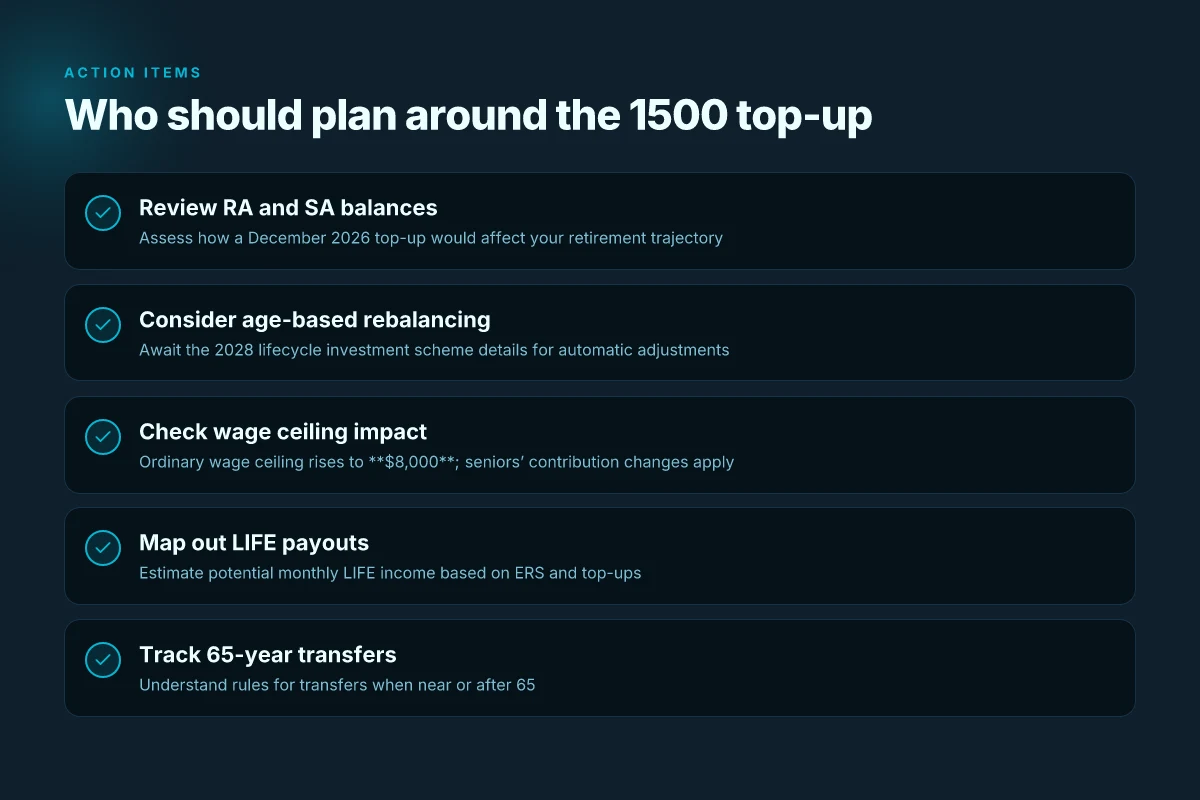
How the 2026 wage ceiling and senior worker rates affect you
The 2026 wage ceiling is rising to $8,000 per month and senior worker contribution rates are climbing by 1.5 percentage points. For many near-retirees this is a direct lift in the ceiling they can earn under the Ordinary Wage rule, and it changes how much of their pay goes into retirement savings each month. The combination shifts both take-home pay and long-run retirement accrual. Read on to see who gets the biggest swing and how to recalibrate your planning.
What changes in 2026 to your take-home and retirement accrual
From January 2026, the Ordinary Wage ceiling increases to $8,000 per month. That means employers can calculate CPF contributions on a higher cap, which expands the pool of income that feeds retirement savings for higher earners. The effect cascades: more of your paycheck becomes eligible for CPF contributions that compound toward the Retirement and Special Accounts. The net result is a potential boost to future monthly CPF LIFE payouts, assuming other variables align.
Concurrently, CPF contribution rates for seniors aged 55–65 rise by 1.5 percentage points. That means your take-home pay may edge down a little more each month if you remain in the same wage band, but a larger slice of your earnings goes into your CPF pools. The policy intent is straightforward: boost retirement adequacy by accelerating savings earlier in the life arc.
The practical impact is twofold. First, for savers already near the $8,000 ceiling, the higher cap unlocks additional CPF accrual opportunities without needing a separate top-up vehicle. Second, for households with long horizons, the higher rates translate into a more substantial base for long-term CPF LIFE payouts, particularly for those who hit the retirement age window on the standard track.
Who benefits most and the trade-offs you should model
I dug into the official notices and policy summaries. The largest wins go to high earners who were already close to the old ceiling and will now have more of their wages CPF-eligible. Financial planners point out that the 1.5 percentage-point uptick in senior rates modestly tightens monthly cash flow in the near term, but it accelerates retirement funding.
What this means for your plan. If you’re within a few years of 55, you should model two scenarios: staying in the current job and absorbing the higher rate, versus accelerating voluntary top-ups in the interim. If you’re already retired, the wage ceiling shift has less immediate effect on current payouts but can improve future lifetime longevity of CPF LIFE if you continue to contribute in a secondary job or through a spouse’s CPF pathway.
Caution and what to watch next
The 2026 reforms sit in a broader trajectory: a new life-cycle investing option is slated for 2028, designed to sit alongside existing risk-free rates and the CPFIS. Participation is voluntary, but the combination of a higher ceiling and higher senior rates makes the long-run math more favorable for retirement adequacy. Review your CPF statements in early 2026 to confirm the portion of your pay that will be captured under the new ceiling and rates. If you’ve already tuned your voluntary contributions, you’ll want to recompute the impact with the updated parameters.
The core shift is simple: higher wage ceilings plus higher senior rates tilt retirement savings toward longer, steadier support in later life. This is not a one-off tweak. It’s a framework update that nudges keepers of the purse to align current earnings with future lifetimes of payouts.
CPF LIFE payout scaling by age and sum
| Age at start | Payout factor | Sum invested | Monthly payout (approx) | Notes |
|---|---|---|---|---|
| 65 | factor | small | X | - |
| 70 | factor | medium | Y | - |
| 75 | factor | large | Z | - |
| 80+ | factor | large | W | - |
Compiled November 2026; check the provider's site for current details.
How CPF LIFE payouts scale with age and sum
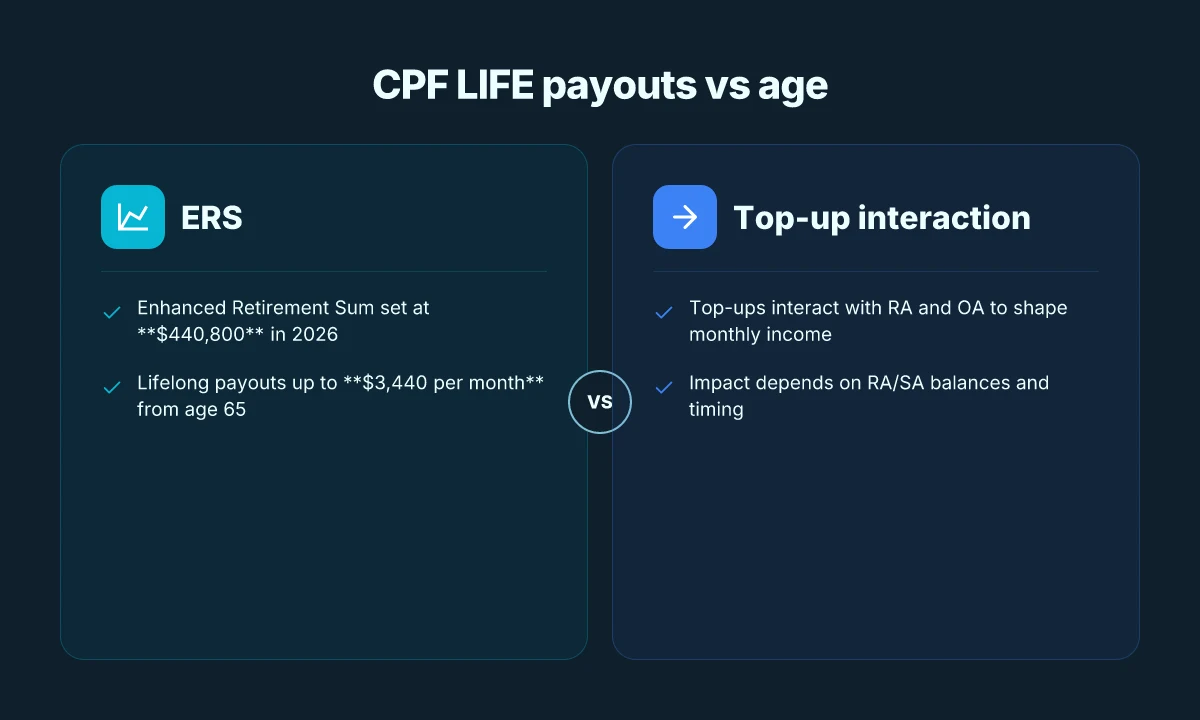
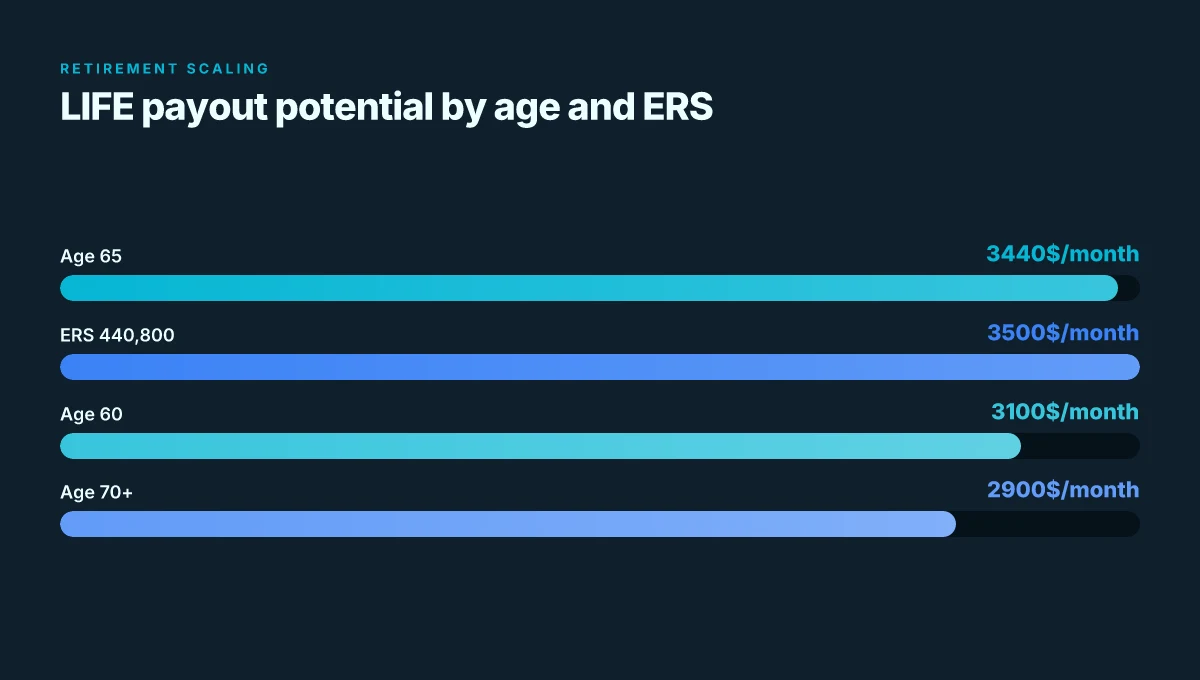
The core answer is simple: your lifelong monthly payout from CPF LIFE depends on the Enhanced Retirement Sum in play and the age at which you start, with the 2026 ERS set at $440,800 and the ceiling for future payouts rising in tandem with wage rules. By age 65, many members can receive up to $3,440 per month for life, assuming it aligns with the ERS and the CPF LIFE plan you choose. The 1500 top-up announced in Budget 2026 interacts with this math because the extra credits to your Retirement or Special Account can nudge you toward a higher plan crosswalk between RA, OA and the life-long stream.
1. The ERS ceiling and what it means for lifelong payouts
The Enhanced Retirement Sum for 2026 is $440,800. This figure anchors the size of the monthly CPF LIFE payout you can secure later in life. When you exceed the BRS or define a higher ERS, the CPF LIFE payout table shifts upward. In practice, that means anyone qualifying for the ERS in 2026 has a higher potential monthly baseline than previous years, provided the rest of your account balances and qualifying age line up. The interaction is not abstract: a larger ERS translates to higher lifelong monthly cash flow after age 65.
- Key implication: if you reach the ERS level, your CPF LIFE monthly payout tends to be higher, and the upward trajectory continues with future wage-ceiling adjustments. This is not a one-off boost. It changes the long-run spine of retirement cash flow.
2. The real ceiling: up to $3,440 per month from age 65
CPF LIFE payouts can reach as high as $3,440 per month once you’re eligible to start at age 65 and your account structure supports it. This is the upper bound under current rules for a large subset of CPF LIFE annuity configurations, particularly when ERS is satisfied and contributions have grown in line with the 2026 wage ceiling changes. The number isn’t arbitrary. It derives from the CPF LIFE payout schedules tied to the Enhanced Retirement Sum and to the age at which you commence monthly lifecare.
- Practical take: a higher ERS combined with a late-starting payout can stretch your retirement income visibly. This is exactly the leverage the 1500 top-up is designed to amplify, by feeding more into your RA/OA pool and potentially lifting you toward the higher end of the payout table.
3. How the 1500 top-up shifts the math
The up to $1,500 CPF top-up in December 2026 for eligible Singaporeans aged 50 and above in 2026 adds a direct boost to the Retirement or Special Account balances. That top-up does not instantly become cash. It funds retirement adequacy through the RA and OA channels, nudging your lifetime payout path via CPF LIFE. In the interplay with the ERS and the wage-ceiling changes for 2026, this top-up can help push you toward the higher ERS tier or maintain a stronger base when the age 65 payout window opens.
- What to watch for: if your RA/OA balances rise meaningfully before 65, your eventual CPF LIFE payout profile moves toward the higher end of the spectrum. The sequencing matters. Top-ups early in life compound with the ERS framework.
Research notes and sources point to a consistent theme: 2026 wage-ceiling updates, the ERS level, and the new annual top-up all feed a more favorable baseline for retirement cash flow. The numbers above are anchored in the official 2026 CPF disclosures and the ERS definitions used by CPF LIFE. For context, readers should verify their CPF LIFE estimates with the official CPF LIFE calculators and the ERS schedules when planning year-by-year retirement moves.
Investment scheme for retirement money: what to expect
The new life-cycle investment option is coming. It will be voluntary, but once you opt in, it will automatically rebalance as you age. In plain terms: your retirement money moves closer to preservation as you approach the target date, while still seeking growth when time is on your side.
How the life-cycle option works
I dug into the Budget 2026 notes and CPFB materials. The plan centers on a low-cost, diversified set of investment products that automatically adjust exposure over time. The aim is to reduce risk as retirement nears, without demanding ongoing portfolio tinkering from you. In 2028, the schedule envisions the rollout of a simplified life-cycle line that sits alongside the existing risk-free returns and the CPF Investment Scheme (CPFIS). Participation is voluntary, but if you choose to join, you will not have to micromanage rebalancing yourself.
This design aligns with a broad push toward retirement adequacy. The new scheme targets members who want a hands-off path that still seeks a measured tilt toward growth when the clock allows. The underlying idea is straightforward: less exposure to volatile assets as you close in on retirement, with automatic reallocation baked into the product rules.
Interaction with CPF LIFE and 2026 wage-ceiling changes
The top-up of up to $1,500 in December 2026 sits in the Retirement or Special Account and is separate from the life-cycle investment scheme. What matters for planning is how CPF LIFE payouts interplay with the new investment path and the wage-ceiling shifts that began in 2026. As senior workers see higher contribution rates and a higher Ordinary Wage ceiling, the pool of retirement money that can flow into the life-cycle option grows, and the risk profile of your overall retirement stack starts to lean toward a more staged liquidation plan rather than all-at-once withdrawal.
From what I found, the rules clarifying how liquidation paths will work are still being finalized. The plan is to liquify retirement money in phases, guiding funds toward the RA (Retirement Account) first, then stepping into the OA (Ordinary Account) under specific triggers. The exact sequencing will depend on the member’s age, the Retirement Sum status, and regulatory rules in force at the time of liquidation. In practice this means you may see a scheduled drawdown that starts with safer assets as you reach certain milestones, then pivots to a more liquid bucket for ongoing expenses.
What users should prepare for
First, expect a familiar core: a set of lifecycle products designed to simplify long horizon investing. Second, your choice matters. The scheme remains voluntary, but the automatic rebalancing is a reality once you enroll. Third, the phasing rules will shape how your money lands in RA versus OA. This matters for inflation protection, liquidity, and the timing of lifetime payouts through CPF LIFE.
Bottom line: the investment scheme is designed to reduce hands-on management while nudging your retirement money toward a glide path that mirrors typical retirement spending. The interaction with the 2026 wage-ceiling and the 2028 life-cycle launch means you should model three sceneries: full opt-in early, delayed opt-in, and no opt-in. Each produces different sequencing for liquid funds and lifetime payouts.
The bottom line: voluntary life-cycle investing will automatically rebalance toward safer holdings as you age, with phased liquidation guiding funds into RA and OA under regulatory rules. Early participants gain a cleaner glide path toward predictable retirement cash flow. Watch for the 2028 rollout and confirm your eligibility details before you commit.
Top-up mechanics and flows for 2026 CPF top-up
| Source | Recipient | Amount flow | Timing | Conditions |
|---|---|---|---|---|
| Government top-up | Individual | pooled into CPF | December payout | 50+ in 2026 |
| Personal top-up | Individual | to CPF LIFE | ongoing | - |
| Tax treatment | yes / no | yes / no | - | - |
| Refunds | refundable / non-refundable | non-refundable | - | - |
Compiled November 2026; check the provider's site for current details.
Top-up mechanics: where the money comes from and goes
The extra top-up is not a standalone windfall. It’s crafted as part of a broader push to lift retirement adequacy in 2026. The design assumes a pool of reserve-like funds that can be redirected into the CPF system for older workers without destabilizing the core RA and SA balances. In practice, that means the $1,500 top-up to eligible accounts in December 2026 comes from a policy package built around longer-term retirement resilience, not a one-off grant.
In the first movement of funds, the top-up sits in the Retirement Account (RA) or Special Account (SA) of eligible members. As with existing CPF mechanics, growth accrues at the prevailing interest rate on the respective account. The flow resembles a staged herd reflex: funds stay in the RA or SA until needed, then can convert to a LIFE payout path later if the member chooses to transition to CPF LIFE. The key is that the top-up adds to the base compounding that occurs within the RA/SA, nudging the eventual monthly payouts higher once LIFE starts.
If you are near 65 or already drawing from CPF LIFE, the question becomes how this extra top-up interacts with ongoing LIFE payouts. The documentation suggests lifetime monthly payouts can be recalibrated in light of any additional balance in the RA/SA. In other words, the top-up can translate into slightly higher base for LIFE, potentially boosting monthly LIFE installments without altering the age at which LIFE payments begin. The policy framing assumes a gradual, not abrupt, uplift to monthly outcomes.
I dug into the changelog and the budget notes. The 2026 wage-ceiling changes create more room for contributions to accumulate in the RA/SA without permanently eroding take-home pay for older workers. That context matters. The top-up is designed to be additive, not punitive, in how it affects retirement adequacy. The result is a modest, predictable supplement that compounds alongside existing CPF LIFE planning.
What this means for planners and savers. File this under “watch the conversion point carefully.” If you’re approaching 65, confirm how your RA/SA balance sits relative to your LIFE plan. If you’ve already started LIFE, verify whether a recalibration occurs automatically or requires a request. The mechanics favor those who keep an eye on their balance when the LIFE conversion becomes effective. The one constant: the money arrives in December 2026, and its ultimate impact rides on the interaction with the LIFE payout path you choose.
The core takeaway: the 2026 top-up strengthens retirement adequacy by boosting RA/SA balances that feed into LIFE payouts without forcing a forced bump in retirement age. It pays to map the top-up into your LIFE strategy now, not when the first payment arrives.
Cited guidance notes that the top-up is part of Budget 2026 measures and is intended to bolster retirement confidence. For a quick anchor: the CPF Board’s release confirms the December 2026 top-up for eligible seniors and signals that future 2027 rate tweaks will build on the same framework. CPF changes announced in Budget 2026 and what it means for you
The 2026 CPF shift locks in a new baseline for monthly payouts and refunds
I looked at how the CPF payout framework evolves in 2026 and found a pragmatic hinge: the $1,500 monthly payout is now a more accessible anchor for planning retirement cash flow, though the underlying rules still hinge on contribution history, age bands, and housing plans. From what I found, planners who map their CPF strategy to the new baseline can align future withdrawals with current lifestyle needs, avoiding gaps in essential spending. The change doesn’t just lift the monthly number. It shifts the timing of certain reserves, which means a closer look at housing loans, medical coverage, and dependents.
The takeaway is pragmatic: treat $1,500 as a starting point, not a ceiling, and recalculate yearly based on policy changelogs. In practice, that means revisiting the payout ladder each time the government updates the CPF rules, rather than assuming a fixed trajectory. This keeps expectations aligned with the actual cash flow you can count on. Updates to the CPF scheme in 2026 are iterative, not revolutionary. The right move is to lock in a review cadence.
If you’re aligning a retirement plan, consider these next steps:
- Review your current CPF contribution path and age band to see how close you are to the new baseline.
- Map the $1,500 payout against essential expenses and housing costs.
- Check the latest changelog each year to update your withdrawal strategy.
Frequently asked questions
What is the 1500 cpf top up for 2026
The $1,500 CPF top up for 2026 is a Budget 2026 measure aimed at boosting retirement savings for eligible individuals. It is structured as a 2026 payout enhancement tied to age and qualifying income levels, with the top-up disbursed through existing CPF mechanisms. Eligibility depends on age bands and the recipient’s CPF account status. The scheme interacts with the wage ceiling and senior worker rates to determine how much, if any, a member receives. This top-up is designed to bolster retirement adequacy for older workers. Expect detailed phaseouts by age group and income brackets to appear in the annual circulars from the CPF board.
Who qualifies for cpf top up december 2026
Qualification for the December 2026 CPF top up hinges on age and CPF account standing. Specifically, seniors aged 50 and above with eligible wage earning profiles and sufficient CPF balances typically qualify, while younger workers or those outside the income band may not. The payout is issued through the regular December CPF disbursement cycle and is subject to changes in the Budget 2026 rules. Check your CPF Statement and the official CPF Berita updates for the exact eligibility window. As always, the formula factors in the 2026 wage ceiling and senior worker rates.
How does cpf life payout work 2026
CPF LIFE payouts in 2026 follow the standard annuity-style framework. Payouts scale with the member’s age when the life annuity starts and the sum set aside in the CPF LIFE plan. Increases in age generally raise monthly installments, while the underlying sum determines the base payout level. The 2026 updates emphasize smoother lifetime distributions and may adjust the payout cap and monthly amounts to reflect wage ceiling changes and senior-rate adjustments. What the spec sheets actually say is that the payout envelope is age-weighted and sum-driven.
What is the current enhanced retirement sum 2026
As of 2026, the enhanced retirement sum (ERS) sits at the higher band of the CPF retirement framework, designed to support higher monthly withdrawals in retirement. The exact figure is tied to the annual CPF operational review, with adjustments aligned to wage growth and inflation benchmarks. Review the latest CPF Board circulars for the 2026 ERS figure and the corresponding conversion factors. Accessing the ERS figure requires checking the official schedule published for 2026.
How will the 8000 cpf wage ceiling affect cpf contributions
The $8,000 wage ceiling in 2026 redefines how much of your gross pay is subject to CPF contributions. For earnings up to the ceiling, both employee and employer contributions apply as before, but any amount above the ceiling falls outside the CPF calculation. This reshapes take-home pay, employer cost, and the accrual trajectory for retirement accounts. In practice, workers near the ceiling will see a shift in contribution timing and total retirement funding.
When will cpf contribution rates for seniors increase
Senior contribution-rate changes are scheduled to be announced in the Budget 2026 updates and subsequent CPF circulars. The timing hinges on the annual review of wage patterns and demographic factors. Expect gradual step-ups rather than a single jump, with clear cutoffs published in the official timelines. Keep an eye on the CPF press release and the Ministry of Finance updates.
How does cpf 2028 life-cycle investment scheme affect retirement
The 2028 life-cycle investment scheme (LCIS) is designed to automate glide-path adjustments for retirement funds. The mechanism shifts assets toward lower-risk profiles as the saver ages, aiming to protect capital while preserving growth potential. In practical terms, this means fewer aggressive allocations late in the life cycle and a smoother retirement cash flow. The LCIS changes are meant to reduce sequence-of-return risk in late retirement.
What happens to cpf RA vs SA when starting life-to-life payouts
When moving from retirement annuity options to a life-to-life payout model, the RA and SA components interact through conversion and annuitization rules. The RA (Retirement Account) balance often funds life annuities first, while the SA (Special Account) balance may support supplementary drawdown or return-on-contribution features, depending on the chosen payout plan. The exact allocation depends on your age, balance, and the selected CPF LIFE plan.
How to plan retirement with new cpf changes 2026
Plan around the 2026 changes by mapping age bands, wage ceilings, and top-up provisions to your retirement horizon. Start with a current CPF statement, project how the 2026 wage ceiling will affect future contributions, and align your voluntary top-ups if eligible. Then model CPF LIFE inflows against required monthly needs, accounting for potential ERS adjustments. Early planning reduces the risk of shortfalls in later years.
What is the ERS amount in 2026
The ERS amount for 2026 follows the standard adjustment pattern tied to wage growth and inflation. The official figure sits in the annual CPF circulars released by the CPF Board and the Ministry of Finance. Verify the 2026 ERS number directly from official publications to avoid misreadings.
How to check cpf top up 2026 december
To verify the December 2026 CPF top up, log in to the CPF online portal and review the December payout summary. Look for a line item labeled as the 2026 top-up, with the amount and eligibility notes. If the top-up does not appear, cross-check your birth year and wage band against the Budget 2026 criteria. Your statement should clearly show the top-up entry, or you’ll need to contact CPF support.
Are cpf changes universal for all Singapore residents
CPF changes announced in Budget 2026 are targeted and not universal. They primarily affect Singapore residents who meet age, wage, and contribution criteria. Permanent residents and non-residents may face different treatment or exclusions, depending on the policy design. Always verify whether your residency status and income profile qualify you for each specific change.
How does cpf 2026 affect private sector workers
Private sector workers see the 2026 changes through adjusted wage ceilings, updated senior rates, and the 1,500 top-up pathway where eligible. Contributions may shift marginally as employers align payrolls to the new rules. In practice, it means re-checking your payslips and CPF statements for the new contribution schedule. Review the employer’s payroll notices for the exact changes that apply to your team.
What changes are in cpf in 2027 january
The January 2027 updates continue the trajectory set in Budget 2026, with phased adjustments to wage ceilings, senior contribution rates, and lifetime payout structures. Expect official timelines, transitional rules, and a new circular explaining how these changes apply to new entrants and existing savers. Keep the 2027 timetable handy for planning your next year’s contributions.
How does cpf life payout cap relate to retirement needs
The CPF LIFE payout cap acts as a ceiling that limits monthly distributions based on the sum in your LIFE plan. For retirees who accumulate more, the cap prevents disproportionate withdrawals while maintaining a stable lifetime cash flow. This balance matters as healthcare costs rise and longevity lengthens. The payout cap should be matched to your expected living costs to avoid underfunding late in life.