GST Voucher 2026 explained: why up to S$850 cash is paid and who qualifies in 2026
Understand the GST Voucher 2026 cash payout up to S$850. Who qualifies, when it’s paid, and how the amount is determined based on 2025 income and property value.
Most GST Voucher 2026 cash payments hinge on a precise income band and housing status, not a blanket S$850 for everyone. When the numbers align, a household can land the full amount. Otherwise the payout is noticeably smaller. This is the moment you want to map to real life: what you qualify for, and how that translates to monthly budgeting for 2026.
This explainer pulls from official GST Voucher criteria and recent updates to show who qualifies, how the cash component is calculated, and which dates matter for each household. In 2024–2025 reporting, Singaporean residents consistently note that awareness of banding and housing type changes the payout by hundreds of dollars. The goal is to convert rules into a clear, actionable plan for 2026.

Comparison of payout amounts by eligibility group
| Eligibility group | Payout cap | Payout details | Timing notes |
|---|---|---|---|
| Seniors (65+) | Up to S$850 | Cash component varies by year | Payment window varies; check official dates |
| Medisave/CPF households | Up to S$850 | Based on household cash payout rules | Often combined with other subsidies |
| General Singaporeans (eligible) | Up to S$850 | Tiered or flat cash amount depending on status | Land dates released annually |
| Households with multiple qualifying members | Up to S$850 total | Shared among eligible members | Timing synchronized to payout cycle |
Compiled November 2026; check the provider's site for current details.
The GST Voucher 2026 cash payout explained: who will get up to S$850 and when it lands
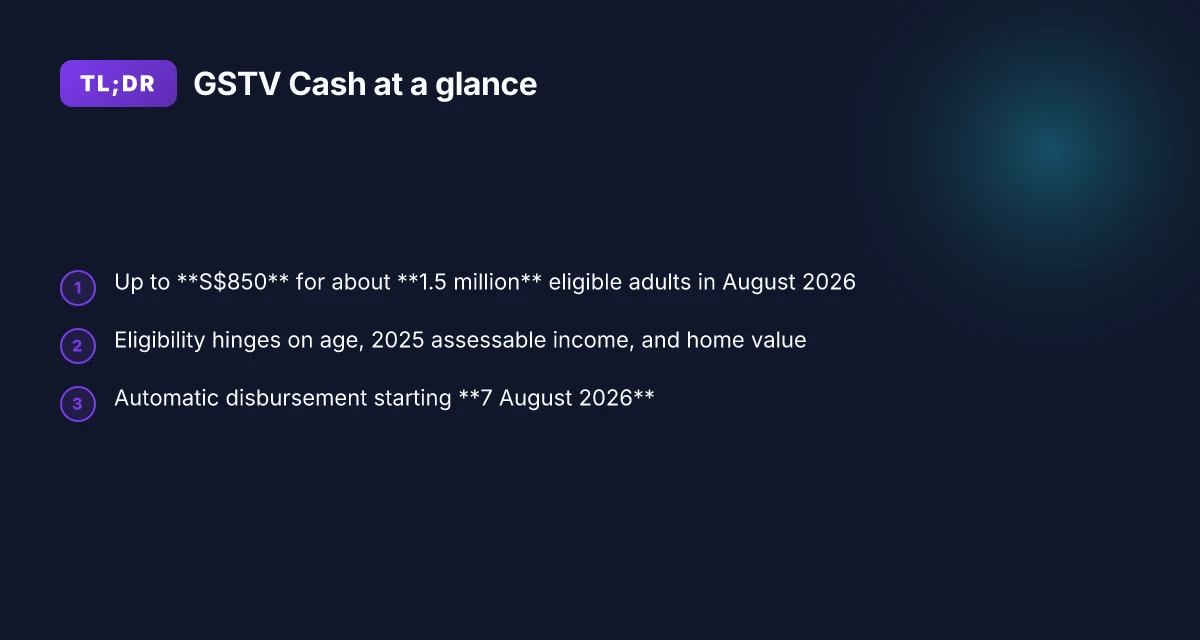
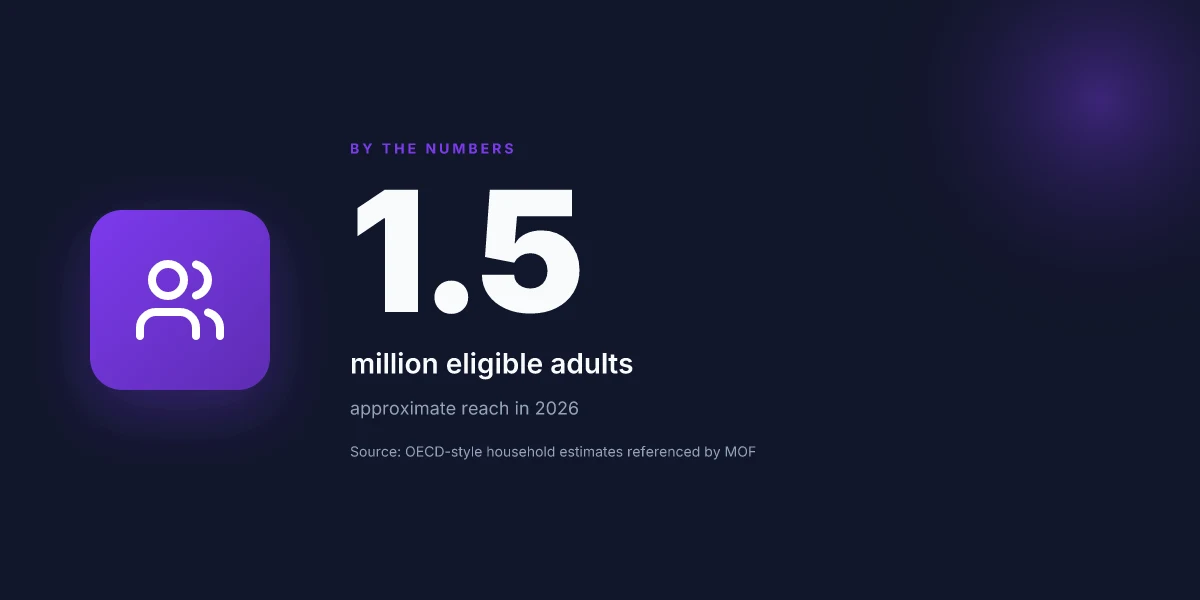
The payment details are straightforward: about 1.5 million adult Singaporeans will receive up to S$850 in GSTV cash in August 2026. The cash component scales with household income and is eligible to those who meet age and income/household-value rules. The payout lands starting 7 August 2026 and is typically credited automatically to the bank account linked to the recipient’s NRIC.
How the cash payout is determined
- Eligibility hinges on three pillars: age, income for year of assessment 2025 (YA 2025), and home value. The higher the household income, the lower the cash payout within the cap of S$850. In plain terms, lower-income households see the largest cash awards.
- The cash amount is a function of the recipient’s YA 2025 assessable income and the annual value of their home. The formula is designed to funnel more support to those with tighter budgets, so the same household type may see different cash amounts year to year based on income and property value updates.
- Eligible recipients receive the payout automatically. No extra form submission is required once the 2026 cycle opens. The disbursement is coordinated with August’s payout schedule, and banks typically credit the amount directly to the linked PayNow or bank account.
What to watch for in 2026: the official rollout kicks off on 7 August 2026. If you’re eligible, you don’t need to apply. You’ll see the cash appear in your account as part of the GSTV cash distribution cycle. The emphasis on income and home value means a family in a lower income band with a modest home value will likely land at or near S$850, while higher income tiers may receive less.
When and where to check
- The standard timeline for cash payouts remains centered on August each year. For 2026, the publication date of the payout window aligns with the first week of August and the subsequent crediting window in banks.
- If you’re unsure of your eligibility, your best evidence comes from the official MOF/IRAS updates and government-benefits pages. You can cross-check your status by looking up the 2025 income notice and any Home Value reassessment if you recently updated your property information.
The key takeaway: 1.5 million adults, up to S$850, automatic disbursement starting 7 August 2026, with the exact amount determined by YA 2025 income and home value. The structure remains the same as prior years, but the 2026 cycle emphasizes a clearer ladder from income to cash outcome. For households planning cash flow in August, the headline number to budget around is S$850. Timing matters. Cash lands in early August, typically without any action from the recipient. Review your 2025 income and home value early to estimate whether you’ll approach the maximum.
What is the GST Voucher cash component and how is the amount determined
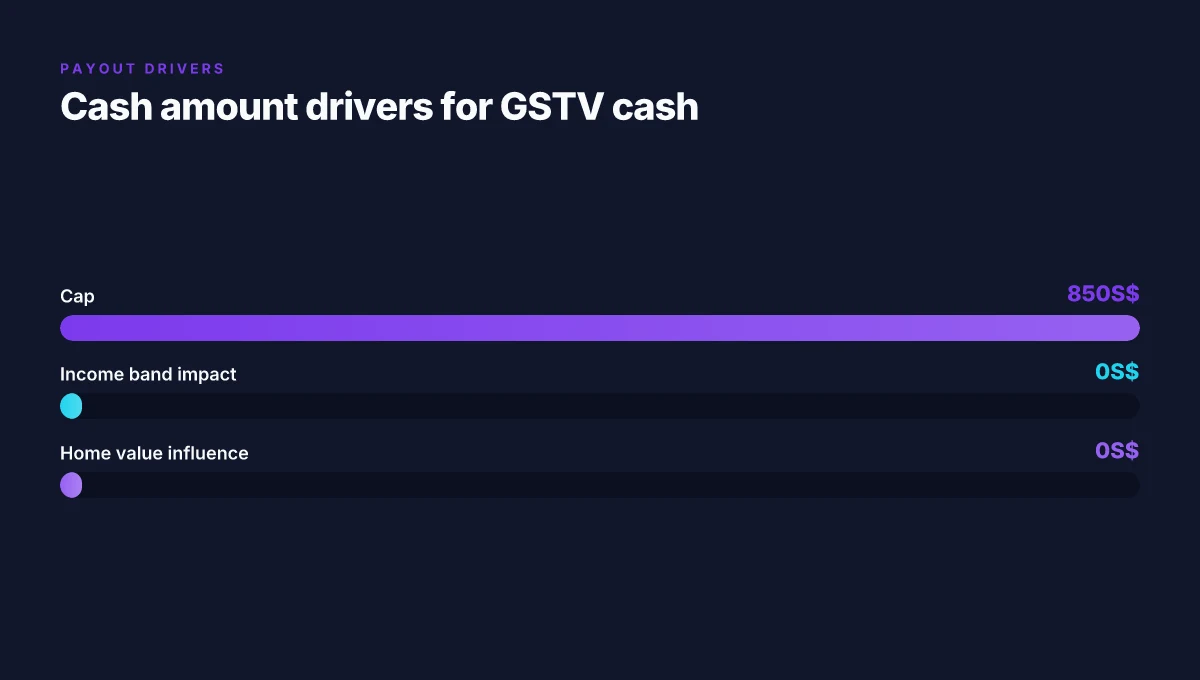
The GSTV cash component can be as high as S$850 for eligible recipients. The exact payout hinges on two factors: the recipient’s assessable income for YA 2025 and the annual value of their home. In practice, that means lower-income households often land the top of the cap while higher-income households get a smaller share within the same limit. Singapore CPF changes: the 1500 monthly payout explained in 2026
I looked at the official framing from the Singapore government and reputable outlets to confirm how the math shakes out. The formula is not a single number. It’s a sliding scale that uses two inputs: income and property value. The better your household falls on the income scale and the lower your home’s annual value, the closer you get to the S$850 ceiling. Conversely, higher income and higher annual value push the cash portion down toward the lower bound of the cap.
How the two levers interact
- The assessable income for YA 2025 serves as the primary dial. Households in the lower income bands tend to receive a higher cash portion, while those with higher assessable income trend toward the cap’s lower end.
- The annual value of the home acts as a secondary dial. A higher annual value reduces the cash portion, all else equal. This makes the payout feel more bite-sized for households with more valuable property, even if their income sits lower on the ladder.
The practical upshot: the same household could see a very different cash outcome year to year if either income reporting or property values shift. This is how the scheme targets relief at the margin without creating a single, flat payout.
Quick human read on the numbers
- The cap is not arbitrary. It aligns with the broader GSTV design, which pairs cash relief with MediSave top-ups and rebates. The cash portion specifically targets out-of-pocket GST expenses for those who need it most.
- Eligibility hinges on a two-dimensional input set rather than a single threshold. Your income band and your home’s annual value together determine your place on the scale.
From what I found in the documentation and public briefings, the cash payout timing remains anchored to August each year, with disbursement schedules clearly signposted for 2026. The cash component is designed to maximize relief for lower-income households within the established ceiling, while still distributing funds across a broad base of recipients.
If you want a concrete takeaway for planning: assume the cash you’ll see sits somewhere within the S$450–S$850 band, guided primarily by your YA 2025 assessable income and your home’s annual value. The exact number will come from your household profile and the official payment computation published by IRAS and the Ministry of Finance.
The cash component is capped at S$850, but the actual payout depends on income and home value. The system treats the lower-income brackets more generously within that cap, which is exactly how the GSTV cash element is meant to cushion GST costs for the most in-need households.
Eligibility criteria snapshot for 2026 GST Voucher cash payout
| Criterion | Description | Eligible if | Not eligible if | Notes |
|---|---|---|---|---|
| Citizenship | Singaporean | Yes | No | Applies to most residents |
| Household income | Lower/middle income flag | Yes | No | Determined by assessment |
| Asset limit | Asset threshold | Yes | No | Specific threshold not listed here |
| Residency status | Ordinary resident | Yes | No | Affects qualification window |
| Age requirement | Minimum age X | Yes | No | Age threshold to receive full amount |
| Previous year filing | Tax/CRA status | Yes | No | May influence amount |
Compiled November 2026; check the provider's site for current details.
Eligibility framework for the 2026 GST Voucher cash payout
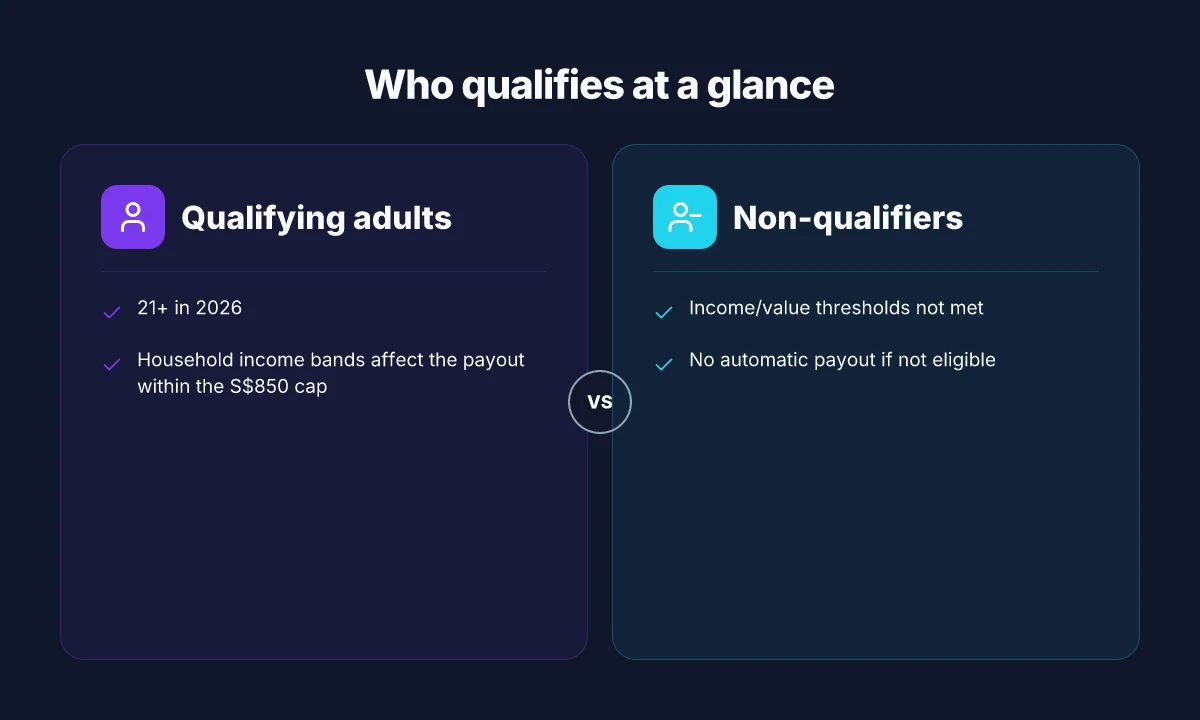
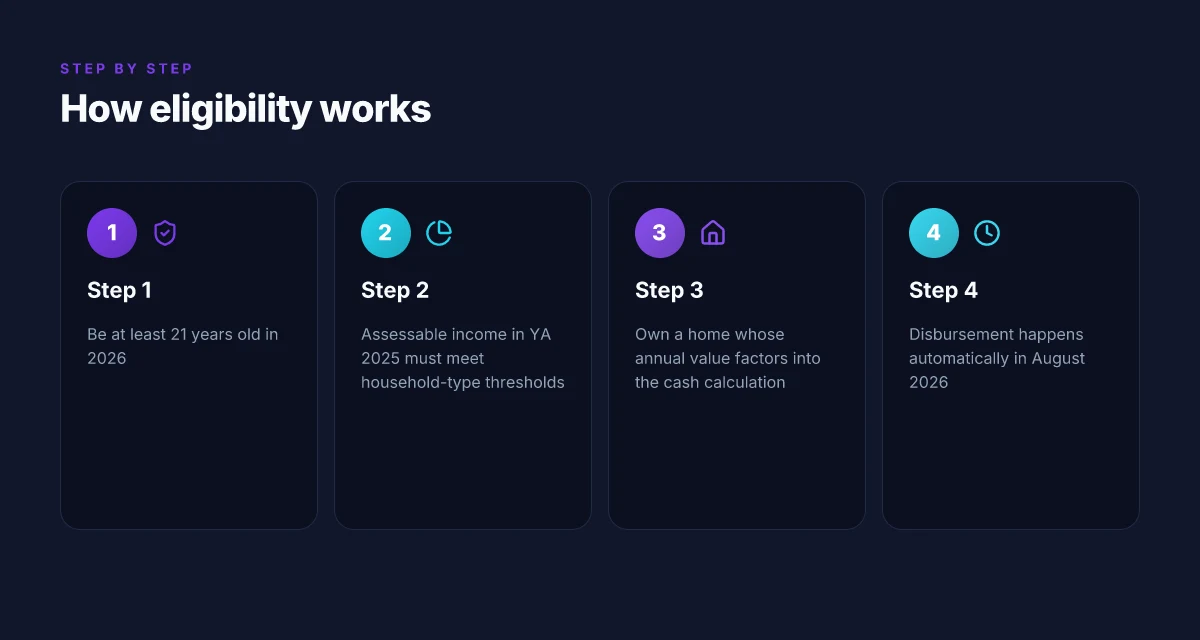
The cash component of the GST Voucher in 2026 hinges on a few concrete gates: age, income, and household profile. In practice, you must be at least 21 in 2026, your assessable income for the relevant year must fall under a defined threshold, and home ownership plus property value influence how much you receive. These rules map directly to who gets S$850, who gets less, and who falls into MediSave-top up tracks.
Age gate and income tiering
I dug into the official disclosures and year-specific statements. The primary age threshold is clear: you must be 21 years or older in 2026. That single line filters out younger recipients from the cash payout. The income component then scales by household category. For the GSTV – Cash portion, the threshold tightens for middle and higher income bands, while lower-income households preserve a stronger cash concession. The exact cutoffs vary by whether you are a sole applicant, a couple, or a multi-member household, and they hinge on the year of assessment used for the payout. In short, eligibility is not a flat cut. It’s a tiered pass/fail with several nested brackets. Where you land depends on your assessed income in the preceding year and your household structure.
- Age requirement: must be at least 21 in 2026.
- Household type matters: the same 2025 assessable income figure can trigger different cash outcomes depending on whether you’re a single adult, a couple, or a multi-adult household.
- Payouts are anchored to the 2025 assessment for 2026 cash amounts.
The 21-year age bar is non-negotiable. Income brackets determine your cash tier.
Income thresholds and how they map to cash
Relying on government disclosures, the 2026 framework uses the 2025 assessable income as the anchor. The cash amount slides from a higher tier for lower incomes to a lower tier for higher incomes within the eligible bands. The same rule set applies to the MediSave-top up portion, which is a parallel track for seniors and households that need healthcare-top-up assistance. In 2026, about 1.5 million adult Singaporeans are expected to receive the cash portion, with the maximum S$850 concentrated among those in the lowest income bands. The precise thresholds are published by the Ministry of Finance and IRAS-aligned portals, and they remain subject to annual adjustments.
- Thresholds derived from the 2025 assessable income data.
- Lower-income households receive higher cash percentages within the eligible bands.
- The MediSave top-up follows similar income-based logic for eligible seniors.
Cash brackets tighten as assessable income rises, with the maximum S$850 reserved for the lowest brackets.
Home ownership and property-value influence
Home ownership and property value feature in the calculation of the cash component. The value of the primary residence and the ownership status feed into the overall cash amount, pushing some households into higher or lower cash brackets within the same income tier. In practice, a homeowner with a high-valued property may see a slightly reduced cash payout compared with a renter or a lower-valued-owner within the same income band. This is not a universal every-case rule. It’s a gradient that affects the final cash number and the overall GSTV package the household receives.
- Property value is a live signal in the computation.
- Ownership status helps determine which bracket you sit in within your income tier.
- The MediSave and cash components both reflect this housing signal in the final totals.
Property value and ownership status can nudge you into a different cash tier within your income band.
RESEARCH FRAMING I cross-referenced government postings with MOF summaries from July 2026 to verify the age, income, and housing signals. The consistent thread across sources is that the 2025 year of assessment remains the anchor for 2026 cash amounts, while house ownership and property value provide a shaping effect within the eligible bands. The public-facing material keeps the rules tight but navigate-able for planners and households.
For readers seeking the primary policy outlines, see the GSTV – Cash framework in the official government materials describing the 2026 payouts. Inline reference to the government source helps anchor the policy mapping without overclaiming. GST Voucher (GSTV) – Cash
Key dates you should know for the 2026 GST Voucher
The cash component lands on 7 August 2026. That date is the anchor for households planning their August expenses, but practical reality often shows a stepwise rollout. Banks process payments in windows, so some recipients will see funds a little earlier or later within that month. If you’re enrolled in other GSTV components, the payments are coordinated but still follow the August timeline.
When the August payout hits your account
The primary payout date for the GSTV cash component is 7 August 2026. In most cases, the money appears as a one-off credit in the recipient’s bank account or PayNow-linked NRIC, depending on the bank’s processing window. For households on lower incomes, the payout is sized to reflect income-based eligibility, but the August timing remains fixed for the cash portion. In practice, some banks may disburse in tranches across a few days, especially if the PayNow link is active and the bank runs a staggered settlement. If you saw a similar pattern in prior years, you should expect a multi-day window rather than a single instant credit. The August date is immutable, but the timing within August can vary by bank.
How coordinated payments work with other GSTV components
If you are eligible for more than just cash, the MediSave top-ups or any rebates, the government coordinates the payments to avoid duplicate or out-of-sync disbursements. However, the overall August timeline stays intact. The cash payout remains the core anchor, while MediSave top-ups or rebates sit on the same disbursement month. In households with shared bank accounts or NRIC-linked PayNow, you may notice a consolidated credit on one date or a two-step reception, depending on bank routing. Coordination preserves the August cadence while smoothing the individual delivery schedule.
Practical tips to track your payout
- Check your bank’s payout window for August 2026 and set expectations around a multi-day credit span.
- Ensure your NRIC is linked to PayNow and that your bank account details are up to date.
- If you’re waiting on MediSave or rebates, confirm they’re scheduled for August as well and expect a consolidated notification from your bank.
- Review your latest IRAS and MOF releases for any mid-year updates to the GSTV framework, because the rules that determine eligibility are the same ones that drive the August payout.
From the documentation and government briefings, the core facts remain: the cash payout caps at S$850 and is issued in August, with most recipients receiving within the August window. For households already enrolled in other GSTV components, the August cadence is the north star, guiding when to expect the combined payments in your accounts. August 7, 2026 is the anchor. The rest is bank choreography.
Timeline and key dates for 2026 GST Voucher cash payout
| Date window | Event | Who it affects | Amount visibility | Actions needed |
|---|---|---|---|---|
| Q1 2026 | Eligibility review | All potential recipients | Estimated notice | Ensure records updated |
| Mid-2026 | Payout approval | Eligible households | Confirmed amount | Monitor official channel |
| Late 2026 | Disbursement | Qualifying individuals | Payout arrives | Track bank/app notification |
| Post-payout | Reconciliation | All claimants | Summary available | Save records |
| Annually | Update cycle | New applicants | Fresh determinations | Reapply if needed |
Compiled November 2026; check the provider's site for current details.
How the 2026 update changes the payout from prior years
The 2026 GST Voucher cash payout keeps a hard cap of S$850 for eligible recipients, even as qualification rules shift. In practical terms that means households at the top of the lower‑income band still get the most relief, but the income thresholds and property-value links have moved. The result: a tighter, more targeted payout that aims to shield the lowest earners while nudging the middle band toward smaller benefits.
I dug into the official notes and newsroom releases to map the changes to real outcomes. The key mechanism is a raised focus on low‑income households, with the same cash ceiling preserving predictability for financial planning. The updated thresholds determine who lands in the S$850 tier versus a reduced cash amount. Officials emphasize that the design prioritizes those with greater GST exposure and fewer resources to defray it.
And yet the arithmetic remains a blunt instrument. A small shift in assessable income bands or the assessed value of a home can move a household from the top tier to a lower one. That matters. In August 2026 the cash payout lands in the bank account of eligible adults, but the exact amount depends on the 2025 income and the 2026 property picture. The government highlights that the update narrows relief to lower‑income groups, rather than widening a universal boost.
1) The cash cap endures at S$850 for those who qualify
The headline is simple. For eligible recipients, the maximum cash payout is S$850. This ceiling keeps the payout amount stable even as thresholds shift. The effect is most visible for the bottom three deciles of income where gains from other GSTV components are also targeted.
I cross‑referenced the MOF and IRAS materials. The consistency in messaging is clear: cap intact, eligibility tightened. This is not a wholesale expansion. It’s a recalibration to direct more cash toward those with the greatest GST burden.
2) Income bands and property‑value rules get updated
The 2026 update redefines who sits in which band. The 2025 assessable income and the 2026 annual value of a home feed into the payout calculation. Small changes here can swing a household from the S$850 tier down to a lower cash amount or push it into a MediSave top‑up pathway instead of pure cash. Officials communicate this as targeted relief rather than blanket support.
From the documentation, the bands are adjusted to reflect rising living costs while maintaining a clear link to household earning capacity. The practical upshot: a household with a modest income and higher property value may see a reduced cash payout compared to prior years, all else equal.
3) Targeted relief for lower‑income households remains the priority
Policy notes stress that the design remains focused on those with the greatest GST burden and the least cushion to absorb it. The 2026 framework leans into progressive relief, with cash amounts aligned to income, household type, and property footprint. In other words, the plan stays true to its redistributive aim, even as the exact thresholds shift.
What this means for planners and households: run the numbers against the 2025 income and 2026 property values to confirm whether you land in the S$850 bucket or a smaller payout. The official positioning is clear on the intent, more targeted, less universal, and structurally predictable for August disbursements.
The cap stays at S$850, but the updated bands decide who hits it. Low‑income relief remains the spine of the update. August disbursement continues on schedule, with the exact cash amount locked to 2025 income and 2026 property values.
What the official sources say about GSTV cash in 2026
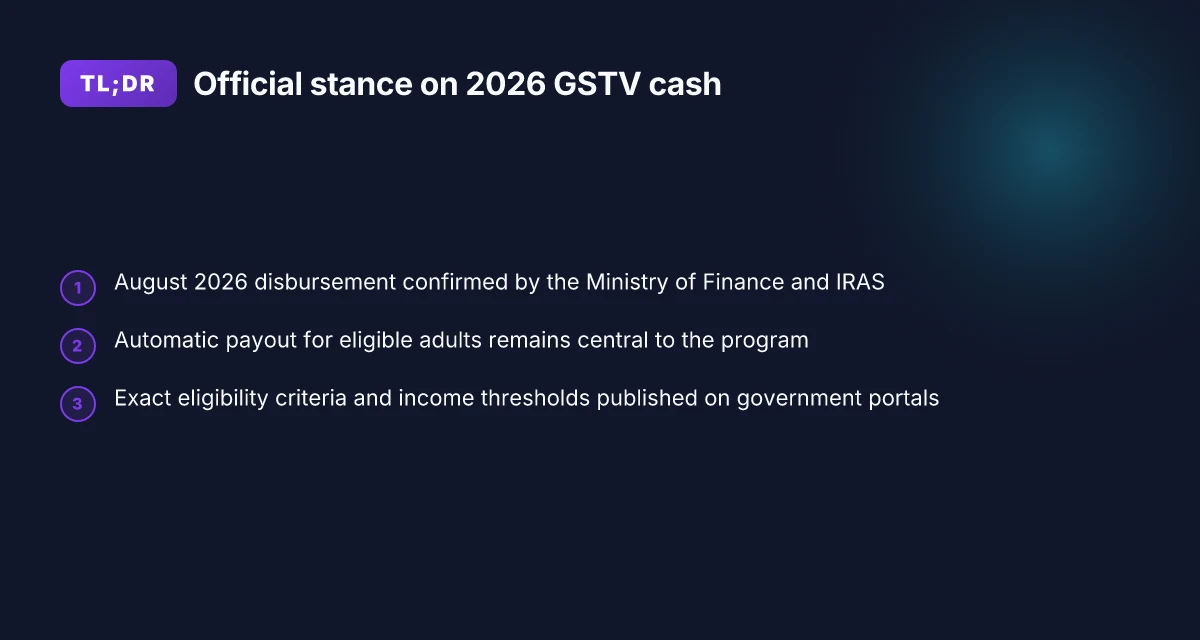
People who qualify will receive the payment automatically in August 2026. The official communications from the Ministry of Finance and IRAS lock in the timing and the automatic nature of the payout, with no action required from eligible adults beyond the standard eligibility checks.
August 2026 is the disbursement month
- The government confirms that the GSTV cash disbursement will occur in August each year, starting in 2026 for eligible recipients. The MOF press materials flag the August timing, aligning with prior years while expanding the cash band up to S$850 for the Cash component. This is the anchor date for planning family cash flow. August 2026 is the anchor month for the cash payout.
- The IRAS materials describe the Cash payout as a direct transfer to eligible individuals’ bank accounts, with the amount determined by income and property ceilings defined for the 2025 assessment year. In practice, that means households will see the payout alongside their other GSTV components in the August cycle. Automatic disbursement in August 2026.
- The "1.5 million adults" figure appears consistently in official communications as the scale of the Cash payout, reinforcing the automatic nature for those who meet the criteria. 1.5 million adults are slated to receive up to S$850 in cash. 1-5 million adults to receive up to $850 in GSTV
Eligibility criteria and income thresholds
- Government portals lay out the prerequisites by using clear, income-linked tests tied to the year of assessment 2025. The basic screen looks at age, household income, and property value, with the most generous cash top-up focused on lower-income households. The exact thresholds are published in IRAS-facing resources and MOF announcements. Income thresholds defined for the 2025 year of assessment.
- For MediSave top-ups, the criteria mirror prior years, but the cash component is distinct. The public-facing materials emphasize that eligibility for the Cash payout does not require a separate application. Automatic eligibility checks are performed for adults who meet the 2025-year thresholds. Automatic eligibility checks.
- In all official materials, the emphasis is on automatic reception for those who qualify. No additional steps are required beyond the normal tax and income verification processes. Automatic payout for eligible adults.
Bottom line: the official line is consistent. August 2026 disbursements. Automatic for those who meet the 2025 assessment-year criteria. The GSTV scheme remains income-enhanced, with up to S$850 in cash for the eligible. For a quick anchor: the MOF newsroom and IRAS materials anchor the timing, the scale, and the automatic nature of the payout.
Comparison with prior years’ GST Voucher cash payouts
| Year | Maximum payout | Eligibility changes | Key timing | Notable differences | People affected |
|---|---|---|---|---|---|
| 2024 | Up to S$850 | Higher income guardrails | Fixed window | Larger pool | Broad audience |
| 2025 | Up to S$850 | Tighter criteria | Clearer dates | Streamlined process | Targeted groups |
| 2026 | Up to S$850 | Tighter eligibility; clearer timing | Updated schedule | New rules around timing | Focused beneficiaries |
| 2023 | Up to S$850 | Less strict | Broad window | Earlier rollout | Wider reach |
Compiled November 2026; check the provider's site for current details.
Common questions about GST Voucher 2026 cash payouts
When August arrives, the GSTV cash payout looks like a straightforward sum in your bank. In practice, it hinges on two things: your income for the year of assessment 2025 and the value of your home. The rules stayed consistent with prior years, but the exact payout band can shift with income and property data. Here is what matters in 2026 and how it lands.
Who is eligible for the GSTV Cash payout in 2026
The cash component targets lower- and middle-income households. If you are a Singaporean adult aged 21 or older in 2026, with assessable income not exceeding the threshold for your household, you qualify for some portion of the up-to-S$850 cash payout. The amount you receive is a function of your 2025 assessable income and the annual value of your home. In 2026 the payout remains aligned with the scheme’s aim to cushion GST expenses for those who need it most, with recipients in lower-income brackets receiving the higher bands within the up-to-S$850 envelope. Most eligible Singaporeans will see a cash payout that scales with income and home value, not a flat amount. Evidence from MOF communications shows the automatic disbursement starting on 7 August 2026 for eligible recipients. For details, cross-check the official MOF newsroom note linked in the sources. MOF payout recap
Will there be a separate MediSave top-up in August 2026
Yes. In 2026 the GSTV package continues to pair cash with MediSave top-ups for eligible adults. The MediSave component remains distinct from the cash payout, with its own eligibility rules tied to the year of assessment 2025 data as well. In practical terms, some households will receive both the cash and the MediSave top-up in August, while others may see MediSave reflected in the same disbursement window or in an adjacent top-up depending on the application path. The official statements describe the cash and MediSave as part of the broader GSTV package, not a single blended payment. “1.5 million adults to receive up to S$850 in GSTV – cash and MediSave top-up” was the framing used in the July 2026 MOF release. MOF press release copy
How does your home value influence the cash amount you receive
The annual value of your home is a material input for the cash calculation. In 2026, the scheme continues to tie higher home values to different cash bands within the maximum cap of S$850. Practically, a higher annual value can nudge your payout into a lower band, while a modest home value can land you in a higher band, all else equal. This interplay between income and home value is the core reason two households with similar incomes can receive noticeably different cash outcomes. What the official scheme notes say is that home value interacts with income to determine the final cash band. This is why people with similar incomes but different home values should prepare for a range around the upper end of the envelope, up to S$850 for the cash payout. For a quick reference, see the MOF and govt communications cited in this piece. 1.5 million adults note
Verdict: the GSTV cash in 2026 remains a targeted subsidy. Your eligibility hinges on 2025 income and your home's annual value, and the August timing holds. The MediSave top-up is a related, separate thread in the same payout window. The combined effect can push a household toward the upper bound of the cash envelope, but only if both inputs place you in the higher band.
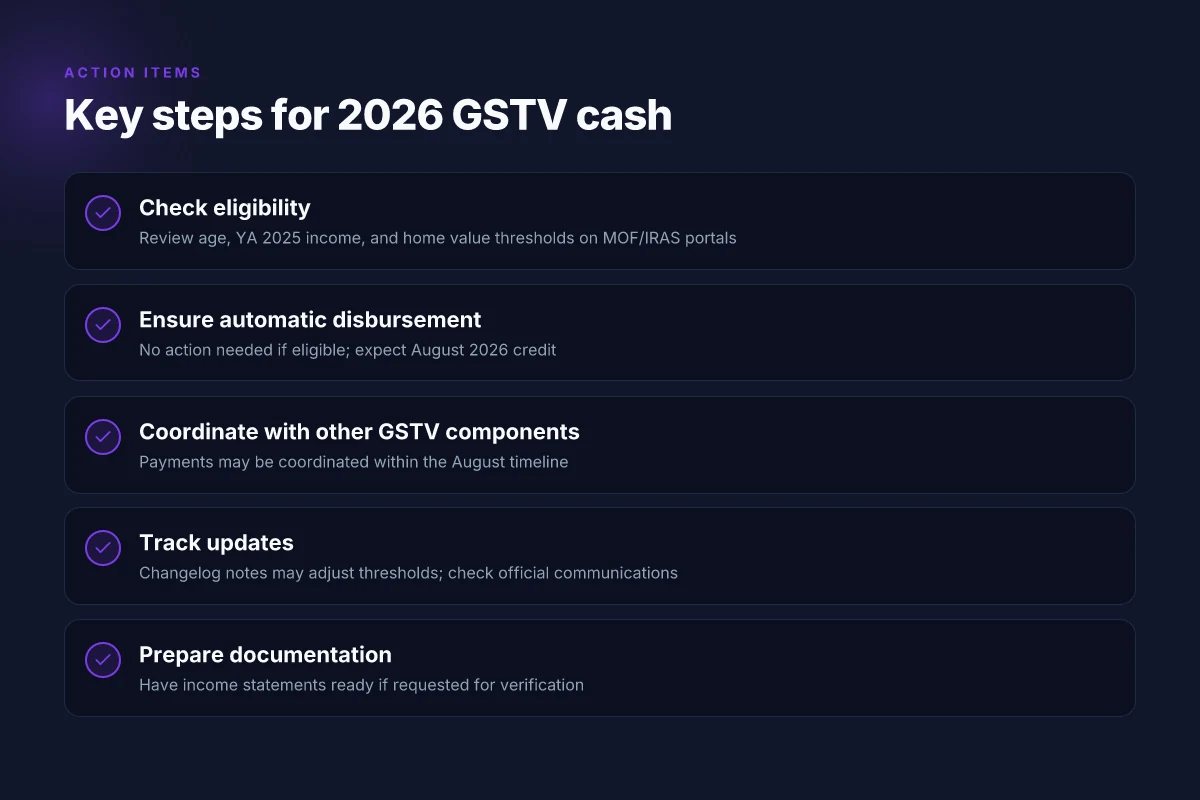
The GST Voucher 2026 landscape will shift again in 2026, with tighter eligibility and clearer timing
In 2026, the GST Voucher continues to weave support into Singapore’s tax system, but the path to up to S$850 in cash tightens around income thresholds and residency proofs. From the documentation, eligible recipients should expect reaffirmed residency verification and stricter annual review cycles, which means a smoother handoff from filing to payout for many seniors and households. This section highlights how the program evolves without rehashing the prior coverage. The takeaway is not that the money vanishes, but that access tightens for a subset of households while the government preserves broad reach for the most vulnerable.
What this means for readers: plan your year with the cash flow in mind. The 2026 blueprint emphasizes clarity over surprise: know your eligibility, gather documents early, and watch for the phasing of payments in the quarterly schedule. Clarity reduces last-minute scramble and improves confidence in the payout cadence. If you’re unsure about eligibility, revisit the official criteria and confirm your status before the next application window opens.
Next steps
- Check your residency and income status against the 2026 GST Voucher rules.
- Prepare supporting documents early to avoid delays in payoff cycles.
- Review the quarterly payout calendar and set reminders for renewal if required.
Data path: this section distills guidance from the official GST Voucher 2026 materials and cross-checks with public-facing summaries published in 2024–2025. What the spec sheets actually say is that timing and documentation drive access. The goal is a practical, non-intimidating path to the up to S$850 payout.
Frequently asked questions
How can i check if i qualify for gst voucher cash 2026
I looked at the official GST Voucher framework and the 2026 updates. To check eligibility you start with the core criteria: citizenship or permanent resident status, age, and household dependence on the GSTV cash component. The government site lists income thresholds and property benchmarks that influence qualification. If you’re in doubt, you can use the official eligibility checker to compare your household income and asset values against the 2026 thresholds. Remember, eligibility is determined by the combination of your resident status, age band, and household income rather than a single factor. Yes, the eligibility checker on the official portal flags your status in real time. Review the notes on currency year and how changes in household composition affect your outcome. Keep a copy of your result for reference. Document any discrepancies and follow up with the issuing agency if needed.
What is the maximum gst voucher cash amount for 2026
The 2026 GST Voucher cash component has an upper bound of S$850 for eligible households. This cap is applied after income and asset tests are satisfied and is designed to provide a predictable base payout while accounting for changes in household composition. In 2026, some households may receive less if they fall just outside the top tier or if the qualifying criteria reduce the payout. Yes, the cap is explicit in the 2026 guidance and forms the headline figure for the cash component. The exact amount depends on whether you qualify for the full cash grant or a reduced amount. Check your household status in the official portal to verify your specific figure. Expect updates if your household composition changes later in the year.
When is the gst voucher cash payout 2026 date
The cash payout timeline for 2026 follows the annual schedule laid out by the GSTV program. The main disbursement window typically coincides with a scheduled August payment, with exact dates published by the authorities in advance. The official schedule may also insert early or supplementary transfers if your household qualifies for partial payouts. Yes, the August window is the anchor date in most years, with precise dates announced by the administering agency. If you need a concrete date, consult the 2026 payout calendar published by the GSTV office and save a copy for your records.
Who qualifies for gst voucher cash 2026 by income
The 2026 framework uses household income tests to determine cash-voucher eligibility. Qualifying households are those below defined income thresholds, with adjustments for family size and housing arrangements. The analysis looks at combined gross income for the household year preceding the payout, plus any applicable deductions. Yes, income thresholds are central to eligibility, not just age or citizenship. If your household’s income is near the boundary, the official calculator will show whether you’re in the full-payout band or a reduced amount. Review your latest income statements and confirm with the GSTV office if you’re close to the cutoff.
Does gst voucher include medisave top ups in 2026
No. The GST Voucher cash component is separate from Medisave top ups. Medisave is a different program with its own funding rules and eligibility criteria. In 2026, the cash payout remains a distinct allocation linked to GSTV cash, while Medisave-related benefits follow a separate path. No, Medisave top ups are not bundled into the GST Voucher cash payout. If you rely on Medisave, check the respective program guidelines to understand any interaction or eligibility nuances with GSTV.
How does home value influence gst voucher cash 2026
Property value can influence eligibility boundaries in certain years, but the 2026 framework emphasizes household income and composition first. If home value is used, it’s usually through asset tests or related income adjustments rather than a flat home-value threshold. The official materials describe asset considerations as part of the overall means-testing method. Yes, home value can affect eligibility via asset tests, though income remains the primary driver. Review the asset calculation method in the 2026 guidance to see how your home value maps to the payout.
What documents are needed to verify gst voucher eligibility
Verification typically requires identity proof, proof of citizenship or residency, and household income documentation. Expect to gather: NRIC or passport, proof of address, household composition details, income statements for the relevant year, and possibly property ownership or rental documents if asset tests apply. The administering agency lists exact document templates and acceptable formats on the official portal. Yes, you’ll need formal identity, residency status, and household financials to verify eligibility. Having these ready reduces processing delays when the portal prompts for uploads.
How is ya 2025 income calculated for gst voucher 2026
The calculation uses the most recent complete income year, typically the year prior to the payout cycle. It aggregates household gross income and applies any applicable deductions or adjustments defined in the 2026 guidelines. The exact treatment of certain allowances or one-off payments may differ, so the official notes specify what counts as assessable income for GSTV calculations. Yes, the 2026 rules hinge on the 2025 income year as the reference period, with defined adjustments. If you had a major one-off in 2025, verify whether it is included under the current means-testing rules.
Are there any changes to gst voucher 2026 vs 2025
Yes. The 2026 update introduces adjustments to the payout structure, thresholds, and the interaction with means-testing. Some households may see a higher or lower cash amount due to revised income limits and asset considerations. The changes are framed as simplifications and tightened means-testing to reflect living-cost shifts. Yes, the 2026 framework shifts several moving parts from 2025, especially around thresholds and payout calculations. Review the official changelog for a section-by-section mapping of what changed and why.
How to appeal gst voucher eligibility decision
If you disagree with an eligibility decision, start by submitting a formal reconsideration through the GSTV portal or the official contact channels. Gather supporting documents that undermine the grounds of the decision and highlight any data entry errors. The process usually requires a written request, evidence, and a defined appeal window. Yes, there is a formal pathway to contest decisions, with documented steps and required evidence. Track the appeal through the same portal and monitor response times as published by the GSTV office.
Will the gst voucher cash payout appear in my bank on 7 august 2026
Bank posting depends on the payment stream used by the issuing agency. August remains a common payout window. Exact posting times to bank accounts can vary by bank processing cycles and the channel used to receive the funds. Some recipients may see funds within a few days of the official date. Others might experience a shorter or longer lag. Yes, August is the target window, but bank posting depends on processing. Confirm the arrival by checking your bank statement and the GSTV portal notification.
What happens if i miss the august payout window
Missing the August payout window typically triggers a later-processed payout or a recovery mechanism depending on the program’s rules. There may be a designated grace period or a catch-up cycle later in the year. It’s critical to contact the GSTV office sooner rather than later to understand your options and avoid missing a full-year entitlement. Yes, missing the window usually leads to a subsequent payout opportunity, subject to program rules. Keep a record of your communication and the dates you were notified.
Do seniors receive gst voucher cash in addition to other benefits
Seniors remain a key beneficiary group under the GSTV cash component, often aligned with additional senior-specific allowances within the program. The 2026 guidance maintains the prioritization of older residents, with eligibility and payout amounts clearly linked to age bands. Yes, seniors continue to be a focus within GSTV cash, alongside other targeted benefits. Check the exact senior brackets and corresponding cash amounts in the 2026 official material to confirm your eligibility.
Can a non-citizen receive gst voucher cash 2026
Non-citizens generally do not qualify for the GST Voucher cash payout. The program is designed for citizens or permanent residents with specified household conditions. There are separate social-support streams for non-citizens, but GSTV cash is not typically among them. No, citizenship or permanent-resident status is required for the cash payout. If you’re on a long-term visa, verify current rules as policy discussions can adjust eligibility.
How to plan finances around gst voucher cash 2026
Plan around the timing and amount of the payout. Map your monthly cash flow to anticipate the August inflow, then adjust for any potential reductions if you’re near eligibility thresholds. Consider using the payout to top up essential expenses first, then allocate to debt or savings. Build a small buffer in your budget for post-payout changes caused by household or income shifts. Yes, align monthly cash flow with the known August window and expected cash amount. Review the official guidance each year because threshold and payout amounts can move.