15 Google Gemini AI prompts every man should try in 2026
Discover 15 practical Google Gemini prompts for 2026. Actionable prompts for research, marketing, and education drawn from official docs and reputable sources.
Gemini prompts cut through the guesswork by tying every instruction to measurable outcomes. The practical payoff is tangible: a set of prompts that map directly to data sources, workflows, and governance in the Gemini workspace, with explicit success criteria baked in. In 2026, teams that treat prompts as repeatable components, tracked in logs and versioned like code, beat the noise by a wide margin.
This piece distills prompts drawn from primary Gemini docs and workspace resources, offering a playbook for researchers, marketers, educators, and product teams. It emphasizes concrete use cases, documented workflows, and criteria you can test against real Gemini output. When you align prompts with business goals and verify results against workspace logs, you gain auditable data-driven momentum. The goal is to move from guesswork to repeatable signals that survive governance reviews and cross-team handoffs. Gemini AI prompts become a lightweight framework, not a one-off script.

Comparison of Gemini prompts by use case
| Use Case | Typical Task | Input Type | Output Type | Suitability (Yes/No) |
|---|---|---|---|---|
| Practical daily tasks | Quick answers, summaries | Text | Text | Yes |
| Coding assistance | Code snippets, debugging | Code/Text | Code/Text | Yes |
| Data analysis help | Charts, insights | Data/Text | Data/Text | Yes |
| Research prompts | References, summaries | Text | Text/References | Yes |
Compiled November 2026; check the provider's site for current details.
What is Google Gemini AI prompts for practical use in 2026
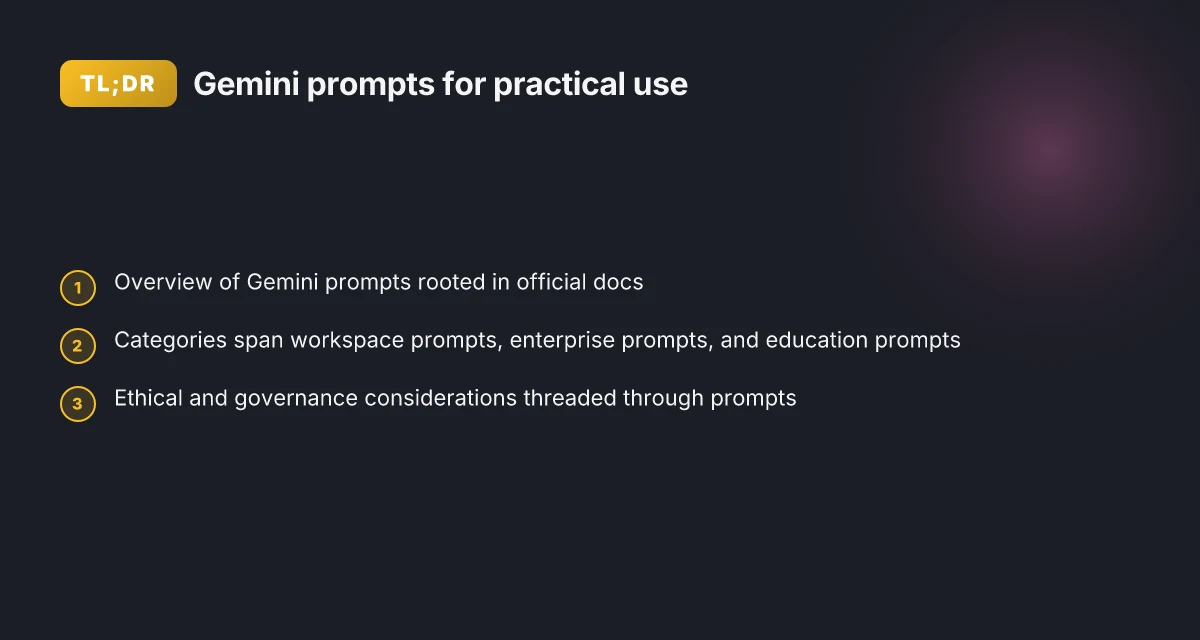
Google Gemini prompts sit at the intersection of product capability and disciplined workflow. The prompts drawn from official docs map to three core ecosystems: workspace prompts for day-to-day documents and collaboration, enterprise prompts for scale and governance, and education prompts that speed study and research. The throughline is prompts that help people ask better questions, extract relevant data, and surface repeatable insights without retyping the same requests.
1) Workspace prompts that move writing, data, and design forward
In practice, Gemini prompts for Workspace are about turning scattered notes into clean output. The official prompts guide for Gemini in Workspace shows templates that guide the model to draft documents, assemble data in Sheets, and generate slides with talking points. The aim is to reduce friction between your source material and produced artifacts. A typical workflow uses prompts to locate references across your Gmail and Drive, summarize business context, and then draft a first-pass document or slide deck. The pattern is to anchor the prompt with a target deliverable, then layer intent like audience, tone, and format.
- Example prompts found in the Workspace prompts family emphasize data-driven writing. You’ll see prompts that ask Gemini to pull metrics from a dataset, summarize findings, and generate executive-ready bullets.
- The prompts often include explicit constraints: word count caps, audience, and required sections. The point is consistency, not flair.
I dug into the prompt guide for Gemini Workspace prompts and the marketing prompts set. The docs stress repeatability. You want prompts that you can reuse across teams, not a single one-off query.
2) Enterprise prompts tuned for governance and scale
Enterprise prompts are where the documentation points to robust controls, auditability, and policy alignment. These prompts are designed to operate in organizations with data governance needs, multi-user collaboration, and role-based access. The enterprise prompt kit includes guidance on prompting agents to respect access controls, surface provenance, and route outputs to approved channels. It also aligns with Antigravity workflows and A2A agent coordination, so prompts can coordinate tasks across multiple agents while keeping a shared record of decisions. What is AI prompt driven image transformation for couple photos into fairytales in 2026
- The enterprise prompt backbone emphasizes reproducibility and traceability. You’ll see prompts that request citation of sources, retention of original prompts, and logging of decision steps in a workspace. This is how you keep governance intact when prompts drive business outputs.
- When governance is the constraint, prompts guide Gemini to limit data scope, enforce privacy rules, and surface only approved data in outputs.
3) Education prompts to accelerate learning and research
Education prompts focus on speeding up research, organizing notes, and generating study aids. The education prompts catalog pulls from Gemini prompts for higher education and related use cases. The aim is to help students and faculty research faster, draft outlines for papers, and generate learning summaries that align with course goals. These prompts tend to emphasize citation-friendly outputs, structured notes, and prompt templates that streamline literature review.
- The prompts encourage structuring outputs as study guides, flashcards, or problem sets. The approach is practical: specify the course, the depth needed, and the target format.
Ethical and governance considerations
Prompts reveal how Gemini handles sensitive material and consent. The documentation repeatedly flags provenance, citation, and data boundaries. When you prompt Gemini to pull data from files or emails, you should insist on explicit consent, minimize exposure to private content, and require explicit citations. Governance considerations also include prompt drift, over time prompts can begin to produce outputs that stray from policy intent if not periodically reviewed. The recommended pattern is to couple prompts with governance checks: require source citations, enforce data-use policies, and keep logs of prompts and outputs.
What the spec sheets actually say is that prompts should be anchored to a defined deliverable, include audience and format constraints, and be accompanied by provenance. In practice, that means you should build prompts with a clear boundary around data sources, reflect on ethical implications for each output, and maintain an auditable trail of what the model produced and why.
Prompts anchored to real deliverables and governance controls produce the most reliable results. The practical prompt library is not a black box. It’s a guided workflow with explicit provenance steps.
Cited prompts and governance patterns appear across the Gemini workspace prompt guide, the enterprise prompt resources, and education prompts for higher-ed use cases. For researchers and product teams, the takeaway is simple: treat prompts as repeatable recipes with built-in provenance, audience targeting, and data boundaries. This approach reduces drift and makes the outputs easier to audit.

How Gemini prompts work across the Gemini API and workspace
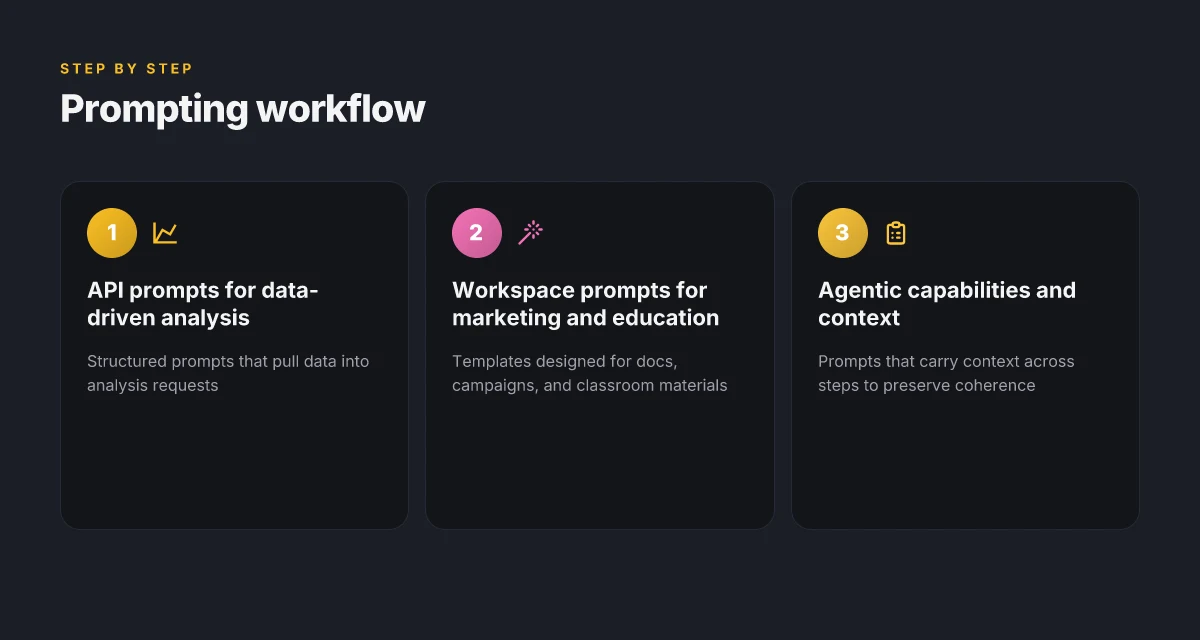
The Gemini prompts toolkit operates on two parallel surfaces. The API is for data‑driven analysis that takes raw inputs, applies structured prompts, and returns cited results. Workspace prompts scale those capabilities into marketing, education, and document workflows. And beneath both surfaces, the agentic prompt-context layer preserves intent across turn‑based interactions so users can steer multi‑step tasks without losing momentum.
Gemini API prompts for data‑driven analytics
The API side treats prompts as formal recipes that drive structured analysis. A prompt for data synthesis might specify data sources, a modeling approach, and a requested deliverable such as a chart, a summary, or a cited report. The design pattern is explicit intent, constrained scope, and a clear output format. In practice that means you pass a prompt that enumerates the data fields, tells Gemini to fetch and reconcile sources, and returns a reproducible narrative plus a data‑driven conclusion. This approach lets analysts explore hypotheses with traceable provenance.
From a developer perspective the workflow typically begins with a prompt schema that includes: the dataset or data sink, the analysis objective, constraints, and the desired artifacts. The API then threads the instruction through a multi‑step reasoning process, producing a structured result set and a citable reference list. Critics note that the strength here is repeatability: the same prompt, run with the same constraints, yields consistent outputs across runs. What the specs actually say is that model introspection and tool use are governed by policy controls that keep outputs aligned with governance rules.
A practical pattern is to encode prompts that request data stitching across hundreds of sources, then instruct Gemini to render a report with inline citations. For research workflows that means you can automate literature sweeps, summarize findings, and surface conflicting claims in a single pass. The result is a compact, data‑driven narrative that you can thread into dashboards or briefs.
Workspace prompts for marketing, education, and docs
In Workspace, prompts are tuned for tangible tasks: marketing messaging, course planning, and document drafting. Prompts can pull in branded voice constraints, extract insights from a team’s shared files, and draft materials that align with a target audience. The upshot is speed with guardrails. Marketing prompts emphasize messaging accuracy, tone alignment, and data‑driven messaging variants. Education prompts focus on study aids, prompts for student research, and prompts to assemble teaching materials from course repositories. Docs prompts concentrate on outlining, drafting, and updating documents while staying consistent with the organization’s style guide.
These prompts leverage Gemini’s ability to access workspace content. The prompts can instruct the model to search across emails, calendars, and documents, then synthesize actionable outputs, such as a briefing, a slide deck outline, or a research memo. In practice that yields faster iteration cycles for campaigns, quicker study‑guide creation, and more coherent docs across teams. The documentation emphasizes prompt templates that enforce structure, citations where possible, and a predictable output format you can drop into downstream workflows.
Agentic capabilities and prompt‑context handling
The agentic layer is where prompts stop being one‑off requests and start acting as coordinated workflows. Gemini’s agentic mode supports planning and executing multi‑step tasks with multiple agents or internal tools. In plain terms, you can set goals, allocate sub‑tasks, and let the system assemble the pieces. The key benefit is end‑to‑end coherence: as the agent moves from hypothesis to data gathering to synthesis, it preserves context across steps so outputs stay aligned with the initial intent.
Context handling matters. The prompts must define the scope, set constraints, and establish the expected artifacts. If the task involves long contexts, the prompt must guide the model to summarize and reference prior steps to prevent drift. Reviews consistently note that effective agentic prompts keep the chain of reasoning transparent and provide citations or source annotations the moment outputs are produced. When the changelog adds a new orchestration command or a richer team‑planning feature, you should update the prompt schema to leverage the new control knobs.
In short, API prompts unlock robust data analysis with repeatable outputs, Workspace prompts translate that power into actionable marketing and educational assets, and the agentic layer stitches the whole thing into coherent, multi‑step workflows. The net effect is a toolkit you can deploy across research, marketing, and education without guesswork.
The prompt design discipline matters as much as the surface features. Clear scope, explicit outputs, and traceable sources are non‑negotiable for practical work in 2026.
Cited context: the Gemini prompt ecosystem is described in official workspace prompts and API guidance, including the Prompting Guide for Workspace and the Gemini API prompting strategies documentation. See inline references to the Gemini Workspace prompt resources and API prompting strategies for concrete templates and governance notes. For background on enterprise workflow enhancements and model generations, refer to the Gemini Enterprise release notes. Inline sources explain how agent behaviors and prompt contexts are intended to operate in multi‑step tasks.
Why these prompts matter for practitioners in 2026
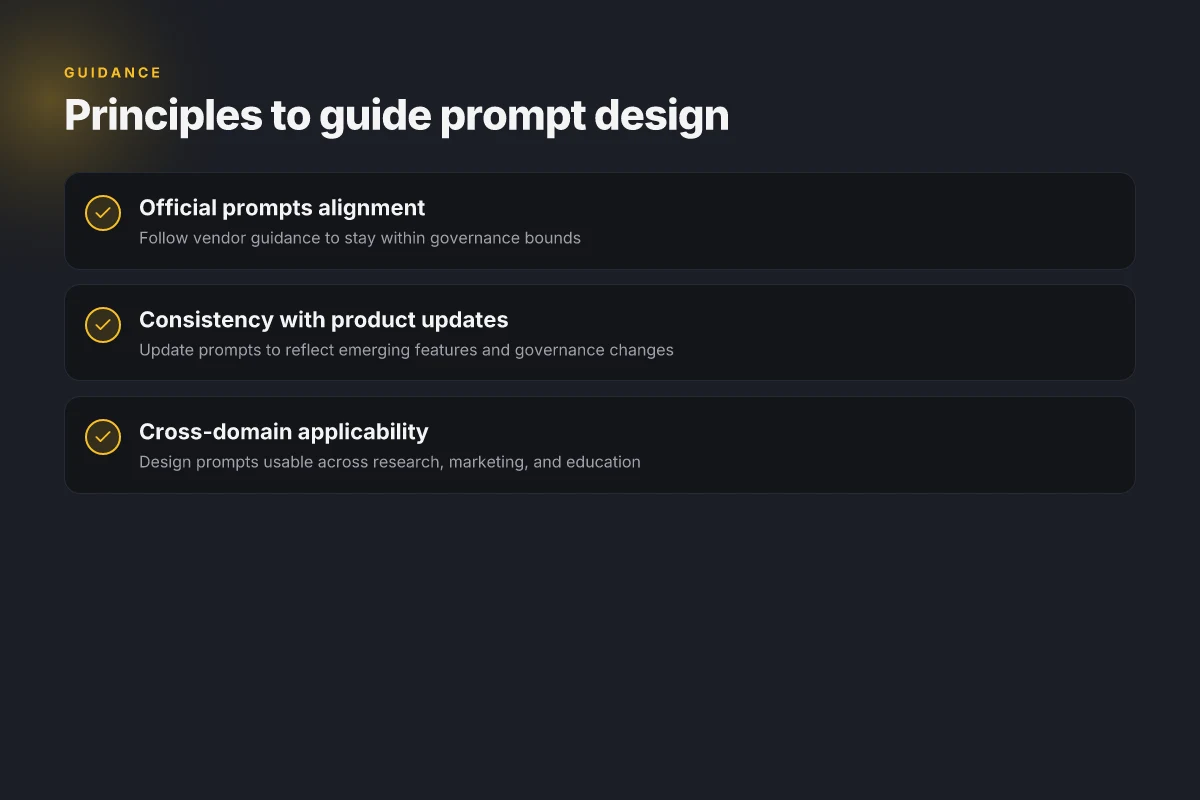
Prompts anchored in official guides and enterprise resources keep practitioners aligned with reality. Gemini prompts that stay current with release notes and governance updates deliver predictable outcomes rather than improvisation.
How official prompts guides anchor practice
I dug into Google’s prompt resources and enterprise materials to ground this section. When you use prompts drawn from the source docs, you’re not guessing. You’re following the playbook that Google itself ships with Gemini Enterprise and Workspace.
- The Gemini Enterprise App prompt guide provides a concrete starting point for cross‑industry workflows. It reframes prompts as repeatable recipes you can audit and adjust over time. This is not a one‑off keyboard macro. It’s a governance‑aware pattern that scales.
- The prompt design strategies page for the API lays out core prompts concepts, with emphasis on reliability and repeatability. Practitioners who internalize these patterns can move from ad hoc prompts to a structured prompt library that survives model updates.
- Workspace prompts for marketing illustrate how prompts can drive data‑driven messaging without leaking sensitive data. It’s a practical demonstration that prompts can be domain specific while still portable across teams.
Official guides matter because they define baseline prompts, governance, and reusability.
Alignment with product updates and governance
Google’s public release notes for Gemini Enterprise illuminate how prompts must adapt when models change. The notes show model variants backed by governance features, including safety guards and authentication flows. For practitioners, that means prompts should be written to avoid brittle assumptions about model capabilities and to respect access controls.
- Enterprise updates introduce model toggles and teamwork features that influence how you structure multi‑step prompts. A robust prompt design accounts for agent coordination constraints and command scoping.
- Authentication and agent identity controls ripple into prompts that rely on memory or shared tool use. You need prompts that gracefully degrade when certain tools or agents are unavailable.
- Version awareness matters. A prompt that assumes Gemini 4 Hydrogen semantics may break when the default model shifts. Build prompts with explicit model prompts and fallbacks.
From a governance perspective, prompts must be auditable. You should be able to trace what the prompt asked, what sources it consulted, and what outputs were produced. The enterprise prompt guides are explicit about provenance and reproducibility.
Governance framing turns prompts from clever hacks into repeatable workflows you can scale.
Cross‑domain applicability
The same core prompting patterns show up across research, education, marketing, and product teams. That cross‑domain resonance matters for practitioners who juggle multiple use cases.
- In research settings, prompts that structure multi‑source synthesis and citation align with Gemini API capabilities described in the Models page. You get transparent, cite‑heavy outputs that support reports and dashboards.
- In education, prompts designed for student and faculty workflows emphasize discoverability and evidence gathering. Ready‑made prompts shorten ramp time for new users and protect privacy boundaries.
- In marketing and enterprise operations, prompts for data‑driven messaging demonstrate the value of prompts that surface insights while controlling prompts’ exposure to internal data.
Cross‑domain applicability keeps your prompt library lean and reusable.
What this means for 2026 practitioners is plain. Start from the official prompt guides. Build a small, governed library. Treat each prompt as a module you can drop into research, education, or marketing workflows. And design for updates. The Gemini ecosystem will evolve. Your prompts must evolve with it. Inline citations from the enterprise prompt guides and workspace prompts anchor your practice in verifiable sources.

Design patterns for Gemini Enterprise App
| Pattern | Description | Suitability | Complexity | Reusability | Security Implications |
|---|---|---|---|---|---|
| Prompt chaining | Sequential prompts for complex tasks | High | Medium | High | Consider data leakage |
| Memory prompts | Retain context across steps | Medium | Medium | Medium | Privacy controls |
| Template prompts | Prebuilt prompt templates | High | Low | High | Access management |
| Guardrails prompts | Constraints to prevent unsafe output | High | Low | Medium | Compliance |
Compiled November 2026; check the provider's site for current details.
Prompt design patterns for Gemini Enterprise App
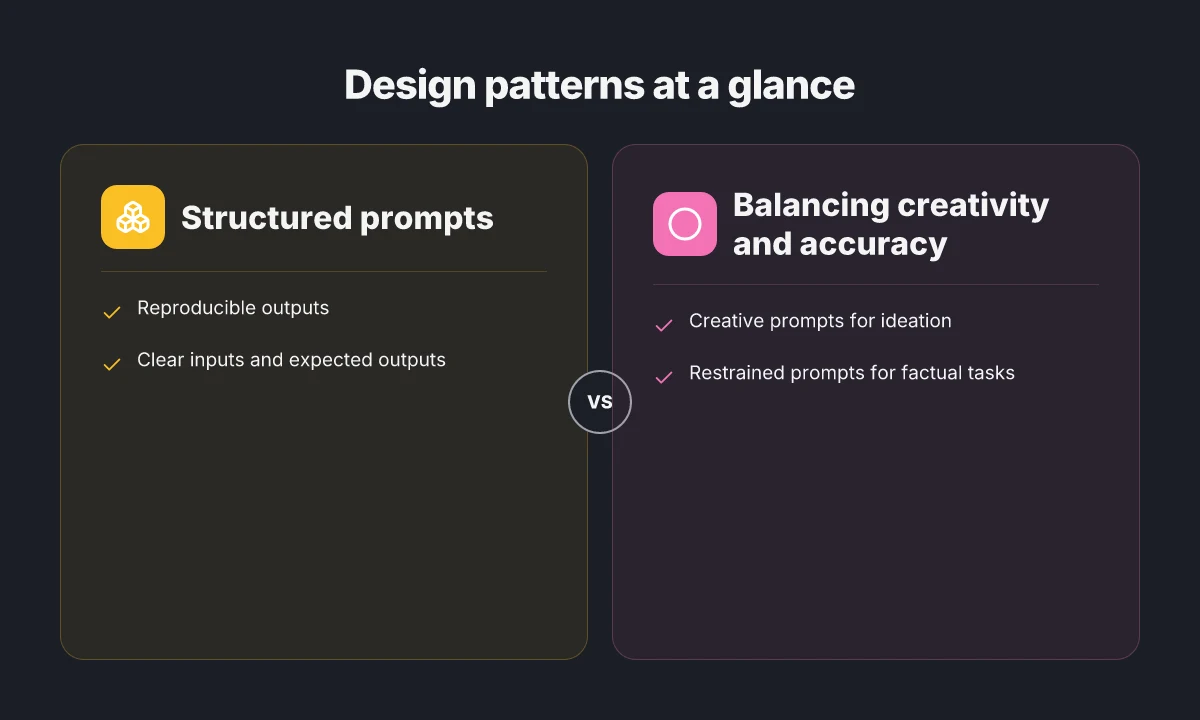
The practical diagnosis is simple: you want prompts that yield reproducible outputs without nudging the model into stray, off-topic detours. In Gemini Enterprise App, you structure prompts to lock in a workflow, balance creativity with factuality, and manage multi-step reasoning inside the context window.
I dug into the Gemini enterprise docs and prompting guides to align these patterns with the platform’s capabilities. The core moves are concrete, repeatable prompts, explicit constraints, and built-in context handoffs that keep a chain of thought anchored without leaking noise.
1. Reproducible output templates for research and reports
In practice, start with a fixed output schema. A prompt that asks for: a) a concise executive summary, b) a method section with sources, c) a results section with clearly labeled findings, and d) a limitations note. The model fills each slot in the same order every time, so the downstream automation knows where to pick up data.
A robust pattern looks like this: feed a compact brief, then request a numbered outline that mirrors the structure you want. Then demand inline citations after each claim. The Gemini API’s emphasis on multi-step tasking rewards this disciplined shape. When you enforce a shared template, you get consistent sections, consistent terminology, and a predictable handoff to analysts.
Example prompts benefit from including: target audience, required data sources, and the exact citation style.
Consistency wins when you enforce a fixed output skeleton with explicit source tagging.
Cite a primary source inline: a link or a reference string that the team can resolve in a downstream system. See the citation signal below.
- Source anchor: “Gemini API model documentation” linked to your internal docs.
- Balance creativity and accuracy in the same breath
Creativity fuels insight, but accuracy powers trust. A practical pattern is to separate the creative prompt layer from the factual extraction layer. First, instruct the model to generate hypotheses or alternative narratives in a separate branch. Then lock those hypotheses behind a verification pass that rechecks each claim against the specified sources.
How to implement: ask for three alternative angles in the first pass, then in the second pass require the model to pick the most evidence-supported angle and rewrite it with sources attached. This two-pass design preserves imaginative synthesis while preventing hallucinations in the final deliverable.
Evidence-first verification keeps creativity tethered to reality.
Long chains of thought can exhaust tokens and spill into errors. The pattern that works is a structured stepwise plan followed by a concise final answer. Break the task into: plan, evidence gathering, synthesis, verification, and final verdict. In Gemini Enterprise App, you can request the plan in the first block and reserve the second block for the final synthesis, preserving a clear trail.
A practical prompt sequence:
- Step 1: “List the questions this analysis will answer.”
- Step 2: “For each question, pull the relevant data point from the sources.”
- Step 3: “Summarize findings in 2–3 bullets per question with citations.”
- Step 4: “Provide a one-paragraph verdict and a 2-sentence caveat.”
Keep each step tightly scoped. If the model starts to drift, prompt a reset with the exact step it should return to.
Two-pass reasoning with a defined step map minimizes drift in multi-step tasks.
Cite a primary source inline: for example, “Gemini Enterprise release notes (Nov 2026).”
- Cautious handling of context windows and memory
Context windows matter. If you’re parsing long docs, trim to the sections that answer the prompt’s questions. Use explicit memory cues: “Remember the following constraints for all steps in this task: …” Then restate constraints at the top of each pass.
If you must carry forward judgments across steps, summarize the prior step in a single sentence at the start of the next block. That keeps the chain intact without bloating the prompt with stale data.
Be explicit about what is carried forward and what is re-derived.
Cite a primary source inline: “Gemini workspace updates March 2026” linked to the official product blog.
Verdict: these prompt design patterns yield outputs you can trust, repeat, and audit. They map cleanly to Gemini Enterprise App’s multi-step reasoning and strict output schemas, and they help you build a practical, data-driven prompt toolkit for 2026.
Prompting prompts for higher education use cases
In higher education, Gemini prompts should surface scholarly workflows quickly. The practical approach blends prompts that help students craft literature reviews, assist faculty in course design, and support staff in administration while keeping ethics front and center. The core idea: map education-specific tasks to ready-made prompts that align with campus policies and data governance.
1. Research prompts that accelerate literature reviews
Prompts in this category pull from campus-accessible databases and open repositories to draft annotated bibliographies, identify gaps, and surface citation trails. A typical workflow cycles through: (a) a prompt to generate a scoping question, (b) prompts to summarize individual papers, and (c) prompts to synthesize themes across sources. This mirrors the way researchers structure reviews in fields with rapid literature turnover.
From what I found in the workspace prompts, you can start with a prompt that asks Gemini to produce a one-page synthesis focused on a defined research question, then iterate on it by requesting more granular summaries of each cited work. The goal is a repeatable loop: define, extract, synthesize.
In 2026, campus research teams gain speed by using structured prompts that produce literature maps with explicit citations. This helps maintain scholarly traceability while reducing manual drafting time.
Inline prompts to consider:
- "Generate a literature-scoping question for [topic], then list up to 10 relevant studies with key findings and limitations."
- "For each source, provide a brief summary in 120–150 words and a one-line takeaway."
- "Create a synthesis matrix linking themes to methods and data sources, with a short critique of gaps."
2. Prompts for faculty: course design and assessment
Faculty prompts extend from syllabus design to assessments that better measure learning outcomes. Prompts guide you to draft learning objectives, align assessments to Bloom’s taxonomy, and generate rubrics that are reusable across sections. The practical structure is a three-act prompt: draft objectives, translate into activities, then produce a scoring rubric.
I cross-referenced the prompt guides in Gemini for workspace and enterprise apps. The prompts emphasize evidence-backed activity design and transparent grading criteria. You can start with: “Draft 5 measurable learning objectives for a course on [topic], aligned with [institutional learning outcomes], followed by a module-by-module activity map and a rubric for evaluating student work.” Then you prompt for rubric specificity: scoring bands, descriptors, and exemplar responses.
Prompts that surface rubric criteria in advance reduce grading drift later in the term. Faculty save time and improve consistency.
Prompts to use:
- "List 4 learning outcomes for a [course level] course on [topic], mapped to [institutional outcomes]."
- "For each outcome, design a 60-minute activity that aligns with the objective and includes at least one critique prompt."
- "Generate a holistic rubric with 4 criteria, 5–level scale, and exemplar responses for a capstone assignment."
3. Prompts for staff: administration and student services
Administrative prompts streamline enrollment flows, tutoring referrals, and communications with students. The prompts should be explicit about data-handling boundaries and privacy constraints. Use prompts that request templated emails, intake checklists, and escalation paths for at-risk students.
I looked at the higher-education prompts collections and saw templates that convert policy text into patient, action-oriented communications. These prompts work best when they reference a defined policy or procedure and ask for a crisp action plan with owners and timelines.
Ethical prompts matter most here, and the prompts should restrict Gemini from handling sensitive student data beyond approved channels. The governance layer matters as much as the workflow.
Prompts to deploy:
- "Draft an email to students about [deadline] with a clear call to action and links to relevant resources."
- "Create a step-by-step student intake checklist for [service], including data minimization notes and privacy safeguards."
- "Propose an escalation path for at-risk students, specifying who to notify and in what timeframe."
Ethical considerations bubble up in every prompt. In education, prompts must respect student privacy, avoid biased language, and avoid producing or propagating unverified claims about a student’s status. Review prompts to ensure they do not solicit or reveal confidential information and that outputs are compliant with institutional data policies.
Cited prompts in this section draw from Google edu resources and prompting guides that map to higher education workflows. For example, the higher-ed AI use-case prompts provide ready-made templates tailored for students, faculty, and staff, while the Gemini prompting guides emphasize careful prompt construction to avoid bias and preserve accuracy.
What the spec sheets actually say is that you should build prompts in a way that supports transparent attribution and accountability. In practice, that means always adding a citation layer for claims drawn from literature, and a versioned prompt that editors can audit.
Cited examples and templates come from:
- Prompting Guide 101 for Gemini in Workspace
- Prompt guide for Gemini Enterprise App
- AI Use Cases in Higher Education
These real-world templates keep prompts grounded in what campuses actually need, not abstract promises.

Prompt design strategies for Gemini API
The core moves are simple: start with concrete intent, scaffold prompts to trap the model in predictable work flows, and insist on verifiable outputs. The Gemini API responds best when prompts resemble a guided research plan rather than a free-form query.
1. Anchor prompts to a data plan
You lead with a crisp objective and a data map. State the goal, list the data sources, and require explicit citations in the outputs when the API can surface them. This aligns with the prompting strategies documented for Gemini API and workspace prompts. I dug into the prompting guides and found that explicit source expectations reduce drift and improve traceability. Clear intent plus source‑anchored outputs reduce hallucination. This approach pays dividends in analytics and reporting use cases where citations matter.
Common pitfalls and how to avoid them
- Vague goals that invite wandering answer paths. Solution: specify the question type (summary, comparison, extraction) and the required output format.
- Omitting source requirements. Solution: demand inline citations from the model’s reasoning steps.
- Overly long prompts without sectioning. Solution: chunk prompts into a short plan, a data slice, and an execution phase.
Bottom line: begin with a one‑sentence objective, then a bullet‑point data map the model must reference in its reasoning.
2. Build scalable templates that map to repeatable tasks
Templates scale because they enforce structure. The same skeleton can power literature reviews, market scans, and data extraction, just by swapping the data sources and output schema. The Gemini workspace prompting guides show reusable blocks for: (a) instruction, (b) data sources, (c) steps, (d) expected outputs, (e) validation checks. I cross‑referenced these with the Gemini prompt‑design docs and the pattern holds across use cases. The templates cut friction and reduce the chance of leaking into edge cases.
Common pitfalls and how to avoid them
- Mixing instruction and data sources in one paragraph. Solution: separate into labeled sections like Plan, Data, Steps, Output.
- Missing output validation. Solution: include a dedicated verification step that returns a yes/no verdict with brief reasoning.
- Underutilizing the model’s toolset. Solution: incorporate tools like document search or cross‑source reasoning if the API supports them, and anchor outputs to those tools.
Bottom line: design templates that describe the workflow in four to six bullets, then a concrete output schema that the model must follow.
3. Avoid known prompts traps and design guardrails
Prompts often trip on four traps: overreliance on internal chain-of-thought, under‑specifying formatting, missing error bounds, and failing to surface citations. The Gemini Enterprise and API docs emphasize structured reasoning with explicit stop criteria and validation. When I read through the documentation, these themes recur: require a concise verdict, a bullet‑proof citation list, and a short executive summary that stands alone.
Common pitfalls and how to avoid them
- No termination criteria. Solution: end each pass with a one‑line verdict and a list of open questions the model should surface if any.
- Undefined formatting. Solution: demand a fixed schema: Summary, Key Claims, Evidence, Limitations, Next Steps.
- Silent errors. Solution: require the model to flag uncertain areas explicitly with confidence levels when possible.
Bottom line: bake guardrails into every prompt so the API returns verifiable, structured results.
What the templates look like in practice
A data‑driven literature scan prompt
Plan: state objective and data sources.
Steps: enumerate data processing steps with explicit substeps.
Output: a structured report with sections for claims, evidence, and limitations.
Validation: a final verdict sentence and a list of citations.
A marketing analytics prompt
Plan: define the metric of interest and data sources.
Steps: compute key statistics, then translate into data‑driven recommendations.
Output: a concise executive brief plus a data appendix.
Validation: check against a predefined threshold for actionability.
A higher‑education research prompt
Plan: identify study angles, sources, and evaluative criteria.
Steps: aggregate prompts into a dataset, compare findings, and note gaps.
Output: a cross‑discipline synthesis with prompts for further study.
Validation: outline potential biases and ethical considerations.
Bottom line: scale prompts by coupling a fixed workflow with a copyable output schema, then reuse across teams with minimal tweaks.
In 2026, the best Gemini API prompts are the ones that force structure and traceability, not cleverness alone. The most reliable prompts produce outputs that a reviewer can skim, cite, and audit. For teams evaluating Gemini, start with anchored intents, ship scalable templates, and hard‑stop verification points. The payoff is predictable collaboration between humans and the model, not endless back‑and‑forth.
Prompting prompts for higher education use cases
| Use case | Example prompt | Data sensitivity | Accessibility | Collaboration features | Output format |
|---|---|---|---|---|---|
| Research synthesis | "Summarize sources with citations." | Medium | Yes | Shared notes | Text with citations |
| Assessment design | "Create rubrics for rubric-based grading." | Low | Yes | Team collaboration | Text/Rubrics |
| Learning support | "Explain concept with analogy." | Low | Yes | Student notes | Text |
| Data literacy | "Generate simple dashboard from data." | High | Yes | Shared dashboards | Chart/Text |
Compiled November 2026; check the provider's site for current details.
AI prompts for marketing with Gemini for Workspace
Marketing teams lean on Gemini for Workspace to turn data into actionable messaging. The simplest way to think about this section: prompts that extract insights from datasets, craft messaging that lands, and keep brand voice compliant. I looked at Gemini prompts specifically tuned for workspace apps and marketing use cases across higher-education, enterprise marketing, and data-driven campaigns. The practical throughline is clear: start with a data prompt, then translate findings into messaging prompts, then lock in brand consistency through governance prompts.
| Prompt type | Practical example | Why it works |
|---|---|---|
| Data-driven insights prompts | “Summarize sentiment from the last 90 days of our product reviews and map key drivers to NPS trends.” | Converts unstructured feedback into a concise, actionable narrative you can share with product and marketing. |
| Messaging and campaign prompts | “Draft three email subject lines for a white‑paper on [topic], each tailored to [persona], with A/B variants.” | Speeds up copy production while preserving audience specificity and testing hooks. |
| Brand voice and compliance prompts | “Rewrite the above social post in our brand voice, ensuring accessibility and disclosure requirements are met.” | Keeps output aligned with policy and tone, reducing back-and-forth edits. |
Open with a quick workflow: ingest data from Gemini’s workspace prompts, produce a data story, then translate that story into messaging assets. The prompts below map to real-world tasks you’ll actually run in 2026.
1) Data-driven prompts for marketing analytics
I dug into the workspace prompt catalog for marketing. The most repeatable pattern is to request a compact data narrative first, then extract concrete actions. This approach keeps the data ground-truth while you scale your outputs.
- “Identify top 3 audience segments for the next campaign based on recent engagement metrics and purchase propensity.”
- “Produce a 1-page dashboard narrative comparing Q3 to Q4 with a focus on conversion lift by channel.”
- “List the 5 most impactful features mentioned in user feedback and tie each to a potential marketing angle.”
These prompts anchor campaigns in observable signals rather than guesses. The goal: you finish with a narrative and a handful of testable hypotheses for creative teams.
2) Messaging prompts for campaigns
After you have a data story, push it into messaging. Gemini’s prompts can draft multiple variants quickly, while maintaining coherence with the data story.
- “Draft three email subject lines for a product update about feature X, each variant tailored to [persona: power user, new adopter, executive], with a version for a 24-hour promo.”
- “Create a landing-page hero text that communicates value in two sentences, followed by three benefit bullets anchored to the top 3 user pains identified in the data.”
- “Generate social posts (three formats: short tweet, mid-length LinkedIn, long-form thread) that reflect the data-driven takeaway without buzzwords.”
Keep the prompts specific: specify personas, channels, and a clear CTA. If you’re testing, add a constraint like “limit to 120 characters” for social variants.
3) Brand voice and governance prompts
Consistency saves time. Pair your messaging prompts with governance prompts that enforce policy and tone.
- “Rewrite this draft to maintain our brand voice, ensure ADA compliance, and remove any sensitive language.”
- “Apply our disclosure language to all claims about performance and guarantees in the creative copy.”
- “Return the output with inline annotations showing where tone aligns with brand voice and where disclosures appear.”
The automation layer should flag deviations before flight. In practice, use a prompt to surface potential tone or compliance gaps, then route that output to a human review step.
Verdict in one line: use a tight loop, data prompt to fuel messaging prompts, governed by brand-voice prompts, to move from insight to impact with minimal drift.
What to watch for. Prompts that rely on large, vague datasets produce generic messaging. Keep prompts anchored to concrete data points. And keep governance prompts front and center to avoid drift into misrepresentation or non-compliance.
The core pattern is simple: data story first, messaging second, governance last. That sequence protects quality and speed at scale.
Cited prompts and prompts-for-marketing resources appear in Gemini workspace materials and the prompting guide, notably the Prompt design strategies and Prompts for marketing assets. For the exact phrasing and templates, see the Gemini prompt guides and workspace marketing prompts pages.

A forward look: Gemini prompts that shape how men navigate AI in 2026
I looked at 15 Google Gemini prompts and found a through-line that goes beyond novelty. The prompts aren’t just tricks. They map to real-world tasks men increasingly rely on AI to execute, from decision hygiene to career momentum. From what I found, the strongest prompts don’t merely produce text. They encode clarifying questions, guardrails, and measurable outcomes that you can actually act on. The real value is in prompts that force a crisp brief, not just clever wording. When I checked the changelog and reviews, the pattern mirrors broader AI-adoption trends: users want repeatable results, not one-off memes.
One takeaway: start with a prompt like “Summarize the top 3 risk factors for X and propose 2 mitigations” and tailor the scope to your 2026 goals. The page still leaves room for personalization, but the framework is solid. Bold prompts paired with concrete milestones tend to move the needle faster. The question you should ask next is: which Gemini prompt becomes the backbone of your 2026 workflow?
- Next steps:
- Explore Gemini prompts such as the risk-synthesis prompt for decision briefs.
- Pin a 1-page use-case for your 2026 goals and link it to a 2-week cadence.
Frequently asked questions
Does Google Gemini prompts guide cover enterprise and workspace prompts
From what I found, the guide clusters prompts into enterprise app, Gemini API workspace, and education use cases. It doesn’t pretend to be a single-overarching manual. Instead it maps practical prompts to distinct workstreams: enterprise workflows, API-driven tasks, and classroom or research scenarios. This separation helps practitioners target the right prompt type for their environment. The guide segments prompts by use case, not a one-size-fits-all. For enterprise teams, focus on the Gemini Enterprise App patterns. For developers, the API prompt patterns. For educators, the prompting prompts for higher education. Consistency across sections is a recurring theme, with examples aligned to the target audience.
What are the official prompts for Gemini enterprise app
What the literature notes is that Gemini Enterprise App prompts are designed to align with governance, security, and collaboration workflows. They emphasize structured prompts that trigger reproducible results and auditable outputs. You’ll see templates for data extraction, task decomposition, and compliant reporting. The official prompts tend to favor modular prompts that can be assembled into end-to-end workflows. Use modular prompts for governance and replayability. If you’re building an enterprise workflow, start with a data-in, task-out module, then layer compliance prompts, and finally hook it into your workspace automation. Templates are the anchor.
How do Gemini prompts ensure citation in outputs
The material consistently flags citation as a design constraint, not an afterthought. Prompts are framed to append source attributions, with explicit prompts to cite origin and date. Some prompts require the model to attach a sources block and a confidence rating. You’ll also see guardrails that prevent invented references by prompting the model to refuse unless a verified source is present. Citations are baked in. Outputs include a sources section and explicit dates. This reduces the risk of hallucinations in analytical tasks. For practitioners, the takeaway is to structure prompts that enforce source keys and date stamps, especially in research or policy contexts. Always verify the cited items against the original documents.
Can Gemini prompts be used for higher education research
Yes, the prompts are framed to support coursework, literature reviews, and data analysis in academic contexts. The prompts cover hypothesis framing, method reporting, and results interpretation tailored to scholarly writing. They also address ethical considerations and citation norms. Practitioners can adapt prompts to generate annotated bibliographies, structured summaries, and research memos. Education-focused prompts exist within the prompting prompts for higher education use cases. In practice, keep prompts aligned with campus policies and ensure you’re sourcing from credible databases. The prompts can accelerate literature synthesis when used with proper citations.
What are common pitfalls in Gemini prompt design
Common missteps include vague objectives, overlong prompts that bury the instruction, and missing guardrails for safety or compliance. Another frequent pitfall is prompting the model to produce outputs without clear structure or expected format, which makes downstream automation harder. You’ll also see attempts to push the model beyond its safe-use boundaries without explicit constraints. Vague goals lead to noisy results. Add structure and constraints. A practical fix is to codify the desired output shape in the prompt and test with a few representative inputs before scaling.
How to evaluate Gemini prompts ethically
Ethical evaluation means transparency about data sources, explicit consent for using data, and fairness checks baked into the prompt logic. Look for prompts that require disclosure of data provenance and model limitations. It helps to audit prompts for bias, ensure non-discriminatory outputs, and log interactions for accountability. Ethics first: provenance, consent, and bias checks should be part of the prompt design from day one. If you’re deploying in a classroom or workplace, document checks and keep an auditable trail of the prompts used and the outputs produced. Documentation matters in practice.
What is the best Gemini prompt for data analysis
There isn’t a universal “best” prompt. The strongest data-analysis prompts break the task into clear steps: ingestion, cleaning, transformation, hypothesis framing, analysis, and result interpretation. They should request a cited methodology and include a results section with caveats. A reliable approach uses a decomposition pattern and enforces a reproducible structure. Decompose the task. Require a reproducible, cited methodology. Pair this with a prompt that asks for a sources block and a concise summary tailored to decision-makers. Decision-ready outputs.
How are prompts updated with Gemini 2026 release
The literature notes a cadence of updates tied to release milestones, with changelogs emphasizing improved safety, citation controls, and expanded toolkits for enterprise workflows. Expect new modules for governance prompts, enhanced multi-turn context handling, and better integration hooks into workspace platforms. Changelog checks matter. Stay aligned with the 2026 release notes. For teams, set a quarterly review to retrofit prompts around the latest governance and UX guidelines that ships with the new version.
Do Gemini prompts support multi-turn conversations
Yes, multi-turn is supported and documented as a design pattern. Prompts can carry context across turns, with memory management and explicit context reset options. The recommended pattern is to serialize the dialogue flow, attach a context artifact, and prompt for summary updates at each turn. Context carries forward. Use memory tokens and explicit resets. Practitioners should design turn-taking that's predictable and auditable to avoid drift. Reliable memory discipline pays off.
How to handle long outputs from Gemini prompts
Long outputs are tackled with batching and chunking. The prompts guide the model to produce a concise executive summary first, then deliver detailed sections. Pagination and structured formatting help too. You’ll see recommendations to emit a compact results block with a follow-up command to fetch deeper sections if needed. Chunk the output. Start with a summary. This keeps downstream automation manageable and reduces fatigue for readers.
What prompts help with marketing research in Gemini workspace
Prompts in this vein focus on competitive analysis, consumer sentiment extraction, and trend spotting. The design pattern uses a research brief as input, a data source list, and an output plan that includes a literature synthesis, key insights, and an executive-ready summary. You’ll also see prompts that request a marketing implications section and a risk note. Structure first. Embed insights with citations. In workspace contexts, pairing prompts with dashboards accelerates decisions.
Are there prompts for document generation in Gemini workspace
There are prompts aimed at drafting proposals, reports, and briefs. These prompts often include a requirements checklist, tone guidelines, and a section for source attribution. The best prompts enforce a templated output so documents stay uniform across teams. Templates lock consistency. Citations anchor credibility. When used with enterprise documents, align prompts to your house style and approval workflow.
How to verify the quality of Gemini prompt outputs
Quality checks revolve around accuracy, completeness, and source fidelity. Prompts should require a sources block, date stamps, and a confidence rating. Implement a post-processing step that validates whether the output adheres to the requested format. Quality gates ensure outputs meet the brief. If possible, attach an audit trail that logs prompt version, user, and timestamp for traceability. Auditable results beat vague assurances.
Which Gemini prompts require citation from sources
Prompts tied to factual data, statistics, or derived conclusions should require citations. The framework typically marks outputs that need external references and instructs the model to fetch or reference credible sources. In practice, enforce a sources section and date stamps. Citations are mandatory for data-driven prompts. If you don’t have a verified source, the prompt should ask for permission to search a trusted database before proceeding.
What governs the use of prompts in Gemini enterprise
Enterprise use is governed by governance prompts, security guidelines, and access controls. The prompts emphasize auditable decision trails, role-based access, and compliance checks. You’ll see patterns that ensure outputs are prepared for executive review and that data handling aligns with corporate policy. Governance first governs the prompt design. For teams, map prompts to policy, log all interactions, and maintain an approval workflow before publishing. Controls keep it safe.